


Page 70 - Haematologica Vol. 110 - January 2025
P. 70
ARTICLE - Real-life study on 421 adult Ph-neg ALL treated with LAL1913 program D. Lazzarotto et al.
and OS and DFS rates above 60% at 3-5 years, despite the differences in trial design, and asparaginase formulations and dosage.1-7 In trials including older adults (>55 years), this patient population presents worse results, with inferior CR rates and survival.1-4 This is likely due to the problems in delivering optimal chemotherapy doses, increased rates of complications, and a different disease biology compared to younger patients.3,4,12
Despite the significant number of clinical trials using pediat- ric-inspired protocols in adult Ph- ALL, very limited data are available on the feasibility, toxicities and outcome of these protocols in the context of daily clinical practice outside of clinical trials.13-16 Since the completion of the GIMEMA LAL1913 trial, the results of which have been recently pub- lished,1 most Italian hematology centers have adopted this
A
pediatric-inspired therapeutic program as the standard of care for the clinical management of newly diagnosed adult Ph- ALL. The current study conducted within the Campus ALL network and involving 39 hematology centers in Italy was thus aimed at analyzing the feasibility and performance of the LAL1913 program in the real-life context in terms of tolerability and outcome, and to compare these results with those obtained in the original clinical trial.1 To our knowl- edge, this multicenter real-life study that included 421 adult Ph-ALL patients homogeneously treated according to a pediatric-inspired protocol (GIMEMA LAL1913)1 is the largest available so far.
Some differences emerged between the characteristics of the real-life population compared to that of the clinical trial. The real-life cohort included more T-ALL (47.5% vs. 31.5%) and a
 B
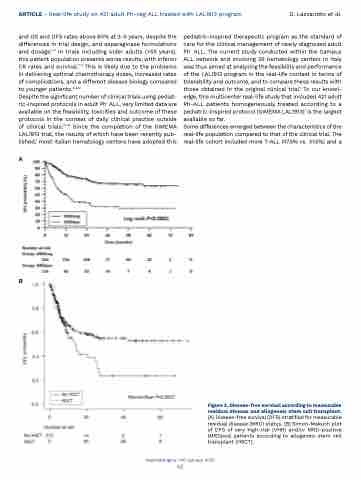
Figure 2. Disease-free survival according to measurable residual disease and allogeneic stem cell transplant. (A) Disease-free survival (DFS) stratified for measurable residual disease (MRD) status. (B) Simon-Makuch plot of DFS of very high-risk (VHR) and/or MRD-positive (MRDpos) patients according to allogeneic stem cell transplant (HSCT).
Haematologica | 110 January 2025
62


