


Page 69 - Haematologica Vol. 110 - January 2025
P. 69
ARTICLE - Real-life study on 421 adult Ph-neg ALL treated with LAL1913 program D. Lazzarotto et al.
the GIMEMA LAL1913 clinical trial (including 203 cases) (Ta- ble 4).1 The real-life population was slightly older, although the difference was not significant (median age, 42 vs. 40 years, P=0.5, with patients >55 years, 23% vs. 19%, P=0.33) and included a higher number of T-ALL/LL (47.5% vs. 31.5%, P=0.0002). Moreover, in the real-life population cohort, we observed a non-significantly higher proportion of HR+VHR patients (51% vs. 43%, P=0.09).
The CR rate at TP1 was higher in the real-life population (94% vs. 85%, P=0.0004), but the rate of MRD negativity at both TP1 and TP2 was lower (46% vs. 56%, P=0.04, and 72% vs. 80%, P=0.04, respectively).
Discussion
Pediatric-inspired protocols have improved the outcome of Ph- ALL in adults,8 as demonstrated by several trials yielding comparable results, with CR rates around 90%,
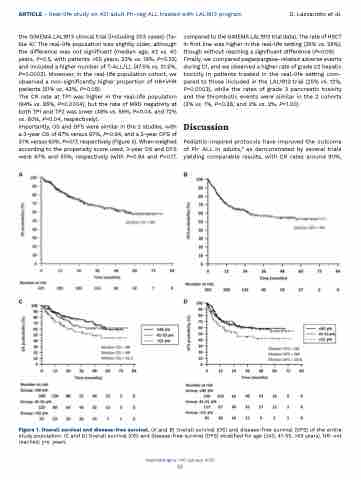
Importantly, OS and DFS were similar in the 2 studies, with a 3-year OS of 67% versus 67%, P=0.94, and a 3-year DFS of 57% versus 63%, P=0.17, respectively (Figure 4). When weighed according to the propensity score used, 3-year OS and DFS were 67% and 55%, respectively (with P=0.94 and P=0.17,
AB
CD
Figure 1. Overall survival and disease-free survival. (A and B) Overall survival (OS) and disease-free survival (DFS) of the entire study population. (C and D) Overall survival (OS) and disease-free survival (DFS) stratified for age (≤40, 41-55, >55 years). NR: not reached; yrs: years.
Haematologica | 110 January 2025
compared to the GIMEMA LAL1913 trial data). The rate of HSCT in first line was higher in the real-life setting (35% vs. 28%), though without reaching a significant difference (P=0.09). Finally, we compared pegaspargase-related adverse events during C1, and we observed a higher rate of grade ≥2 hepatic toxicity in patients treated in the real-life setting com- pared to those included in the LAL1913 trial (25% vs. 12%, P=0.0003), while the rates of grade 3 pancreatic toxicity and the thrombotic events were similar in the 2 cohorts (3% vs. 1%, P=0.26, and 2% vs. 2%, P=1.00).
 61


