


Page 68 - Haematologica Vol. 110 - January 2025
P. 68
ARTICLE - Real-life study on 421 adult Ph-neg ALL treated with LAL1913 program D. Lazzarotto et al.
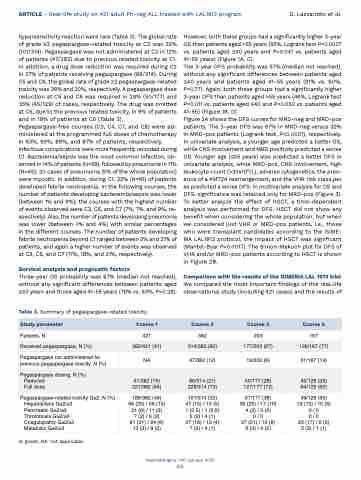
hypersensitivity reaction were rare (Table 3). The global rate of grade ≥2 pegaspargase-related toxicity at C2 was 32% (101/314). Pegaspargase was not administered at C2 in 12% of patients (47/382) due to previous related toxicity at C1. In addition, a drug dose reduction was required during C2 in 27% of patients receiving pegaspargase (86/314). During C5 and C6, the global rate of grade ≥2 pegaspargase-related toxicity was 38% and 30%, respectively. A pegaspargase dose reduction at C5 and C6 was required in 28% (50/177) and 35% (45/129) of cases, respectively. The drug was omitted at C5, due to the previous related toxicity, in 9% of patients and in 19% of patients at C6 (Table 3).
Pegaspargase-free courses (C3, C4, C7, and C8) were ad- ministered at the programmed full doses of chemotherapy in 93%, 93%, 89%, and 87% of patients, respectively. Infectious complications were more frequently recorded during C1. Bacteremia/sepsis was the most common infection, ob- served in 14% of patients (N=59), followed by pneumonia in 11% (N=45); 20 cases of pneumonia (5% of the whole population) were mycotic. In addition, during C1, 22% (N=91) of patients developed febrile neutropenia. In the following courses, the number of patients developing bacteremia/sepsis was lower (between 1% and 9%); the courses with the highest number of events observed were C3, C6, and C7 (7%, 7%, and 9%, re- spectively). Also, the number of patients developing pneumonia was lower (between 0% and 4%) with similar percentages in the different courses. The number of patients developing febrile neutropenia beyond C1 ranged between 3% and 21% of patients, and again a higher number of events was observed at C3, C6, and C7 (17%, 18%, and 21%, respectively).
Survival analysis and prognostic factors
Three-year OS probability was 67% (median not reached), without any significant differences between patients aged ≤40 years and those aged 41-55 years (76% vs. 63%, P=0.28).
Table 3. Summary of pegaspargase-related toxicity.
However, both these groups had a significantly higher 3-year OS than patients aged >55 years (55%, Logrank test P=0.0007 vs. patients aged ≤40 years and P=0.041 vs. patients aged 41-55 years) (Figure 1A, C).
The 3-year DFS probability was 57% (median not reached), without any significant differences between patients aged ≤40 years and patients aged 41-55 years (61% vs. 60%, P=0.77). Again, both these groups had a significantly higher 3-year DFS than patients aged >55 years (46%, Logrank test P=0.011 vs. patients aged ≤40 and P=0.050 vs. patients aged 41-55) (Figure 1B, D).
Figure 2A shows the DFS curves for MRD-neg and MRD-pos patients. The 3-year DFS was 67% in MRD-neg versus 32% in MRD-pos patients (Logrank test, P<0.0001), respectively. In univariate analysis, a younger age predicted a better OS, while CNS involvement and MRD positivity predicted a worse OS. Younger age (≤55 years) also predicted a better DFS in univariate analysis, while MRD-pos, CNS involvement, high leukocyte count (>30x109/L), adverse cytogenetics, the pres- ence of a KMT2A rearrangement, and the VHR risk class per se predicted a worse DFS. In multivariate analysis for OS and DFS, significance was retained only for MRD-pos (Figure 3). To better analyze the effect of HSCT, a time-dependent analysis was performed for DFS. HSCT did not show any benefit when considering the whole population, but when we considered just VHR or MRD-pos patients, i.e., those who were transplant candidates according to the GIME- MA LAL1913 protocol, the impact of HSCT was significant (Mantel-Byar P=0.0017). The Simon-Makuch plot for DFS of VHR and/or MRD-pos patients according to HSCT is shown in Figure 2B.
Comparison with the results of the GIMEMA LAL 1913 trial
We compared the most important findings of this real-life observational study (including 421 cases) and the results of
 Study parameter
 Course 1
 Course 2
 Course 5
 Course 6
 Patients, N
  421
  382
  203
  167
 Received pegaspargase, N (%)
 382/421 (91)
 314/382 (82)
 177/203 (87)
 129/167 (77)
 Pegaspargase not administered for previous pegaspargase toxicity, N (%)
 NA
 47/382 (12)
 19/203 (9)
 31/167 (19)
 Pegaspargase dosing, N (%) Reduced
Full dose
 61/382 (16) 321/382 (84)
 86/314 (27) 228/314 (73)
 50/177 (28) 127/177 (72)
 45/129 (35) 84/129 (65)
  Pegaspargase-related toxicity G≥2, N (%) Hepatobiliary G≥2/≥3
Pancreatic G≥2/≥3
Thrombosis G≥2/≥3
Coagulopathy G≥2/≥3 Metabolic G≥2/≥3
   189/382 (49) 96 (25) / 59 (15) 21 (6) / 11 (3) 7 (2) / 6 (2) 81 (21) / 24 (6) 13 (3) / 9 (2)
  101/314 (32) 47 (15) / 15 (5) 1 (0.5) / 1 (0.5) 5 (2) / 4 (1) 57 (18) / 13 (4) 7 (2) / 4 (1)
  67/177 (38) 36 (20) / 17 (10) 4 (2) / 3 (2) 0/ 0
37 (21) / 10 (6) 6 (3) / 4 (2)
  39/129 (30) 19 (15) / 10 (8) 0/ 0
0/ 0
22 (17) / 6 (5) 2 (2) / 1 (1)
    G: grade; NA: not applicable.
Haematologica | 110 January 2025
60


