


Page 67 - Haematologica Vol. 110 - January 2025
P. 67
ARTICLE - Real-life study on 421 adult Ph-neg ALL treated with LAL1913 program D. Lazzarotto et al.
9 during induction (2%), 3 during consolidation (7 of which due to infection), and 3 unrelated to disease or therapy, while 40 patients switched to an alternative treatment, 26 (65%) due to refractoriness or early progression (14 after C1 and 12 after C2) and 14 (35%) due to adverse events (10 after C1 and 4 after C2). Eight patients had a short follow-up (too early for analysis) and had not undergone C3 at data cut off. Overall, only 6% of the entire patient population (26/421) was refractory after C2.
The morphologic CR rate after C1 was 94% (356/379) and after C2 95% (329/347) of evaluable patients; not evaluable patients were those with LL without marrow involvement and those in whom bone marrow was not studied. The early death rate was 3% (N=12) of the whole population. After C3, 146 patients (35%) underwent a HSCT in first line; in 16% of patients (N=24), the procedure was preceded by immunotherapy for MRD persistence (N=22 blinatumomab, N=2 inotuzumab). The two main indications for HSCT were: VHR disease (70.5%, N=103) and MRD positivity (21%, N=31). HSCT was more frequently carried out in T-ALL patients (47% vs. 31%, P=0.002). Overall, 129 SR-MRD-neg patients were able to proceed to maintenance. Globally, 39 patients were treated with immunotherapy (N=35 blinatumomab, N=3 inotuzumab, N=1 daratumumab) for MRD persistence after first-line chemotherapy.
Measurable residual disease data were available in 381 pa-
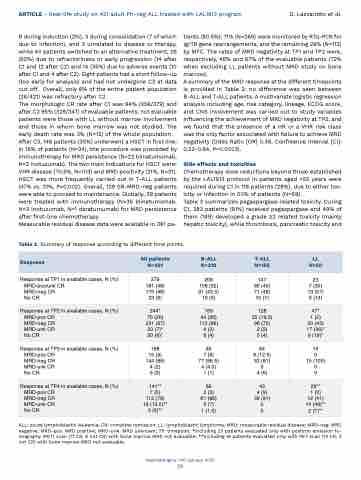
tients (90.5%); 71% (N=269) were monitored by RTq-PCR for Ig/TR gene rearrangements, and the remaining 29% (N=112) by MFC. The rates of MRD negativity at TP1 and TP2 were, respectively, 46% and 67% of the evaluable patients (72% when excluding LL patients without MRD study on bone marrow).
A summary of the MRD response at the different timepoints is provided in Table 2; no difference was seen between B-ALL and T-ALL patients. A multivariate logistic regression analysis including age, risk category, lineage, ECOG score, and CNS involvement was carried out to study variables influencing the achievement of MRD negativity at TP2, and we found that the presence of a HR or a VHR risk class was the only factor associated with failure to achieve MRD negativity (Odds Ratio [OR] 0.38, Confidence Interval [CI]: 0.22-0.64, P=0.0003).
Side effects and toxicities
Chemotherapy dose reductions beyond those established by the LAL1913 protocol in patients aged >55 years were required during C1 in 118 patients (28%), due to either tox- icity or infection in 50% of patients (N=59).
Table 3 summarizes pegaspargase-related toxicity. During C1, 382 patients (91%) received pegaspargase and 49% of them (189) developed a grade ≥2 related toxicity (mainly hepatic toxicity), while thrombosis, pancreatic toxicity and
Table 2. Summary of response according to different time points.
 Response
  All patients N=421
  B-ALL N=216
  T-ALL N=155
  LL N=50
  Response at TP1 in available cases, N (%) MRD-pos/unk CR
MRD-neg CR
No CR
  379 181 (48) 175 (46) 23 (6)
   209 108 (52) 91 (43.5) 10 (5)
 147 66 (45) 71 (48) 10 (7)
   23
7 (30) 13 (57) 3 (13)
  Response at TP2 in available cases, N (%) MRD-pos CR
MRD-neg CR
MRD-unk CR
No CR
 344* 70 (20) 231 (67) 23 (7)* 20 (6)*
  169 44 (26) 115 (68) 4 (2) 6 (4)
128 25 (19.5) 96 (75) 2 (2)
5 (4)
  47*
1 (2) 20 (43) 17 (36)* 9 (19)*
 Response at TP3 in available cases, N (%) MRD-pos CR
MRD-neg CR
MRD-unk CR
No CR
  168 15 (9) 144 (86) 4 (2)
5 (3)
  89
7 (8) 77 (86.5) 4 (4.5) 1 (1)
  64
8 (12.5) 52 (81) 0
4 (6)
  15
0
15 (100)
0
  Response at TP4 in available cases, N (%) MRD-pos CR
MRD-neg CR
MRD-unk CR
No CR
  141**
7 (5) 112 (79) 19 (13.5)** 3 (2)**
   69
2 (3) 61 (88) 5 (7) 1 (1.5)
 43
4 (9) 39 (91)
0
   29**
1 (3) 12 (41) 14 (48)** 2 (7)**
   ALL: acute lymphoblastic leukemia; CR: complete remission; LL: lymphoblastic lymphoma; MRD: measurable residual disease; MRD-neg: MRD negative; MRD-pos: MRD positive; MRD-unk: MRD unknown; TP: timepoint. *Including 23 patients evaluated only with positron emission to- mography (PET) scan (17 CR, 6 not CR) with bone marrow MRD not evaluable. **Including 16 patients evaluated only with PET scan (14 CR, 2 not CR) with bone marrow MRD not evaluable.
Haematologica | 110 January 2025
59


