


Page 72 - Haematologica Vol. 110 - January 2025
P. 72
ARTICLE - Real-life study on 421 adult Ph-neg ALL treated with LAL1913 program D. Lazzarotto et al.
higher proportion of HR+VHR patients, albeit the difference was not significant (51% vs. 43%). Median age and the proportion of patients aged >55 years were comparable in the 2 cohorts (23% in real-life vs. 19% in clinical trial, P=0.33).
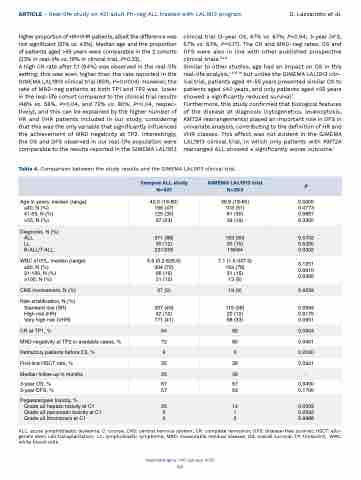
A high CR rate after C1 (94%) was observed in the real-life setting; this was even higher than the rate reported in the GIMEMA LAL1913 clinical trial (85%, P=0.0004). However, the rate of MRD-neg patients at both TP1 and TP2 was lower in the real-life cohort compared to the clinical trial results (46% vs. 56%, P=0.04, and 72% vs. 80%, P=0.04, respec- tively), and this can be explained by the higher number of HR and VHR patients included in our study, considering that this was the only variable that significantly influenced the achievement of MRD negativity at TP2. Interestingly, the OS and DFS observed in our real-life population were comparable to the results reported in the GIMEMA LAL1913
clinical trial (3-year OS, 67% vs. 67%, P=0.94; 3-year DFS, 57% vs. 63%, P=0.17). The CR and MRD-neg rates, OS and DFS were also in line with other published prospective clinical trials.3,4,6
Similar to other studies, age had an impact on OS in this real-life analysis,1-4,14-16 but unlike the GIMEMA LAL1913 clin- ical trial, patients aged 41-55 years presented similar OS to patients aged ≤40 years, and only patients aged >55 years showed a significantly reduced survival.1
Furthermore, this study confirmed that biological features of the disease at diagnosis (cytogenetics, leukocytosis, KMT2A rearrangements) played an important role in DFS in univariate analysis, contributing to the definition of HR and VHR classes. This effect was not evident in the GIMEMA LAL1913 clinical trial, in which only patients with KMT2A rearranged ALL showed a significantly worse outcome.1
Table 4. Comparison between the study results and the GIMEMA LAL1913 clinical trial.
   Campus ALL study N=421
  GIMEMA LAL1913 trial N=203
  P
  Age in years, median (range) ≤40, N (%)
41-55, N (%)
>55, N (%)
   42.0 (18-80) 199 (47) 125 (30) 97 (23)
 39.8 (18-65) 103 (51) 61 (30) 39 (19)
   0.5000 0.4773 0.9867 0.3300
  Diagnosis, N (%) ALL
LL B-ALL/T-ALL
  371 (88) 50 (12) 221/200
183 (90) 20 (10) 139/64
  0.5702 0.5200 0.0002
 WBC x109/L, median (range) ≤30, N (%)
31-100, N (%)
>100, N (%)
 9.9 (0.2-626.9) 304 (72)
66 (16)
51 (12)
 7.1 (1.5-347.3) 159 (78)
31 (15)
13 (6)
 0.1251 0.9910 0.0395
 CNS involvement, N (%)
  37 (9)
  19 (9)
  0.9559
  Risk stratification, N (%) Standard risk (SR) High risk (HR)
Very high risk (VHR)
  207 (49) 42 (10) 171 (41)
115 (58) 20 (10) 68 (33)
  0.0994 0.9175 0.0951
 CR at TP1, %
 94
 85
 0.0004
 MRD negativity at TP2 in available cases, %
 72
 80
 0.0401
 Refractory patients before C3, %
  6
  3
  0.2030
 First-line HSCT rate, %
35
28
0.0921
 Median follow-up in months
  25
  39
  -
 3-year OS, % 3-year DFS, %
 67 57
 67 63
 0.9400 0.1700
  Pegaspargase toxicity, %
Grade ≥2 hepatic toxicity at C1 Grade ≥3 pancreatic toxicity at C1 Grade ≥3 thrombosis at C1
   25 32
 12 12
   0.0003 0.2592 0.9988
   ALL: acute lymphoblastic leukemia; C: course; CNS: central nervous system; CR: complete remission; DFS: disease-free survival; HSCT: allo- geneic stem cell transplantation; LL: lymphoblastic lymphoma; MRD: measurable residual disease; OS: overall survival; TP: timepoint; WBC: white blood cells.
Haematologica | 110 January 2025
64


