


Page 73 - Haematologica Vol. 110 - January 2025
P. 73
ARTICLE - Real-life study on 421 adult Ph-neg ALL treated with LAL1913 program D. Lazzarotto et al.
We also confirmed the crucial role of MRD monitoring in clinical practice and its important prognostic impact on OS and DFS, as observed in many clinical trials.1,2,14,17-19
Our real-life data also highlighted the prognostic impact of first-line HSCT in patients with unfavorable risk factors (VHR and/or MRD-pos), with results comparable to those reported in the GIMEMA LAL1913 clinical study. In our population, a proportion of patients was bridged to HSCT procedure with immunotherapy for MRD positivity. This option was not available in the GIMEMA LAL1913 trial. However, given that this approach is becoming standard clinical practice, and that several trials (such as the ongoing GIMEMA LAL2317) are exploring a sequential chemo-immunotherapy approach, the role of HSCT may change in the near future.17,20,21
In terms of tolerability, the highest rate of pegaspargase-re- lated toxicity in our study was observed at C1, with 49% of patients experiencing at least one grade ≥2 adverse event. In particular, during C1, 25% of patients in this study devel- oped grade ≥2 hepatic toxicity compared to 12% of patients in the GIMEMA LAL1913 clinical trial (P=0.0003). Overall, the pegaspargase-related toxicity observed compares favorably to other international reports in the literature.22,23 This find-
A
ing may reflect less attention to risk factors for pegaspar- gase-related toxicity (such as obesity, hepatopathies) and/ or a less stringent patient selection in the real-life setting than in the GIMEMA LAL1913 clinical trial.
Infectious complications are a significant concern during the management of Ph- ALL patients.24 In our analysis, in- fectious complications mainly occurred at C1, with 14% of patients developing bacteremia/sepsis and 11% of patients developing pneumonia (mycotic in nearly half of the cases). While pneumonia is not a common event in subsequent courses, the number of patients who developed bacteremia/ sepsis reached 9% of cases, in line with previous studies involving Ph- ALL patients treated with intensive proto- cols.6,7,13 Despite the low rate of early mortality observed in our study (3%, 12/421), infections were the main cause of death, affecting more than half of cases. This suggests the need to improve infection surveillance, prophylactic measures, and antimicrobial therapy.
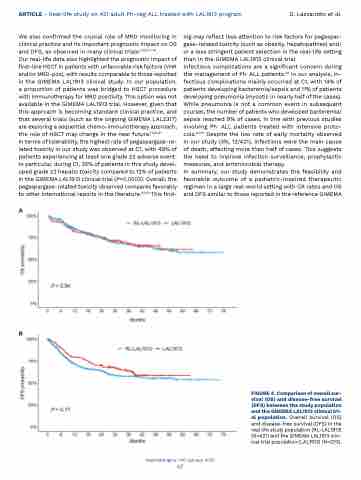
In summary, our study demonstrates the feasibility and favorable outcome of a pediatric-inspired therapeutic regimen in a large real-world setting with CR rates and OS and DFS similar to those reported in the reference GIMEMA
 B
Haematologica | 110 January 2025
65
FIGURE 4. Comparison of overall sur- vival (OS) and disease-free survival (DFS) between the study population and the GIMEMA LAL1913 clinical tri- al population. Overall survival (OS) and disease-free survival (DFS) in the real life study population (RL-LAL1913) (N=421) and the GIMEMA LAL1913 clin- ical trial population (LAL1913) (N=203).


