


Page 105 - Haematologica Vol. 110 - January 2025
P. 105
ARTICLE - Pirtobrutinib in patients with prior intolerance to BTKi N.N. Shah et al.
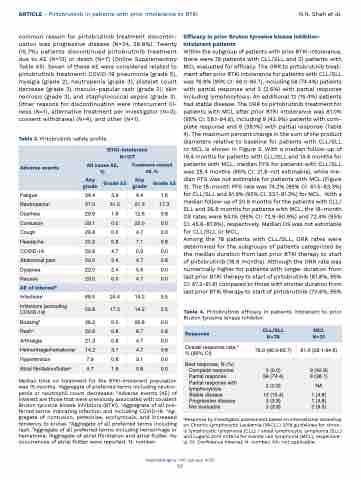
common reason for pirtobrutinib treatment discontin- uation was progressive disease (N=34, 26.8%). Twenty (15.7%) patients discontinued pirtobrutinib treatment due to AE (N=13) or death (N=7) (Online Supplementary Table S5). Seven of these AE were considered related to pirtobrutinib treatment: COVID-19 pneumonia (grade 5), myalgia (grade 2), neutropenia (grade 3), platelet count decrease (grade 3), maculo-papular rash (grade 2), skin necrosis (grade 3), and staphylococcal sepsis (grade 3). Other reasons for discontinuation were intercurrent ill- ness (N=1), alternative treatment per investigator (N=2), consent withdrawal (N=4), and other (N=1).
Table 3. Pirtobrutinib safety profile.
Efficacy in prior Bruton tyrosine kinase inhibitor- intolerant patients
Within the subgroup of patients with prior BTKi-intolerance, there were 78 patients with CLL/SLL and 21 patients with MCL evaluated for efficacy. The ORR to pirtobrutinib treat- ment after prior BTKi intolerance for patients with CLL/SLL was 76.9% (95% CI: 66.0-85.7), including 58 (74.4%) patients with partial response and 2 (2.6%) with partial response including lymphocytosis. An additional 12 (15.4%) patients had stable disease. The ORR to pirtobrutinib treatment for patients with MCL after prior BTKi intolerance was 81.0% (95% CI: 58.1-94.6), including 9 (42.9%) patients with com- plete response and 8 (38.1%) with partial response (Table 4). The maximum percent change in the sum of the product diameters relative to baseline for patients with CLL/SLL or MCL is shown in Figure 2. With a median follow-up of 19.4 months for patients with CLL/SLL and 14.8 months for patients with MCL, median PFS for patients with CLL/SLL was 28.4 months (95% CI: 21.8-not estimable), while me- dian PFS was not estimable for patients with MCL (Figure 3). The 18-month PFS rate was 74.2% (95% CI: 61.5-83.3%) for CLL/SLL and 61.9% (95% CI: 33.1-81.3%) for MCL. With a median follow-up of 20.8 months for the patients with CLL/ SLL and 26.8 months for patients with MCL, the 18-month OS rates were 84.1% (95% CI: 72.9-90.9%) and 72.4% (95% CI: 45.6-87.6%), respectively. Median OS was not estimable for CLL/SLL or MCL.
Among the 78 patients with CLL/SLL, ORR rates were determined for the subgroups of patients categorized by the median duration from last prior BTKi therapy to start of pirtobrutinib (18.8 months). Although the ORR rate was numerically higher for patients with longer duration from last prior BTKi therapy to start of pirtobrutinib (81.8%, 95% CI: 67.3-91.8) compared to those with shorter duration from last prior BTKi therapy to start of pirtobrutinib (70.6%, 95%
Table 4. Pirtobrutinib efficacy in patients intolerant to prior Bruton tyrosine kinase inhibitor.
 Adverse events
 BTKi-intolerant N=127
 All cause AE, %
 Treatment-related AE, %
 Any grade
 Grade ≥3
 Any grade
 Grade ≥3
 Fatigue
  39.4
  3.9
  9.4
  1.6
 Neutropeniaa
 37.0
 31.5
 21.3
 17.3
 Diarrhea
 29.9
 1.6
 12.6
 0.8
 Contusion
29.1
0.0
22.0
0.0
 Cough
  26.8
  0.0
  4.7
  0.0
 Headache
25.2
0.8
7.1
0.8
 COVID-19
 22.8
 4.7
 0.0
 0.0
 Abdominal pain
 22.0
 2.4
 4.7
 0.8
 Dyspnea
  22.0
  2.4
  5.5
  0.0
 Nausea
 20.5
 0.0
 4.7
 0.0
 AE of interestb
 Infectionsc
  68.5
  24.4
  14.2
  5.5
 Infections (excluding COVID-19)
59.8
17.3
14.2
5.5
 Bruisingd
 36.2
 0.0
 26.8
 0.0
 Rashe
 22.8
 0.8
 8.7
 0.8
 Arthralgia
  21.3
  0.8
  4.7
  0.0
 Hemorrhage/hematomaf
14.2
3.1
4.7
0.8
 Hypertension
 7.9
 0.8
 3.1
 0.0
 Atrial fibrillation/flutterg
  4.7
  1.6
  0.8
  0.0
   Response
 CLL/SLL N=78
 MCL N=21
 Overall response rate,a % (95% CI)
  76.9 (66.0-85.7)
  81.0 (58.1-94.6)
  Best response, N (%) Complete response Partial response Partial response with lymphocytosis Stable disease Progressive disease Not evaluable
   0 (0.0) 58 (74.4)
2 (2.6)
12 (15.4) 3 (3.8) 3 (3.8)
  9 (42.9) 8 (38.1)
NA
1 (4.8) 1 (4.8) 2 (9.5)
    Median time on treatment for the BTKi-intolerant population was 15 months. aAggregate of preferred terms including neutro- penia or neutrophil count decreased. bAdverse events (AE) of interest are those that were previously associated with covalent Bruton tyrosine kinase inhibitors (BTKi). cAggregrate of all pre- ferred terms indicating infection and including COVID-19. dAg- gregate of contusion, petechiae, ecchymosis, and increased tendency to bruise. eAggregate of all preferred terms including rash. fAggregate of all preferred terms including hemorrhage or hematoma. gAggregate of atrial fibrillation and atrial flutter. No occurrences of atrial flutter were reported. N: number.
aResponse by investigator assessment based on International Workshop on Chronic Lymphocytic Leukemia (IWCLL) 2018 guidelines for chron- ic lymphocytic lymphoma (CLL) / small lymphocytic lymphoma (SLL) and Lugano 2014 criteria for mantle cell lymphoma (MCL), respective- ly. CI: Confidence Interval; N: number; NA: not applicable.
Haematologica | 110 January 2025
97


