


Page 106 - Haematologica Vol. 110 - January 2025
P. 106
ARTICLE - Pirtobrutinib in patients with prior intolerance to BTKi N.N. Shah et al.
CI: 52.5-84.9), the Confidence Intervals overlapped (Online Supplementary Table S6).
Discussion
Covalent Bruton tyrosine kinase inhibitors are most com- monly discontinued in clinical trial patients and real-world practice because of toxicities and disease progression.17 Data suggest switching to acalabrutinib or zanubrutinib after ibrutinib intolerance may result in lower rates of AE recurrence caused by prior BTKi treatment.1,7,8 In this retrospective analysis, we characterized the safety and efficacy of pirtobrutinib monotherapy in patients who had previously discontinued a BTKi due to intolerance. While the vast majority of patients (120/127) had discontinued a treatment containing the first-generation cBTKi ibrutinib,18 we also examined a limited number of intolerant patients who had received acalabrutinib or zanubrutinib (only 5 patients received either acalabrutinib or zanubrutinib with- out first receiving ibrutinib). AE that led to the discontin- uation of a prior BTKi were consistent with the toxicities associated with intolerance to ibrutinib, acalabrutinib, and zanubrutinib.7,8 Overall, pirtobrutinib treatment was well tolerated, and recurrence of AE that commonly led to prior discontinuation were infrequent and of low grade. Pirtobrutinib has been shown to be highly selective for BTK when evaluated against 370 kinases.9 The highly selective nature of pirtobrutinib may account for the low rates of recurrence of most AE that previously led to a patient dis- continuing a cBTKi. As an exception, neutropenia recurred
in 75% (N=9, 8.3% low grade and 66.7% grade >3) of the 12 patients who had previously discontinued a cBTKi for neutropenia, and infections recurred in 77% (N=10, 30.8% low grade and 46.2% grade >3) of the 13 patients who pre- viously discontinued a cBTKi for infection. This study was conducted mostly during the time of the COVID-19 pandemic before an active vaccine was available. Infections occurring in more than one of these 13 patients were COVID-19 (N=4), pneumonia (N=4), COVID-19 pneumonia (N=2), and urinary tract infection (N=2). The neutropenia and infection find- ings highlight the immunosuppressed nature of patients with hematologic malignancies, and show the importance of careful patient monitoring and vaccinations.
The most common reason for patients to discontinue a prior BTKi was a cardiac disorder. Only 10 of 40 patients (25%) had recurrence of any cardiac disorder with pirtobrutinib. Recognizing that an association between atrial fibrillation and the covalent BTKi agents has been observed across multiple studies,19 among the 30 patients in this study who discontinued a prior cBTKi due to atrial fibrillation, recurrence with pirtobrutinib occurred in only 2 patients. These results are consistent with the broader BRUIN B-cell malignancy patient population where atrial fibrillation was reported in 21 of 773 (2.7%) patients receiving pirtobrutinib monotherapy. These results suggest that it may be possible to reduce the occurrence of atrial fibrillation induced by a cBTKi by using pirtobrutinib. As for AE of special interest, bleeding and hypertension have been commonly associated with cBTKi treatment.2,20,21 Of the 9 patients in this study that previously discontinued a cBTKi due to bleeding/hemorrhage, 3 had recurrence but no major hemorrhage (grade ≥3) was reported.
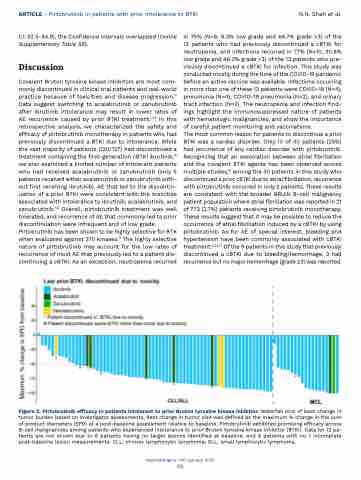
 Figure 2. Pirtobrutinib efficacy in patients intolerant to prior Bruton tyrosine kinase inhibitor. Waterfall plot of best change in tumor burden based on investigator assessments. Best change in tumor size was defined as the maximum % change in the sum of product diameters (SPD) at a post-baseline assessment relative to baseline. Pirtobrutinib exhibited promising efficacy across B-cell malignancies among patients who experienced intolerance to prior Bruton tyrosine kinase inhibitor (BTKi). Data for 12 pa- tients are not shown due to 6 patients having no target lesions identified at baseline, and 6 patients with no / incomplete post-baseline lesion measurements. CLL: chronic lymphocytic lymphoma; SLL: small lymphocytic lymphoma.
Haematologica | 110 January 2025
98


