


Page 104 - Haematologica Vol. 110 - January 2025
P. 104
ARTICLE - Pirtobrutinib in patients with prior intolerance to BTKi N.N. Shah et al.
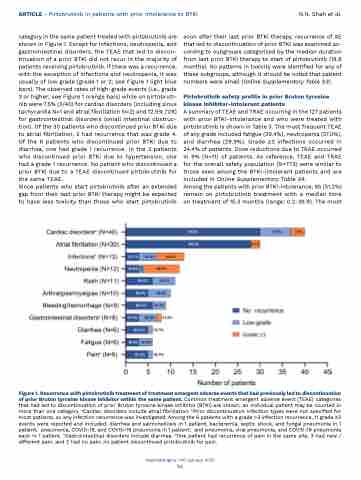
category in the same patient treated with pirtobrutinib are shown in Figure 1. Except for infections, neutropenia, and gastrointestinal disorders, the TEAE that led to discon- tinuation of a prior BTKi did not recur in the majority of patients receiving pirtobrutinib. If there was a recurrence, with the exception of infections and neutropenia, it was usually of low grade (grade 1 or 2; see Figure 1 light blue bars). The observed rates of high-grade events (i.e., grade 3 or higher; see Figure 1 orange bars) while on pirtobruti- nib were 7.5% (3/40) for cardiac disorders (including sinus tachycardia N=1 and atrial fibrillation N=2) and 12.5% (1/8) for gastrointestinal disorders (small intestinal obstruc- tion). Of the 30 patients who discontinued prior BTKi due to atrial fibrillation, 2 had recurrence that was grade 4. Of the 6 patients who discontinued prior BTKi due to diarrhea, one had grade 1 recurrence. In the 3 patients who discontinued prior BTKi due to hypertension, one had a grade 1 recurrence. No patient who discontinued a prior BTKi due to a TEAE discontinued pirtobrutinib for the same TEAE.
Since patients who start pirtobrutinib after an extended gap from their last prior BTKi therapy might be expected to have less toxicity than those who start pirtobrutinib
soon after their last prior BTKi therapy, recurrence of AE that led to discontinuation of prior BTKi was examined ac- cording to subgroups categorized by the median duration from last prior BTKi therapy to start of pirtobrutinib (18.8 months). No patterns in toxicity were identified for any of these subgroups, although it should be noted that patient numbers were small (Online Supplementary Table S3).
Pirtobrutinib safety profile in prior Bruton tyrosine kinase inhibitor-intolerant patients
A summary of TEAE and TRAE occurring in the 127 patients with prior BTKi-intolerance and who were treated with pirtobrutinib is shown in Table 3. The most frequent TEAE of any grade included fatigue (39.4%), neutropenia (37.0%), and diarrhea (29.9%). Grade ≥3 infections occurred in 24.4% of patients. Dose reductions due to TRAE occurred in 9% (N=11) of patients. As reference, TEAE and TRAE for the overall safety population (N=773) were similar to those seen among the BTKi-intolerant patients and are included in Online Supplementary Table S4.
Among the patients with prior BTKi-intolerance, 65 (51.2%) remain on pirtobrutinib treatment with a median time on treatment of 15.3 months (range: 0.2-39.9). The most
 Figure 1. Recurrence with pirtobrutinib treatment of treatment emergent adverse events that had previously led to discontinuation of prior Bruton tyrosine kinase inhibitor within the same patient. Common treatment emergent adverse event (TEAE) categories that had led to discontinuation of prior Bruton tyrosine kinase inhibitor (BTKi) are shown; an individual patient may be counted in more than one category. aCardiac disorders include atrial fibrillation. bPrior discontinuation infection types were not specified for most patients, so any infection recurrence was investigated. Among the 6 patients with a grade >3 infection recurrence, 11 grade ≥3 events were reported and included: diarrhea and salmonellosis in 1 patient; bacteremia, septic shock, and fungal pneumonia in 1 patient; pneumonia, COVID-19, and COVID-19 pneumonia in 1 patient; and pneumonia, viral pneumonia, and COVID-19 pneumonia each in 1 patient. cGastrointestinal disorders include diarrhea. dOne patient had recurrence of pain in the same site, 3 had new / different pain, and 2 had no pain; no patient discontinued pirtobrutinib for pain.
Haematologica | 110 January 2025
96


