


Page 103 - Haematologica Vol. 110 - January 2025
P. 103
ARTICLE - Pirtobrutinib in patients with prior intolerance to BTKi N.N. Shah et al.
Results
Patients and treatment
As of July 29, 2022, 773 patients with CLL/SLL, MCL, or other NHL were enrolled in the BRUIN study and received at least one dose of pirtobrutinib. Of these, 597 patients had received a prior BTKi-containing regimen, and 127 patients discontinued at least one prior BTKi-containing regimen in the absence of progressive disease (either as monotherapy or a combination regimen) (Online Supple- mentary Table S1) due to intolerance (cBTKi ibrutinib N=120, acalabrutinib N=9, zanubrutinib N=3, and DTRMWXHS-12 N=1 or non-covalent BTKi nemtabrutinib N=4) (Table 1, Online Supplementary Figure S1). At the time of enroll- ment to BRUIN, the median age for patients with prior BTKi intolerance was 70 years (range: 42-87), and Eastern Cooperative Oncology Group Performance Status (ECOG PS) was 0, 1, and 2 in 55.1%, 37.8%, and 7.1% of patients respectively, and was similar to the overall safety popu- lation (Online Supplementary Table S2). Median number of prior lines of systemic therapy for the BTKi intolerant subgroup was 3 (range: 1-11). The median time from the end of last BTKi containing-regimen discontinued due to intolerance to the first dose of pirtobrutinib was 18.8 months (range: 0.1-90.5). At the time of the data cutoff date, median study follow-up for all patients was 17.4
months (range: 0.5-39.9) and median time on pirtobrutinib treatment was 15.3 months (range: 0.2-39.9).
Adverse events leading to discontinuation of prior Bruton tyrosine kinase inhibitors
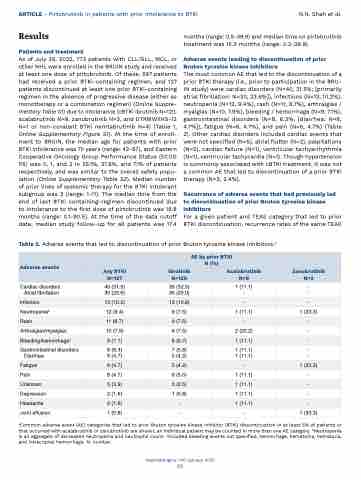
The most common AE that led to the discontinuation of a prior BTKi therapy (i.e., prior to participation in the BRU- IN study) were cardiac disorders (N=40, 31.5%; [primarily atrial fibrillation: N=30, 23.6%]), infections (N=13, 10.2%), neutropenia (N=12, 9.4%), rash (N=11, 8.7%), arthralgias / myalgias (N=10, 7.9%), bleeding / hemorrhage (N=9, 7.1%), gastrointestinal disorders (N=8, 6.3%; [diarrhea: N=6, 4.7%]), fatigue (N=6, 4.7%), and pain (N=6, 4.7%) (Table 2). Other cardiac disorders included cardiac events that were not specified (N=5), atrial flutter (N=2), palpitations (N=2), cardiac failure (N=1), ventricular tachyarrhythmia (N=1), ventricular tachycardia (N=1). Though hypertension is commonly associated with cBTKi treatment, it was not a common AE that led to discontinuation of a prior BTKi therapy (N=3, 2.4%).
Recurrence of adverse events that had previously led to discontinuation of prior Bruton tyrosine kinase inhibitors
For a given patient and TEAE category that led to prior BTKi discontinuation, recurrence rates of the same TEAE
Table 2. Adverse events that led to discontinuation of prior Bruton tyrosine kinase inhibitors.a
 Adverse events
 AE by prior BTKi N (%)
 Any BTKi N=127
 Ibrutinib N=120
 Acalabrutinib N=9
 Zanubrutinib N=3
 Cardiac disorders Atrial fibrillation
 40 (31.5) 30 (23.6)
 39 (32.5) 30 (25.0)
 1 (11.1) -
 -
 Infection
  13 (10.2)
  13 (10.8)
  -
  -
 Neutropeniab
12 (9.4)
9 (7.5)
1 (11.1)
1 (33.3)
 Rash
  11 (8.7)
  9 (7.5)
  -
  -
 Arthralgias/myalgias
10 (7.9)
9 (7.5)
2 (22.2)
-
 Bleeding/hemorrhagec
  9 (7.1)
  8 (6.7)
  1 (11.1)
  -
 Gastrointestinal disorders Diarrhea
8 (6.3) 6 (4.7)
7 (5.8) 5 (4.2)
1 (11.1) 1 (11.1)
-
 Fatigue
  6 (4.7)
  5 (4.2)
  -
  1 (33.3)
 Pain
6 (4.7)
6 (5.0)
1 (11.1)
-
 Unknown
 5 (3.9)
 3 (2.5)
 1 (11.1)
 -
 Depression
  2 (1.6)
  1 (0.8)
  1 (11.1)
  -
 Headache
2 (1.6)
-
1 (11.1)
-
 Joint effusion
  1 (0.8)
  -
  -
  1 (33.3)
   aCommon adverse event (AE) categories that led to prior Bruton tyrosine kinase inhibitor (BTKi) discontinuation in at least 5% of patients or that occurred with acalabrutinib or zanubrutinib are shown; an individual patient may be counted in more than one AE category. bNeutropenia is an aggregate of decreased neutropenia and neutrophil count. cIncluded bleeding events not specified, hemorrhage, hematoma, hematuria, and intracranial hemorrhage. N: number.
Haematologica | 110 January 2025
95


