


Page 90 - Haematologica Vol. 110 - January 2025
P. 90
ARTICLE - LP-118: a promising treatment for CLL J. Ravikrishnan et al.
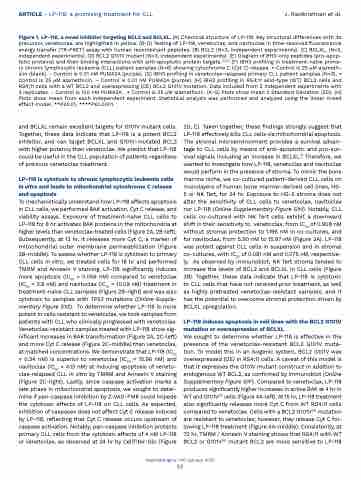
Figure 1. LP-118, a novel inhibitor targeting BCL2 and BCLXL. (A) Chemical structure of LP-118. Key structural differences with its precursor, venetoclax, are highlighted in yellow. (B-D) Testing of LP-118, venetoclax, and navitoclax in time-resolved fluorescence energy transfer (TR-FRET) assay with human recombinant peptides. (B) BCL2 (N=3, independent experiments). (C) BCLXL, (N=3, independent experiments). (D) BCL2 G101V mutant (N=3, independent experiments). (E) Diagram of BH3-only peptides (pro-apop- totic proteins) and their binding interactions with anti-apoptotic protein targets.20,22 (F) iBH3 profiling in treatment-naïve prima- ry chronic lymphocytic leukemia (CLL) patient samples (N=6) showing cytochrome C (Cyt C) release. + Control is 25 μM alameth- icin (black). - Control is 0.01 nM PUMA2A (purple). (G) iBH3 profiling in venetoclax-relapsed primary CLL patient samples (N=3). + Control is 25 μM alamethicin. – Control is 0.01 nM PUMA2A (purple). (H) iBH3 profiling in RS4;11 wild-type (WT) BCL2 cells and RS4;11 cells with a WT BCL2 and overexpressing (OE) BCL2 G101V mutation. Data included from 2 independent experiments with 3 replicates. - Control is 100 nM PUMA2A. + Control is 25 μM alamethicin. (A-G) Plots show mean ± Standard Deviation (SD). (H) Plots show mean from each independent experiment. Statistical analysis was performed and analyzed using the linear mixed effect model. **P≤0.01, ****P≤0.0001.
and BCLXL remain excellent targets for G101V mutant cells. Together, these data indicate that LP-118 is a potent BCL2 inhibitor, and can target BCLXL and G101V-mutated BCL2 with higher potency than venetoclax. We predict that LP-118 could be useful in the CLL population of patients regardless of previous venetoclax treatment.
LP-118 is cytotoxic to chronic lymphocytic leukemia cells in vitro and leads to mitochondrial cytochrome C release and apoptosis
To mechanistically understand how LP-118 affects apoptosis in CLL cells, we performed BAK activation, Cyt C release, and viability assays. Exposure of treatment-naïve CLL cells to LP-118 for 8 hr activates BAK proteins in the mitochondria at higher levels than venetoclax-treated cells (Figure 2A, 2B-left). Subsequently, at 12 hr, it releases more Cyt C, a marker of mitochondrial outer membrane permeabilization (Figure 2B-middle). To assess whether LP-118 is cytotoxic to primary CLL cells in vitro, we treated cells for 18 hr and performed TMRM and Annexin V staining. LP-118 significantly induces more apoptosis (IC50 = 0.056 nM) compared to venetoclax (IC50 = 3.8 nM) and navitoclax (IC50 = 10.09 nM) treatment in treatment-naïve CLL samples (Figure 2B-right) and was also cytotoxic to samples with TP53 mutations (Online Supple- mentary Figure S1G). To determine whether LP-118 is more potent in cells resistant to venetoclax, we took samples from patients with CLL who clinically progressed with venetoclax. Venetoclax-resistant samples treated with LP-118 show sig- nificant increases in BAK transformation (Figure 2A, 2C-left) and more Cyt C release (Figure 2C-middle) than venetoclax, at matched concentrations. We demonstrate that LP-118 (IC50 = 0.34 nM) is superior to venetoclax (IC50 = 15.96 nM) and navitoclax (IC50 = 4.13 nM) at inducing apoptosis of veneto- clax-relapsed CLL in vitro by TMRM and Annexin V staining (Figure 2C-right). Lastly, since caspase activation marks a late phase in mitochondrial apoptosis, we sought to deter- mine if pan-caspase inhibition by Z-VAD-FMK could impede the cytotoxic effects of LP-118 on CLL cells. As expected, inhibition of caspases does not affect Cyt C release induced by LP-118, reflecting that Cyt C release occurs upstream of caspase activation. Notably, pan-caspase inhibition protects primary CLL cells from the cytotoxic effects of 4 nM LP-118 or venetoclax, as observed at 24 hr by CellTiter-Glo (Figure
2D, E). Taken together, these findings strongly suggest that LP-118 effectively kills CLL cells via mitochondrial apoptosis. The stromal microenvironment provides a survival advan- tage to CLL cells by means of anti-apoptotic and pro-sur- vival signals including an increase in BCLXL.12 Therefore, we wanted to investigate how LP-118, venetoclax and navitoclax would perform in the presence of stroma. To mimic the bone marrow niche, we co-cultured patient-derived CLL cells on monolayers of human bone marrow-derived cell lines, HS- 5 or NK Tert, for 24 hr. Exposure to HS-5 stroma does not alter the sensitivity of CLL cells to venetoclax, navitoclax nor LP-118 (Online Supplementary Figure S1H). Notably, CLL cells co-cultured with NK Tert cells exhibit a downward shift in their sensitivity to venetoclax, from IC50 of 0.908 nM without stromal protection to 1.196 nM in co-cultures, and for navitoclax, from 5.90 nM to 15.97 nM (Figure 3A). LP-118 was potent against CLL cells in suspension and in stromal co-cultures, with IC50 of 0.081 nM and 0.075 nM, respective- ly. As observed by immunoblot, NK Tert stroma tended to increase the levels of BCL2 and BCLXL in CLL cells (Figure 3B). Together, these data indicate that LP-118 is cytotoxic to CLL cells that have not received prior treatment, as well as highly pretreated venetoclax-resistant samples, and it has the potential to overcome stromal protection driven by BCLXL upregulation.
LP-118 induces apoptosis in cell lines with the BCL2 G101V mutation or overexpression of BCLXL
We sought to determine whether LP-118 is effective in the presence of the venetoclax-resistant BCL2 G101V muta- tion. To model this in an isogenic system, BCL2 G101V was overexpressed (OE) in RS4;11 cells. A caveat of this model is that it expresses the G101V mutant construct in addition to endogenous WT BCL2, as confirmed by immunoblot (Online Supplementary Figure S1F). Compared to venetoclax, LP-118 produces significantly higher increases in active BAK at 4 hr in WT and G101VOE cells (Figure 4A-left). At 15 hr, LP-118 treatment also significantly releases more Cyt C from WT RS4;11 cells compared to venetoclax. Cells with a BCL2 G101VOE mutation are resistant to venetoclax; however, they release Cyt C fol- lowing LP-118 treatment (Figure 4A-middle). Consistently, at 72 hr, TMRM / Annexin V staining shows that RS4;11 with WT BCL2 or G101VOE mutant BCL2 are more sensitive to LP-118
Haematologica | 110 January 2025
82


