


Page 88 - Haematologica Vol. 110 - January 2025
P. 88
ARTICLE - LP-118: a promising treatment for CLL
J. Ravikrishnan et al.
efficacy relative to navitoclax while sparing platelets to reduce the risk of thrombocytopenia in the clinical setting. This was achieved through rational structure-based design using the platelet-sparing structure of venetoclax as the starting scaffold (Figure 1A, Online Supplementary Figure S1A). We tested whether LP-118 is a genuine BH3 mimetic for BCL2 and BCLXL. For such classification, compounds must occupy the BH3 binding pocket of anti-apoptotic proteins and inhibit their interaction with pro-apoptotic proteins, such as pore-forming protein BAK. A cell-free Fluorescence Resonance Energy Transfer (FRET) competitive assay was performed to evaluate the ability of LP-118 to displace BAK from BCL2, BCLXL, or MCL1. This in vitro biochemical study with LP-118 shows strong targeting of BCL2 (Figure 1B) with IC50 of 0.25 nM, compared to 0.34 nM for venetoclax and 0.75 nM for navitoclax. The BCLXL affinity of LP-118 (Figure 1C) is in-between navitoclax and venetoclax (IC50 = 3.76 nM, 0.9 nM and 34 nM, respectively; LP-118 vs. navitoclax P<0.0001; LP-118 vs. venetoclax P<0.0001). LP-118 does not inhibit MCL1 (IC50>1 μM) (Online Supplementary Figure S1B), denoting se- lectivity for BCL2 and BCLXL. Furthermore, LP-118 has the highest percentage of inhibition of a recombinant BCL2 G101V peptide (IC50= 1.6 nM, 6-fold shift relative to wild-type [WT]) (Figure 1D), compared to venetoclax (IC50= 19.5nM, P<0.0001, 57-fold) and navitoclax (IC50= 33.2 nM, P<0.0001, 44-fold). Computational modeling predicts docking of LP-118 at the BH3 binding groove of human BCL2 (Online Supplementary Figure S1C). GlideScores, an empirical measure of the free energy of binding, revealed a decreasing order of binding affinity for LP-118 with human BCL2 WT (-6.377 kcal/mol), D103E (-4.476 kcal/mol), and G101V (-3.995 kcal/mol), followed by murine WT BCL2 (-3.313 kcal/mol) (Online Supplementary Figure S1C, D).
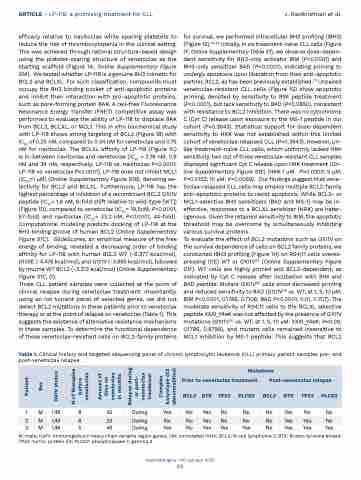
Three CLL patient samples were collected at the point of clinical relapse during venetoclax treatment. Importantly, using an ion torrent panel of selected genes, we did not detect BCL2 mutations in these patients prior to venetoclax therapy or at the point of relapse on venetoclax (Table 1). This suggests the existence of alternative resistance mechanisms in these samples. To determine the functional dependence of these venetoclax-resistant cells on BCL2-family proteins
for survival, we performed intracellular BH3 profiling (iBH3) (Figure 1E).20-22 Initially, in six treatment-naïve CLL cells (Figure 1F, Online Supplementary Table S1), we observe dose-depen- dent sensitivity for BH3-only activator BIM (P<0.0001) and BH3-only sensitizer BAD (P<0.0001), indicating priming to undergo apoptosis upon liberation from their anti-apoptotic partner, BCL2, as has been previously established.23 Unpaired venetoclax-resistant CLL cells (Figure 1G) show apoptotic priming, denoted by sensitivity to BIM peptide treatment (P<0.0001), but lack sensitivity to BAD (P=0.0850), consistent with resistance to BCL2 inhibition. There was no cytochrome C (Cyt C) release upon exposure to the MS-1 peptide in our cohort (P=0.3643). Statistical support for dose-dependent sensitivity to HRK was not established within this limited cohort of venetoclax-relapsed CLL (P=0.3643). However, un- like treatment-naïve CLL cells, which uniformly lacked HRK sensitivity, two out of three venetoclax-resistant CLL samples displayed significant Cyt C release upon HRK treatment (On- line Supplementary Figure S1E) (HRK 1 μM: P=0.0303; 5 μM: P=0.0152; 10 μM: P=0.0059). Our findings suggest that vene- toclax-relapsed CLL cells may employ multiple BCL2-family anti-apoptotic proteins to resist apoptosis. While BCL2- or MCL1-selective BH3 sensitizers (BAD and MS-1) may be in- effective, responses to a BCLXL sensitizer (HRK) are heter- ogenous. Given the retained sensitivity to BIM, the apoptotic threshold may be overcome by simultaneously inhibiting various survival proteins.
To evaluate the effect of BCL2 mutations such as G101V on the survival dependence of cells on BCL2 family proteins, we conducted iBH3 profiling (Figure 1H) on RS4;11 cells overex- pressing (OE) WT or G101VOE (Online Supplementary Figure S1F). WT cells are highly primed and BCL2-dependent, as indicated by Cyt C release after incubation with BIM and BAD peptide. Mutant G101VOE cells show decreased priming and reduced sensitivity to BAD (G101VOE vs. WT, at 1, 5, 10 μM: BIM P<0.0001, 0.1786, 0.7106; BAD P<0.0001, 0.01, 0.707). The moderate sensitivity of RS4;11 cells to the BCLXL selective peptide XXA1_Y4eK was not affected by the presence of G101V mutations (G101VOE vs. WT, at 1, 5, 10 μM: XXA1_Y4eK: P=0.09, 0.1786, 0.8799), and mutant cells remained insensitive to MCL1 inhibition by MS-1 peptide. This suggests that BCL2
Table 1. Clinical history and targeted sequencing panel of chronic lymphocytic leukemia (CLL) primary patient samples pre- and post-venetoclax relapse.
M: male; IGHV: immunoglobulin heavy chain variable region genes; UM: unmutated IGHV; BCL2: B-cell lymphoma 2; BTK: Bruton tyrosine kinase; TP53: tumor protein 53; PLCG2: phospholipase C gamma 2.
Haematologica | 110 January 2025
       Mutations
  Prior to venetoclax treatment
 Post-venetoclax relapse
 BCL2
BTK
 TP53
 PLCG2
 BCL2
 BTK
 TP53
 PLCG2
1
M
 UM
 8
 32
 During
 Yes
 No
Yes
 No
 No
 No
 Yes
 No
 No
2
M
UM
 8
 23
 During
 No
 No
 Yes
No
 No
 No
 Yes
 Yes
 No
 3
M
UM
  5
  46
  During
  Yes
  No
  Yes
Yes
  Yes
  No
  Yes
  Yes
  Yes
     80
Patient Sex
IGHV status
N of therapies before venetoclax
Amount of time on venetoclax in months
Relapse during or post- venetoclax treatment
Complex karyotype (≥3 abnormalities)


