


Page 78 - Haematologica Vol. 110 - January 2025
P. 78
ARTICLE - HCT in elderly AML
D. Niederwieser et al.
Outcomes
Results
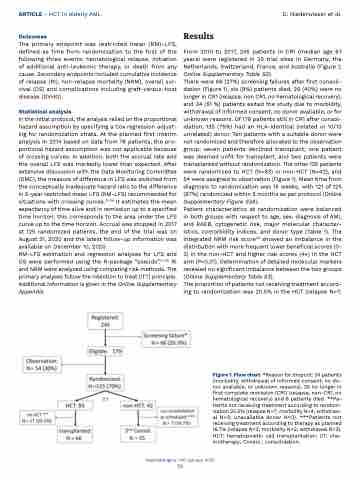
From 2010 to 2017, 245 patients in CR1 (median age 67 years) were registered in 25 trial sites in Germany, the Netherlands, Switzerland, France, and Australia (Figure 1; Online Supplementary Table S2).
There were 66 (27%) screening failures after first consoli- dation (Figure 1), six (9%) patients died, 26 (40%) were no longer in CR1 (relapse, non CR1, no hematological recovery), and 34 (51 %) patients exited the study due to morbidity, withdrawal of informed consent, no donor available, or for unknown reasons. Of 179 patients still in CR1 after consol- idation, 135 (75%) had an HLA-identical (related or 10/10 unrelated) donor. Ten patients with a suitable donor were not randomized and therefore allocated to the observation group: seven patients declined transplant; one patient was deemed unfit for transplant, and two patients were transplanted without randomization. The other 125 patients were randomized to HCT (N=83) or non-HCT (N=42), and 54 were assigned to observation (Figure 1). Mean time from diagnosis to randomization was 15 weeks, with 121 of 125 (97%) randomized within 5 months as per protocol (Online Supplementary Figure S3A).
Patient characteristics at randomization were balanced in both groups with respect to age, sex, diagnosis of AML and RAEB, cytogenetic risk, major molecular character- istics, comorbidity indices, and donor type (Table 1). The integrated NRM risk score28 showed an imbalance in the distribution with more frequent lower beneficial scores (0- 3) in the non-HCT and higher risk scores (4+) in the HCT arm (P=0.01). Determination of detailed molecular markers revealed no significant imbalance between the two groups (Online Supplementary Table S3).
The proportion of patients not receiving treatment accord- ing to randomization was 20.5% in the HCT (relapse N=7;
The primary endpoint was restricted mean (RM)-LFS, defined as time from randomization to the first of the following three events: hematological relapse, initiation of additional anti-leukemic therapy, or death from any cause. Secondary endpoints included cumulative incidence of relapse (RI), non-relapse mortality (NRM), overall sur- vival (OS) and complications including graft-versus-host disease (GVHD).
Statistical analysis
In the initial protocol, the analysis relied on the proportional hazard assumption by specifying a Cox regression adjust- ing for randomization strata. At the planned first interim analysis in 2014 based on data from 78 patients, the pro- portional hazard assumption was not applicable because of crossing curves. In addition, both the accrual rate and the overall LFS was markedly lower than expected. After extensive discussion with the Data Monitoring Committee (DMC), the measure of difference in LFS was switched from the conceptually inadequate hazard ratio to the difference in 5-year restricted mean LFS (RM-LFS) recommended for situations with crossing curves.21-26 It estimates the mean expectancy of time alive and in remission up to a specified time horizon; this corresponds to the area under the LFS curve up to the time horizon. Accrual was stopped in 2017 at 125 randomized patients, the end of the trial was on August 31, 2020 and the latest follow-up information was available on December 10, 2020.
RM-LFS estimation and regression analyses for LFS and OS were performed using the R-package “pseudo”.21-26 RI and NRM were analyzed using competing risk methods. The primary analyses follow the intention to treat (ITT) principle. Additional information is given in the Online Supplementary Appendix.
 Haematologica | 110 January 2025
70
Figure 1. Flow chart. *Reason for dropout: 34 patients (morbidity, withdrawal of informed consent, no do- nor available, or unknown reasons), 26 no longer in first complete remission (CR1) (relapse, non-CR1, no hematological recovery) and 6 patients died. **Pa- tients not receiving treatment according to random- ization 20.5% (relapse N=7; morbidity N=4; withdraw- al N=3; unavailable donor N=3). ***Patients not receiving treatment according to therapy as planned 16.7% (relapse N=2; morbidity N=2; withdrawal N=3). HCT: hematopoietic cell transplantation; CT: che- motherapy; Consol.: consolidation.


