


Page 60 - Haematologica Vol. 110 - January 2025
P. 60
ARTICLE - IVIG prophylaxis in pediatric ALL
K.A. Thus et al.
groups, respectively (Online Supplementary Figure S1). One patient in the IVIG prophylaxis group died in remission 45 months after diagnosis, due to a complication of stem cell transplantation; of note, this patient stopped the IVIG trial within 3 months after diagnosis because the interval between IVIG infusions was too long due to toxicity. Two patients in the control group died, one of bacteremia 9.5 months after diagnosis and one after relapse 54 months after diagnosis. IVIG prophylaxis did not significantly affect either 5-year disease-free survival, which was 90.3% (3.3%) and 91.4% (3.4%) for the IVIG prophylaxis and control groups, re- spectively) (Online Supplementary Figure S1) or overall survival, which was 98.7% (1.3%) and 98.8% (1.2%) for the IVIG prophylaxis and control groups, respectively (Online Supplementary Figure S1).
A
Discussion
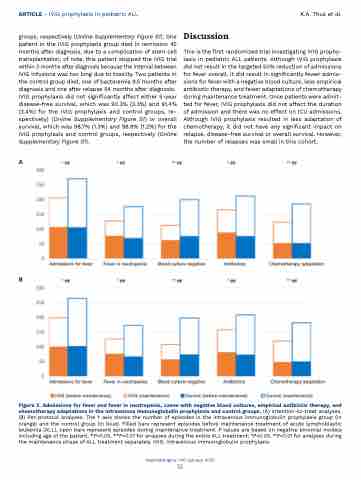
This is the first randomized trial investigating IVIG prophy- laxis in pediatric ALL patients. Although IVIG prophylaxis did not result in the targeted 50% reduction of admissions for fever overall, it did result in significantly fewer admis- sions for fever with a negative blood culture, less empirical antibiotic therapy, and fewer adaptations of chemotherapy during maintenance treatment. Once patients were admit- ted for fever, IVIG prophylaxis did not affect the duration of admission and there was no effect on ICU admissions. Although IVIG prophylaxis resulted in less adaptation of chemotherapy, it did not have any significant impact on relapse, disease-free survival or overall survival. However, the number of relapses was small in this cohort.
 B
Figure 3. Admissions for fever and fever in neutropenia, cases with negative blood cultures, empirical antibiotic therapy, and chemotherapy adaptations in the intravenous immunoglobulin prophylaxis and control groups. (A) Intention-to-treat analyses. (B) Per-protocol analyses. The Y axis shows the number of episodes in the intravenous immunoglobulin prophylaxis group (in orange) and the control group (in blue). Filled bars represent episodes before maintenance treatment of acute lymphoblastic leukemia (ALL), open bars represent episodes during maintenance treatment. P values are based on negative binomial models including age of the patient. *P<0.05, **P<0.01 for analyses during the entire ALL treatment; #P<0.05, ##P<0.01 for analyses during the maintenance phase of ALL treatment separately. IVIG: intravenous immunoglobulin prophylaxis.
Haematologica | 110 January 2025
52


