


Page 214 - Haematologica Vol. 110 - January 2025
P. 214
LETTER TO THE EDITOR
Contribution of copy number to improve risk stratification of adult T-cell acute lymphoblastic leukemia patients enrolled in measurable residual disease-oriented trials
T-cell acute lymphoblastic leukemia (T-ALL) is a genetically heterogeneous disease characterized by a complex multistep mutagenic process in which different alterations cooperate to transform T-cell precursors. However, the clinical impact of most of these alterations remains unclear, which partly explains why T-ALL subtypes are still defined on morpho- logical and immunophenotypic grounds in the current World Health Organization (WHO) 2022 classification. Here, we used single nucleotide ploymorphism (SNP) arrays to investigate the frequency of common copy number variations (CNV), and integrated the results obtained with single nucleotide variants (SNV)/insertions deletions (indel) data on the same homogeneously treated T-ALL cohort, to evaluate their im- pact on disease outcome.
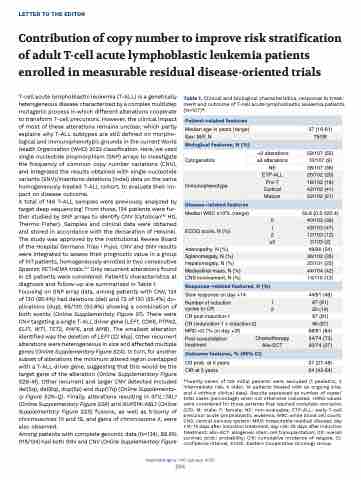
A total of 146 T-ALL samples were previously analyzed by target deep sequencing.1 From those, 134 patients were fur- ther studied by SNP arrays to identify CNV (CytoScanTM HD, Thermo Fisher). Samples and clinical data were obtained and stored in accordance with the declaration of Helsinki. The study was approved by the Institutional Review Board of the Hospital Germans Trias i Pujol. CNV and SNV results were integrated to assess their prognostic value in a group of 107 patients, homogeneously enrolled in two consecutive Spanish PETHEMA trials.2,3 Only recurrent alterations found in ≥5 patients were considered. Patient’s characteristics at diagnosis and follow-up are summarized in Table 1. Focusing on SNP array data, among patients with CNV, 124 of 130 (95.4%) had deletions (del) and 72 of 130 (55.4%) du- plications (dup), 66/130 (50.8%) showing a combination of both events (Online Supplementary Figure S1). There were CNV targeting a single T-ALL driver gene (LEF1, CDK6, PTPN2, ELF1, WT1, TET2, PHF6, and MYB). The smallest alteration identified was the deletion of LEF1 (22 kbp). Other recurrent alterations were heterogeneous in size and affected multiple genes (Online Supplementary Figure S2A). In turn, for another subset of alterations the minimum altered region overlapped with a T-ALL driver gene, suggesting that this would be the target gene of the alteration (Online Supplementary Figure S2B-M). Other recurrent and larger CNV detected included del(5q), del(6q), dup(5p) and dup(17q) (Online Supplementa- ry Figure S2N-Q). Finally, alterations resulting in STIL::TAL1 (Online Supplementary Figure S2R) and NUP214::ABL1 (Online Supplementary Figure S2S) fusions, as well as trisomy of chromosomes 10 and 19, and gains of chromosome X, were also observed.
Among patients with complete genomic data (N=134), 88.8% (119/134) had both SNV and CNV (Online Supplementary Figure
Table 1. Clinical and biological characteristics, response to treat- ment and outcome of T-cell acute lymphoblastic leukemia patients (N=107)*.
 Patient-related features
Median age in years (range)
 37 (16-61)
 Sex: M/F, N
  79/28
  Biological features, N (%)
 Cytogenetics
 <3 alterations
 59/107 (55)
 ≥3 alterations
  10/107 (9)
  NE
38/107 (36)
Immunophenotype
ETP-ALL
  20/102 (20)
  Pre-T
18/102 (18)
Cortical
 42/102 (41)
 Mature
  22/102 (21)
   Disease-related features
Median WBC x109/L (range)
  52.8 (0.5-525.4)
 ECOG score, N (%)
0
  40/103 (39)
  1
49/103 (47)
2
 12/103 (12)
 ≥3
  2/103 (2)
 Adenopathy, N (%)
  49/90 (54)
  Splenomegaly, N (%)
36/102 (35)
Hepatomegaly, N (%)
  25/101 (25)
  Mediastinal mass, N (%)
44/104 (42)
CNS involvement, N (%)
  14/110 (13)
  Response-related features, N (%)
Slow response on day +14
  44/91 (48)
 Number of induction cycles to CR
1
 87 (81)
 2
  20 (19)
 CR post induction-1
 87 (81)
 CR (indunction-1 + induction-2)
  96 (87)
  MRD <0.1% on day +35
 68/81 (84)
 Post consolidation treatment
 Chemotherapy
 54/74 (73)
Allo-SCT
  20/74 (27)
  Outcome features, % (95% CI)
OS prob. at 5 years
  37 (27-48)
  CIR at 5 years
 54 (43-64)
  Haematologica | 110 January 2025
206
*Twenty-seven of 134 initial patients were excluded (1 pediatric; 3 intermediate risk; 4 older; 14 patients treated with an ongoing trial; and 4 without clinical data). Results expressed as number of cases/ total cases (percentage) when not otherwise indicated. +MRD values were considered for those patients that reached complete remission (CR). M: male; F: female; NE: non-evaluable; ETP-ALL: early T-cell precursor acute lymphoblastic leukemia; WBC: white blood cell count; CNS: central nervous system; MRD: measurable residual disease; day +14: 14 days after induction treatment; day +35: 35 days after induction treatment; allo-SCT: allogeneic stem cell transplantation; OS: overall survival; prob.: probability; CIR: cumulative incidence of relapse; CI: confidence interval; ECOG: Eastern Cooperative Oncology Group.


