


Page 177 - Haematologica Vol. 110 - January 2025
P. 177
ARTICLE - Multiple myeloma and the risk of infections
C.H. Blimark et al.
of dying from an infection compared to controls.
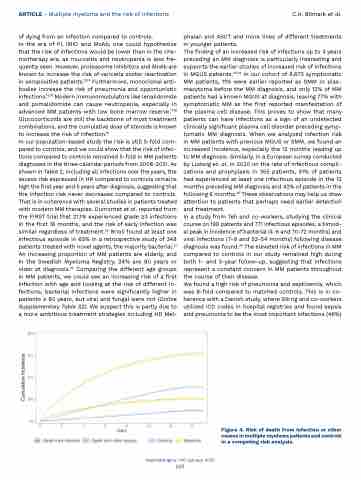
In the era of PI, IMiD and MoAb, one could hypothesize that the risk of infections would be lower than in the che- motherapy era, as mucositis and neutropenia is less fre- quently seen. However, proteasome inhibitors and MoAb are known to increase the risk of varicella zoster reactivation in seropositive patients.13,14 Furthermore, monoclonal anti- bodies increase the risk of pneumonia and opportunistic infections.15,16 Modern immunomodulators like lenalidomide and pomalidomide can cause neutropenia, especially in advanced MM patients with low bone marrow reserve.17,18 Glucocorticoids are still the backbone of most treatment combinations, and the cumulative dose of steroids is known to increase the risk of infection.19
In our population-based study the risk is still 5-fold com- pared to controls, and we could show that the risk of infec- tions compared to controls remained 5-fold in MM patients diagnosed in the three calendar periods from 2008-2021. As shown in Table 2, including all infections over the years, the excess risk expressed in HR compared to controls remains high the first year and 5 years after diagnosis, suggesting that the infection risk never decreases compared to controls. That is in coherence with several studies in patients treated with modern MM therapies. Dumontet et al. reported from the FIRST trial that 21.1% experienced grade ≥3 infections in the first 18 months, and the risk of early infection was similar regardless of treatment.20 Brioli found at least one infectious episode in 65% in a retrospective study of 348 patients treated with novel agents, the majority bacterial.21 An increasing proportion of MM patients are elderly, and in the Swedish Myeloma Registry, 24% are 80 years or older at diagnosis.22 Comparing the different age groups in MM patients, we could see an increasing risk of a first infection with age and looking at the risk of different in- fections, bacterial infections were significantly higher in patients ≥ 80 years, but viral and fungal were not (Online Supplementary Table S2). We suspect this is partly due to a more ambitious treatment strategies including HD Mel-
phalan and ASCT and more lines of different treatments in younger patients.
The finding of an increased risk of infections up to 4 years preceding an MM diagnosis is particularly interesting and supports the earlier studies of increased risk of infections in MGUS patients.23,24 In our cohort of 8,672 symptomatic MM patients, 11% were earlier reported as SMM or plas- macytoma before the MM diagnosis, and only 12% of MM patients had a known MGUS at diagnosis, leaving 77% with symptomatic MM as the first reported manifestation of the plasma cell disease. This proves to show that many patients can have infections as a sign of an undetected clinically significant plasma cell disorder preceding symp- tomatic MM diagnosis. When we analyzed infection risk in MM patients with previous MGUS or SMM, we found an increased incidence, especially the 12 months leading up to MM diagnosis. Similarly, in a European survey conducted by Ludwig et. al. in 2020 on the rate of infectious compli- cations and prophylaxis in 355 patients, 51% of patients had experienced at least one infectious episode in the 12 months preceding MM diagnosis and 42% of patients in the following 6 months.25 These observations may help us draw attention to patients that perhaps need earlier detection and treatment.
In a study from Teh and co-workers, studying the clinical course on 199 patients and 771 infectious episodes, a bimod- al peak in incidence of bacterial (4-6 and 70-72 months) and viral infections (7-9 and 52-54 months) following disease diagnosis was found.26 The elevated risk of infections in MM compared to controls in our study remained high during both 1- and 5-year follow-up, suggesting that infections represent a constant concern in MM patients throughout the course of their disease.
We found a high risk of pneumonia and septicemia, which was 8-fold compared to matched controls. This is in co- herence with a Danish study, where Sörrig and co-workers utilized ICD codes in hospital registries and found sepsis and pneumonia to be the most important infections (46%)
 Haematologica | 110 January 2025
169
Figure 4. Risk of death from infection or other causes in multiple myeloma patients and controls in a competing risk analysis.


