


Page 176 - Haematologica Vol. 110 - January 2025
P. 176
ARTICLE - Multiple myeloma and the risk of infections
C.H. Blimark et al.
viral and fungal infections the first year after MM diagnosis was especially high, 8-fold and 11-fold compared to con- trols, respectively (Table 2). The risk of infection compared to controls remained 5-fold in MM patients diagnosed in the three calendar periods as shown in Table 2.
Females had overall a significantly lower risk of infections compared to males (HR=0.88; 95% CI: 0.86-0.91). The anal- yses above were adjusted for Charlson Comorbidity Index in a separate model yielding the same results (data not shown). The risk of a first infection increases significant by age, compared to <65, the age groups 65-80 and ≥80 years had a HR of 1,21 and 1,75 respectively (P<0.001).
Patients >80 years at diagnosis had an increased risk of bacterial infections compared to younger patients (HR=1.11; 95% CI: 1.04-1.19). However, in viral and fungal infections, all patients >65 years had less reported infections compared to younger patients (Online Supplementary Table S2). Com- paring the risk of all infections in MM patients in the first calendar period 2008-2012 to the two following periods, the risk was slightly increased in the period 2013-2017 (HR=1.06; 95% CI: 1.0-1.11) but decreased in the latest calendar period 2018-2021 (HR=0.87; 95% CI: 0.82-0.93) (Online Supplemen- tary Table S3).
Infection-related mortality
A total of 678 (8%) of MM patients had died within 3 months
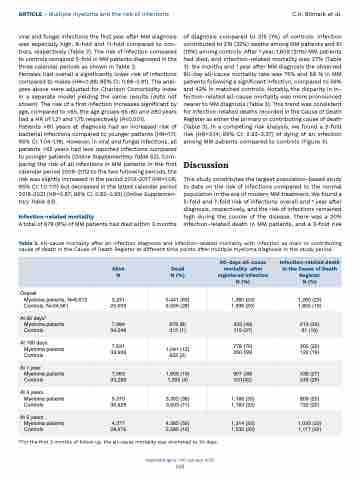
of diagnosis compared to 315 (1%) of controls. Infection contributed to 219 (32%) deaths among MM patients and 61 (19%) among controls. After 1 year, 1,609 (20%) MM patients had died, and infection-related mortality was 27% (Table 3). Six months and 1 year after MM diagnosis the observed 90-day all-cause mortality rate was 75% and 56 % in MM patients following a significant infection, compared to 56% and 42% in matched controls. Notably, the disparity in in- fection-related all-cause mortality was more pronounced nearer to MM diagnosis (Table 3). This trend was consistent for infection-related deaths recorded in the Cause of Death Register as either the primary or contributing cause of death (Table 3). In a competing risk analysis, we found a 3-fold risk (HR=3.14; 95% CI: 2.92-3.37) of dying of an infection among MM patients compared to controls (Figure 4).
Discussion
This study constitutes the largest population-based study to date on the risk of infections compared to the normal population in the era of modern MM treatment. We found a 5-fold and 7-fold risk of infections overall and 1 year after diagnosis, respectively, and the risk of infections remained high during the course of the disease. There was a 30% infection-related death in MM patients, and a 3-fold risk
Table 3. All-cause mortality after an infection diagnosis and infection-related mortality with infection as main or contributing cause of death in the Cause of Death Register at different time points after multiple myeloma diagnosis in the study period.
  Alive N
  Dead N (%)
 90-days all-cause mortality after registered infection N (%)
 Infection-related death in the Cause of Death Register
N (%)
 Overall
Myeloma patients, N=8,672 Controls, N=34,561
  3,231 25,005
   5,441 (63) 9,556 (28)
  1,360 (24) 1,938 (20)
  1,260 (23) 1,855 (19)
  At 90 days* Myeloma patients Controls
  7,994 34,246
 678 (8) 315 (1)
332 (49) 115 (37)
  219 (32) 61 (19)
 At 180 days Myeloma patients Controls
  7,631 33,939
   1,041 (12) 622 (2)
  778 (75) 350 (56)
  305 (29) 122 (19)
  At 1 year
Myeloma patients Controls
  7,063 33,296
 1,609 (19) 1,265 (4)
907 (56) 531(42)
  436 (27) 249 (20)
 At 3 years Myeloma patients Controls
 5,370 30,928
  3,302 (38) 3,633 (11)
 1,168 (35) 1,163 (32)
 809 (25) 732 (20)
 At 5 years Myeloma patients Controls
  4,377 28,976
   4,385 (50) 5,585 (16)
  1,314 (35) 1,532 (32)
  1,033 (23) 1,117 (20)
   *For the first 3 months of follow up, the all-cause mortality was shortened to 30 days.
Haematologica | 110 January 2025
168


