


Page 134 - Haematologica Vol. 110 - January 2025
P. 134
ARTICLE - CITE-seq analysis of HU effects on CML cells H. Komic et al. AB
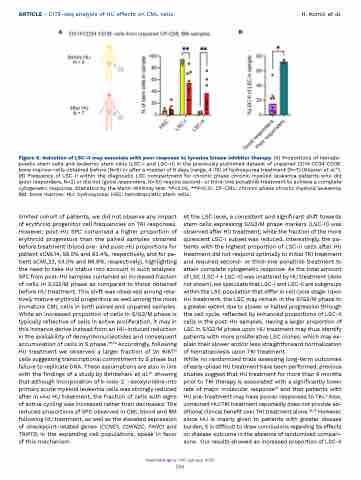
Figure 8. Induction of LSC-II may associate with poor response to tyrosine kinase inhibitor therapy. (A) Proportions of hemato- poietic stem cells and leukemic stem cells (LSC-I and LSC-II) in the previously published dataset of unpaired CD14-CD34+CD38- bone marrow cells obtained before (N=5) or after a median of 9 days (range, 4-19) of hydroxyurea treatment (N=7) (Nilsson et al.19). (B) Frequency of LSC-II within the diagnostic LSC compartment for chronic phase chronic myeloid leukemia patients who did (poor responders, N=2) or did not (good responders, N=10) require second- or third-line ponatinib treatment to achieve a complete cytogenetic response. Statistics by the Mann-Whitney test. *P<0.05, **P<0.01. CP-CML: chronic phase chronic myeloid leukemia; BM: bone marrow; HU: hydroxyurea; HSC: hematopoietic stem cells.
 limited cohort of patients, we did not observe any impact of erythroid progenitor cell frequencies on TKI responses. However, post-HU SPC comprised a higher proportion of erythroid progenitors than the paired samples obtained before treatment (blood pre- and post-HU proportions for patient sCML14, 56.5% and 63.4%, respectively, and for pa- tient sCML23, 53.0% and 66.9%, respectively), highlighting the need to take HU status into account in such analyses. SPC from post-HU samples contained an increased fraction of cells in S/G2/M phase as compared to those obtained before HU treatment. This shift was observed among rela- tively mature erythroid progenitors as well among the most immature CML cells in both paired and unpaired samples. While an increased proportion of cells in S/G2/M phase is typically reflective of cells in active proliferation, it may in this instance derive instead from an HU-induced reduction in the availability of deoxyribonucleotides and consequent accumulation of cells in S phase.28,29 Accordingly, following HU treatment we observed a larger fraction of 2n Ki67hi cells suggesting transcriptional commitment to S phase but failure to replicate DNA. These assumptions are also in line with the findings of a study by Behbehani et al.30 showing that although incorporation of 5-iodo-2´-deoxyuridine into primary acute myeloid leukemia cells was strongly reduced after in vivo HU treatment, the fraction of cells with signs of active cycling was increased rather than decreased. The reduced proportions of SPC observed in CML blood and BM following HU treatment, as well as the elevated expression of checkpoint-related genes (CCNE1, CDKN2C, FANCI and TRIP13) in the expanding cell populations, speak in favor of this mechanism.
At the LSC level, a consistent and significant shift towards stem cells expressing S/G2/M phase markers (LSC-II) was observed after HU treatment, while the fraction of the more quiescent LSC-I subset was reduced. Interestingly, the pa- tients with the highest proportion of LSC-II cells after HU treatment did not respond optimally to initial TKI treatment and required second- or third-line ponatinib treatment to attain complete cytogenetic response. As the total amount of LSC (LSC-I + LSC-II) was unaltered by HU treatment (data not shown), we speculate that LSC-I and LSC-II are subgroups within the LSC population that differ in cell cycle stage. Upon HU treatment, the LSC may remain in the S/G2/M phase to a greater extent due to slower or halted progression through the cell cycle, reflected by enhanced proportions of LSC-II cells in the post-HU samples. Having a larger proportion of LSC in S/G2/M phase upon HU treatment may thus identify patients with more proliferative LSC clones, which may ex- plain their slower and/or less straightforward normalization of hematopoiesis upon TKI treatment.
While no randomized trials assessing long-term outcomes of early-phase HU treatment have been performed, previous studies suggest that HU treatment for more than 6 months prior to TKI therapy is associated with a significantly lower rate of major molecular response31 and that patients with HU pre-treatment may have poorer responses to TKI.8 Also, combined HU/TKI treatment reportedly does not provide ad- ditional clinical benefit over TKI treatment alone.32,33 However, since HU is mainly given to patients with greater disease burden, it is difficult to draw conclusions regarding its effects on disease outcome in the absence of randomized compari- sons. Our results showed an increased proportion of LSC-II
Haematologica | 110 January 2025
126


