


Page 147 - Haematologica Vol. 109 - July 2024
P. 147
ARTICLE - Patterns of lower risk MDS progresion A.G. Jain et al. Table 2. Mutational profile of the 4 cohorts.
 Mutation
 LR-LR, N (%) N=1,300
 LR-HR, N (%) N=317
 LR-HR-AML, N (%) N=124
 LR-AML, N (%) N=173
 P
 SF3B1
  259 (38.1)
  47 (28.8)
  5 (10.2)
  13 (16.7)
  <0.0001
 SRSF2
60 (8.9)
22 (13.7)
16 (32.7)
20 (25.6)
<0.0001
 U2AF1
  68 (10.1)
  19 (11.7)
  10 (20.8)
  11 (14.1)
  0.1127
 ZRSR2
50 (7.4)
11 (6.8)
5 (10.4)
10 (12.8)
0.3222
 TET2
  193 (28.7)
  49 (30.2)
  15 (30)
  28 (34.1)
  0.7723
 IDH1
16 (2.4)
0
1 (2)
8 (9.5)
0.0001
 IDH2
 13 (1.9)
 7 (4.3)
 2 (4)
 6 (7.1)
 0.0290
 DNMT3A
  88 (13.1)
  23 (14.3)
  6 (12.2)
  12 (14.6)
  0.9575
 EZH2
43 (13.1)
13 (14.3)
4 (12.2)
11 (14.6)
0.0855
 ASXL1
  133 (18.8)
  39 (23.2)
  18 (32.1)
  26 (31)
  0.0092
 SETBP1
28 (4.2)
7 (4.4)
3 (6.1)
5 (6.4)
0.7698
 TP53
  26 (3.7)
  20 (12)
  6 (10.9)
  11 (13.8)
  <0.0001
 PHF6
6 (0.9)
1 (0.6)
3 (6.1)
1 (0.2)
0.0093
 RUNX1
  37 (5.2)
  17 (10.1)
  10 (18.2)
  20 (25)
  <0.0001
 ETV6
9 (1.3)
12 (7.2)
6 (10.9)
1 (1.3)
<0.0001
 CBL
  16 (2.4)
  9 (5.6)
  3 (6.1)
  7 (9)
  0.0074
 NRAS
6 (0.9)
4 (2.5)
3 (6.1)
4 (5.1)
0.0030
 JAK2
 46 (6.8)
 10 (6.2)
 3 (6.1)
 1 (1.3)
 0.3012
 NPM1
  0
  1 (0.6)
  1 (2)
  7 (8)
  <0.0001
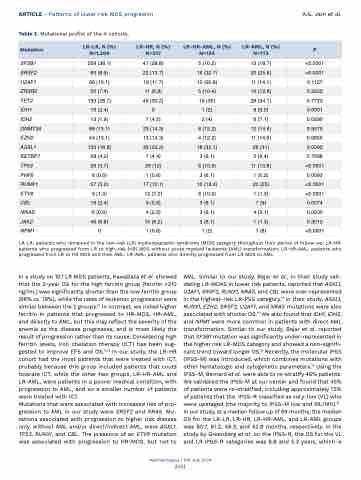
   LR-LR: patients who remained in the low-risk (LR) myelodysplastic syndrome (MDS) category throughout their period of follow-up; LR-HR: patients who progressed from LR to high-risk (HR) MDS without acute myeloid leukemia (AML) transformation; LR-HR-AML: patients who progressed from LR to HR MDS and then AML; LR-AML: patients who directly progressed from LR MDS to AML.
In a study on 107 LR MDS patients, Kawabata et al. showed that the 3-year OS for the high ferritin group (ferritin >210 ng/mL) was significantly shorter than the low ferritin group (66% vs. 79%), while the rates of leukemic progression were similar between the 2 groups.10 In contrast, we noted higher ferritin in patients that progressed to HR-MDS, HR-AML, and directly to AML, but this may reflect the severity of the anemia as the disease progresses, and is most likely the result of progression rather than its cause. Considering high ferritin levels, iron chelation therapy (ICT) has been sug- gested to improve EFS and OS.11,12 In our study, the LR-HR cohort had the most patients that were treated with ICT, probably because this group included patients that could tolerate ICT, while the other two groups, LR-HR-AML and LR-AML, were patients in a poorer medical condition, with progression to AML, and so a smaller number of patients were treated with ICT.
Mutations that were associated with increased risk of pro- gression to AML in our study were SRSF2 and NRAS. Mu- tations associated with progression to higher risk disease only, without AML and/or direct/indirect AML, were ASXL1, TP53, RUNX1, and CBL. The presence of an ETV6 mutation was associated with progression to HR-MDS, but not to
AML. Similar to our study, Bejar et al., in their study vali- dating LR-MDAS in lower risk patients, reported that ASXL1, U2AF1, SRSF2, RUNX1, NRAS, and CBL were over-represented in the highest-risk LR-PSS category.13 In their study, ASXL1, RUNX1, EZH2, SRSF2, U2AF1, and NRAS mutations were also associated with shorter OS.13 We also found that IDH1, IDH2, and NPM1 were more common in patients with direct AML transformation. Similar to our study, Bejar et al. reported that SF3B1 mutation was significantly under-represented in the higher risk LR-MDS category and showed a non-signifi- cant trend toward longer OS.13 Recently, the molecular IPSS (IPSS-M) was introduced, which combines mutations with other hematologic and cytogenetic parameters.14 Using the IPSS-M, Bernard et al. were able to re-stratify 46% patients. We validated the IPSS-M at our center and found that 45% of patients were re-stratified, including approximately 75% of patients that the IPSS-R classified as very-low (VL) who were upstaged (the majority to IPSS-M low and ML/MH).15 In our study, at a median follow up of 99 months, the median OS for the LR-LR, LR-HR, LR-HR-AML, and LR-AML groups was 80.7, 61.2, 48.3, and 42.8 months, respectively. In the study by Greenberg et al. on the IPSS-R, the OS for the VL and LR IPSS-R categories was 8.8 and 5.3 years, which is
Haematologica | 109 July 2024
2161


