


Page 146 - Haematologica Vol. 109 - July 2024
P. 146
ARTICLE - Patterns of lower risk MDS progresion A.G. Jain et al.
 Variable
 LR-LR, N (%) N=1,300 (67.9%)
 LR-HR, N (%) N=317 (16.6%)
 LR-HR-AML, N (%) N=124 (6.5%)
 LR-AML, N (%) N=173 (9%)
 P
 del5q/-5
  101 (7.7)
  45 (14.2)
  17 (13.7)
  14 (8.1)
  0.001
 del7q/-7
 19 (1.5)
 7 (2.2)
 1 (0.8)
 2 (1.2)
 0.656
  Lower risk MD Anderson Model Good
Intermediate Poor
   318 (24.5) 847 (65.3) 132 (10.2)
  73 (23) 212 (66.9) 32 (10.1)
  19 (15.3) 87 (70.2) 18 (14.5)
 34 (19.8) 119 (69.2) 19 (11)
   0.239
 Treatment categories Azacitidine Lenalidomide Decitabine
ATG ICT alloSCT
   370 (28.5) 320 (24.6) 85 (6.5) 37 (2.8) 159 (12.2) 63 (4.8)
 213 (67.2) 95 (30) 62 (19.6) 12 (3.8) 65 (20.5) 53 (16.7)
 109 (87.9) 32 (25.8) 38 (30.6) 4 (3.2)
17 (13.7) 18 (14.5)
93 (53.8) 24 (13.9) 51 (29) 3 (1.7) 18 (10.4) 27 (15.6)
  <0.0001 0.001 <0.001 0.624 0.001 <0.0001
 Deaths, N (%) <2 years 2-5 years >5 years
  171 (13.1) 215 (16.5) 266 (20.5)
   47 (14.8) 95 (29.9) 93 (29.3)
   16 (12.9) 68 (54.8) 31 (25)
  46 (26.6) 58 (33.5) 42 (24.3)
  <0.0001
   LR-LR: patients who remained in the low-risk (LR) myelodysplastic syndrome (MDS) category throughout their period of follow up; LR-HR: patients who progressed from LR to high-risk (HR) MDS without acute myeloid leukemia (AML) transformation; LR-HR-AML: patients who progressed from LR to HR MDS and then AML; LR-AML: patients who directly progressed from LR MDS to AML; WBC: white blood cell count; ANC: absolute neutrophil count; Hb: hemoglobin; BM: bone marrow; t-MDS: therapy-related MDS; SLD: single lineage dysplasia; MLD: multi- lineage dysplasia; RS: ring sideroblasts; EB: excess blasts; MPN: myeloproliferative neoplasm: RS-T: ring sideroblasts and thrombocytosis; ATG: antithymocyte globulin; ICT: iron chelation therapy; alloSCT: allogeneic stem cell transplant.
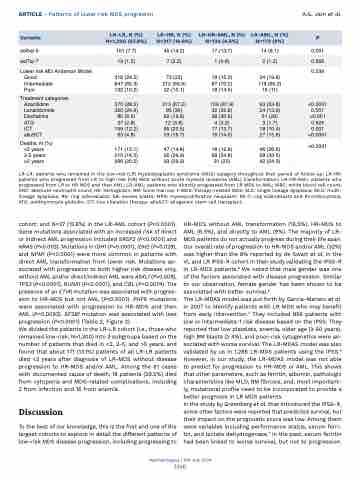
cohort; and N=27 (15.6%) in the LR-AML cohort (P<0.0001). Gene mutations associated with an increased risk of direct or indirect AML progression included SRSF2 (P<0.0001) and NRAS (P=0.003). Mutations in IDH1 (P=0.0001), IDH2 (P=0.029), and NPM1 (P<0.0001) were more common in patients with direct AML transformation from lower risk. Mutations as- sociated with progression to both higher risk disease only, without AML and/or direct/indirect AML were ASXL1 (P=0.009), TP53 (P<0.0001), RUNX1 (P<0.0001), and CBL (P=0.0074). The presence of an ETV6 mutation was associated with progres- sion to HR-MDS but not AML (P<0.0001). PHF6 mutations were associated with progression to HR-MDS and then AML (P=0.0093). SF3B1 mutation was associated with less progression (P<0.0001) (Table 2, Figure 2).
We divided the patients in the LR-LR cohort (i.e., those who remained low-risk; N=1,300) into 3 subgroups based on the number of patients that died in <2, 2-5, and >5 years, and found that about 171 (13.1%) patients of all LR-LR patients died <2 years after diagnosis of LR-MDS without disease progression to HR-MDS and/or AML. Among the 61 cases with documented cause of death, 18 patients (29.5%) died from cytopenia and MDS-related complications, including 2 from infection and 16 from anemia.
Discussion
To the best of our knowledge, this is the first and one of the largest cohorts to explore in detail the different patterns of low-risk MDS disease progression, including progressing to
HR-MDS without AML transformation (16.5%), HR-MDS to AML (6.5%), and directly to AML (9%). The majority of LR- MDS patients do not actually progress during their life span. Our overall rate of progression to HR-MDS and/or AML (32%) was higher than the 8% reported by de Swart et al. in the VL and LR IPSS-R cohort in their study validating the IPSS-R in LR-MDS patients.8 We noted that male gender was one of the factors associated with disease progression. Similar to our observation, female gender has been shown to be associated with better survival.8
The LR-MDAS model was put forth by Garcia-Manero et al. in 2007 to identify patients with LR MDS who may benefit from early intervention.4 They included 856 patients with low or intermediate-1 risk disease based on the IPSS. They reported that low platelets, anemia, older age (≥ 60 years), high BM blasts (≥ 4%), and poor-risk cytogenetics were as- sociated with worse survival. The LR-MDAS model was also validated by us in 1,288 LR-MDS patients using the IPSS.9 However, in our study, the LR-MDAS model was not able to predict for progression to HR-MDS or AML. This shows that other parameters, such as ferritin, albumin, pathologic characteristics like MLD, BM fibrosis, and, most important- ly, mutational profile need to be incorporated to provide a better prognosis in LR MDS patients.
In the study by Greenberg et al. that introduced the IPSS-R, some other factors were reported that predicted survival, but their impact on the prognostic score was low. Among them were variables including performance status, serum ferri- tin, and lactate dehydrogenase.2 In the past, serum ferritin had been linked to worse survival, but not to progression.
Haematologica | 109 July 2024
2160


