


Page 47 - Haematologica Vol. 110 - January 2025
P. 47
PERSPECTIVE ARTICLE
G. Semenzato et al.
technologies and high-throughput sequencing as well as from the expanding use of TRBC1/2 antibodies (Table 1)7,17,18 indicate that the incidence of T-cell clones in elderly people, and more in general in healthy individuals, may be high- er than previously thought, tentatively around 1-2%. This figure is consistent with the incidence observed in other premalignant conditions such as MBL and MGUS.4 Their preferential occurrence with increasing age, especially in the oldest populations,20 suggests potential overlaps with the mechanisms of immune system senescence. The obvi- ous question then arising regards the significance of these cell expansions in different settings, both in hematologic disorders as well as in various non-hematologic disease states.
T-cell clones in patients with large granular lymphocyte leukemia
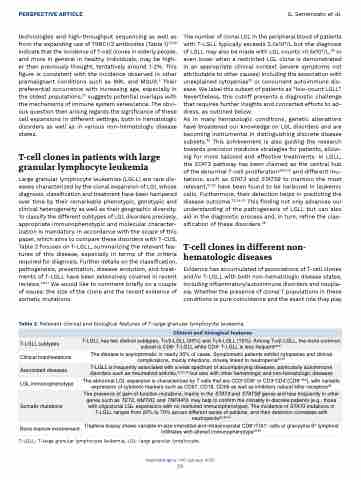
Large granular lymphocyte leukemias (LGLL) are rare dis- eases characterized by the clonal expansion of LGL whose diagnosis, classification and treatment have been hampered over time by their remarkable phenotypic, genotypic and clinical heterogeneity as well as their geographic diversity. To classify the different subtypes of LGL disorders precisely, appropriate immunophenotypic and molecular character- ization is mandatory. In accordance with the scope of this paper, which aims to compare these disorders with T-CUS, Table 2 focuses on T-LGLL, summarizing the relevant fea- tures of this disease, especially in terms of the criteria required for diagnosis. Further details on the classification, pathogenesis, presentation, disease evolution, and treat- ments of T-LGLL have been extensively covered in recent reviews.26,27 We would like to comment briefly on a couple of issues: the size of the clone and the recent evidence of somatic mutations.
The number of clonal LGL in the peripheral blood of patients with T-LGLL typically exceeds 2.0x10⁹/L but the diagnosis of LGLL may also be made with LGL counts >0.5x10⁹/L,28 or even lower when a restricted LGL clone is demonstrated in an appropriate clinical context (severe symptoms not attributable to other causes) including the association with unexplained cytopenias29 or concurrent autoimmune dis- ease. We label this subset of patients as “low-count LGLL”. Nevertheless, this cutoff presents a diagnostic challenge that requires further insights and concerted efforts to ad- dress, as outlined below.
As in many hematologic conditions, genetic alterations have broadened our knowledge on LGL disorders and are becoming instrumental in distinguishing discrete disease subsets.30 This achievement is also guiding the research towards precision medicine strategies for patients, allow- ing for more tailored and effective treatments. In LGLL, the STAT3 pathway has been claimed as the central hub of the abnormal T-cell proliferation26,27,31 and different mu- tations, such as STAT3 and STAT5B to mention the most relevant,32,33 have been found to be harbored in leukemic cells. Furthermore, their detection helps in predicting the disease outcome.32,34-37 This finding not only advances our understanding of the pathogenesis of LGLL but can also aid in the diagnostic process and, in turn, refine the clas- sification of these disorders.38
T-cell clones in different non- hematologic diseases
Evidence has accumulated of associations of T-cell clones and/or T-LGLL with both non-hematologic disease states, including inflammatory/autoimmune disorders and neopla- sia. Whether the presence of clonal T populations in these conditions is pure coincidence and the exact role they play
Table 2. Relevant clinical and biological features of T-large granular lymphoycte leukemia.
   Clinical and biological features
 T-LGLL subtypes
T-LGLL has two distinct subtypes, Ta/β-LGLL (90%) and Tg/d-LGLL (10%). Among Ta/β-LGLL, the more common subset is CD8+ T-LGLL while CD4+ T-LGLL is less frequent26,27
 Clinical manifestations
The disease is asymptomatic in nearly 35% of cases. Symptomatic patients exhibit cytopenias and clinical complications, mainly infections, closely linked to neutropenia26,27
  Associated diseases
T-LGLL is frequently associated with a wide spectrum of accompanying diseases, particularly autoimmune disorders such as rheumatoid arthritis,26,27,40 but also with other hematologic and non-hematologic diseases
  LGL immunophenotype
 The abnormal LGL expansion is characterized by T cells that are CD3+CD8+ or CD3+CD4+(CD8–/dim), with variable expression of cytotoxic markers such as CD57, CD16, CD56 as well as inhibitory natural killer receptors28
    Somatic mutations
The presence of gain-of-function mutations, mainly in the STAT3 and STAT5B genes and less frequently in other genes such as TET2, KMT2D, and TNFAIP3, may help to confirm the clonality in discrete patients (e.g., those with oligoclonal LGL expansions with no restricted immunophenotype). The incidence of STAT3 mutations in T-LGLL ranges from 20% to 70% across different series of patients, and their detection correlates with neutropenia32,34-37
  Bone marrow involvement
 Trephine biopsy shows variable-in-size interstitial and intrasinusoidal CD8+/TIA1+ cells or granzyme B+ lymphoid infiltrates with altered immunophenotype28,85
    T-LGLL: T-large granular lymphocyte leukemia; LGL: large granular lymphocyte.
Haematologica | 110 January 2025
39


