


Page 39 - Haematologica Vol. 110 - January 2025
P. 39
REVIEW ARTICLE - Molecular pathogenesis and novel treatments for CMML L. Marando et al.
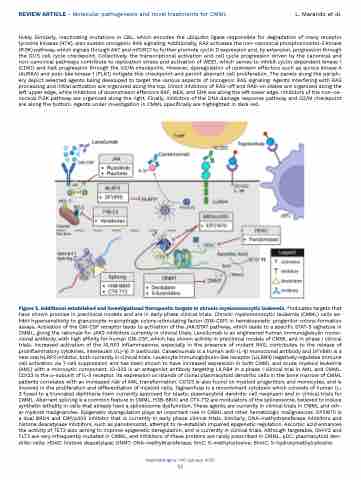
tively. Similarly, inactivating mutations in CBL, which encodes the ubiquitin ligase responsible for degradation of many receptor tyrosine kinases (RTK), also sustain oncogenic RAS signaling. Additionally, RAS activates the non-canonical phosphoinositol-3 kinase (PI3K) pathway, which signals through AKT and mTORC1 to further promote cyclin D expression and, by extension, progression through the G1/S cell cycle checkpoint. Collectively, the transcriptional activation and cell cycle progression driven by the canonical and non-canonical pathways contribute to replication stress and activation of WEE1, which serves to inhibit cyclin dependent kinase 1 (CDK1) and halt progression through the G2/M checkpoint. However, dysregulation of upstream effectors such as aurora kinase A (AURKA) and polo-like kinase 1 (PLK1) mitigate this checkpoint and permit aberrant cell proliferation. The panels along the periph- ery depict selected agents being developed to target the various aspects of oncogenic RAS signaling. Agents interfering with RAS processing and initial activation are organized along the top. Direct inhibitors of RAS-off and RAS-on states are organized along the left upper edge, while inhibitors of downstream effectors RAF, MEK, and ERK are along the left lower edge. Inhibitors of the non-ca- nonical PI3K pathway are organized along the right. Finally, inhibitors of the DNA damage response pathway and G2/M checkpoint are along the bottom. Agents under investigation in CMML specifically are highlighted in dark red.
Figure 5. Additional established and investigational therapeutic targets in chronic myelomonocytic leukemia. *Indicates targets that have shown promise in preclinical models and are in early phase clinical trials. Chronic myelomonocytic leukemia (CMML) cells ex- hibit hypersensitivity to granulocyte-macrophage colony-stimulating factor (GM-CSF) in hematopoietic progenitor colony-formation assays. Activation of the GM-CSF receptor leads to activation of the JAK/STAT pathway, which leads to a specific STAT-5 signature in CMML, giving the rationale for JAK2 inhibitors currently in clinical trials. Lenzilumab is an engineered human immunoglobulin mono- clonal antibody, with high affinity for human GM-CSF, which has shown activity in preclinical models of CMML and in phase I clinical trials. Increased activation of the NLRP3 inflammasome, especially in the presence of mutant RAS, contributes to the release of proinflammatory cytokines, interleukin (IL)-1β in particular. Canakinumab is a human anti-IL-1β monoclonal antibody and DFV890 is a new oral NLRP3 inhibitor, both currently in clinical trials. Leukocyte immunoglobulin-like receptor (LILRB4) negatively regulates immune cell activation via T-cell suppression and has been shown to have increased expression in both CMML and acute myeloid leukemia (AML) with a monocytic component. IO-202 is an antagonist antibody targeting LILRB4 in a phase I clinical trial in AML and CMML. CD123 is the a-subunit of IL-3 receptor. Its expression on islands of clonal plasmacytoid dendritic cells in the bone marrow of CMML patients correlates with an increased risk of AML transformation. CD123 is also found on myeloid progenitors and monocytes, and is involved in the proliferation and differentiation of myeloid cells. Tagraxofusp is a recombinant cytotoxin which consists of human IL- 3 fused to a truncated diphtheria toxin currently approved for blastic plasmacytoid dendritic cell neoplasm and in clinical trials for CMML. Aberrant splicing is a common feature in CMML. H3B-8800 and CTX-712 are modulators of the spliceosome, believed to induce synthetic lethality in cells that already have a spliceosome dysfunction. These agents are currently in clinical trials in CMML and oth- er myeloid malignancies. Epigenetic dysregulation plays an important role in CMML and other hematologic malignancies. EP31670 is a dual BRD4 and CBP/p300 inhibitor that is currently in early phase clinical trials. Similarly, DNA-methyltransferase inhibitors and histone deacetylase inhibitors, such as panobinostat, attempt to re-establish impaired epigenetic regulation. Ascorbic acid enhances the activity of TET2 also aiming to improve epigenetic deregulation, and is currently in clinical trials. Although targetable, IDH1/2 and FLT3 are very infrequently mutated in CMML, and inhibitors of these proteins are rarely prescribed in CMML. pDC: plasmacytoid den- dritic cells; HDAC: histone deacetylase; DNMT: DNA-methyltransferase; 5mC: 5-methylcytosine; 5hmC: 5-hydroxymethylcytosine.
Haematologica | 110 January 2025
 31


