


Page 38 - Haematologica Vol. 110 - January 2025
P. 38
REVIEW ARTICLE - Molecular pathogenesis and novel treatments for CMML L. Marando et al.
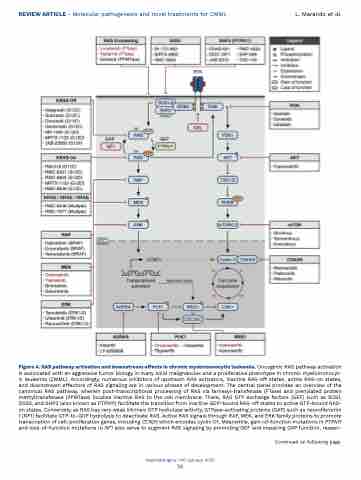
 Figure 4. RAS pathway activation and downstream effects in chronic myelomonocytic leukemia. Oncogenic RAS pathway activation is associated with an aggressive tumor biology in many solid malignancies and a proliferative phenotype in chronic myelomonocyt- ic leukemia (CMML). Accordingly, numerous inhibitors of upstream RAS activators, inactive RAS-off states, active RAS-on states, and downstream effectors of RAS signaling are in various phases of development. The central panel provides an overview of the canonical RAS pathway, wherein post-transcriptional processing of RAS via farnesyl-transferase (FTase) and prenylated protein methyltransferase (PPMTase) localize inactive RAS to the cell membrane. There, RAS GTP exchange factors (GEF) such as SOS1, SOS2, and SHP2 (also known as PTPN11) facilitate the transition from inactive GDP-bound RAS-off states to active GTP-bound RAS- on states. Conversely, as RAS has very weak intrinsic GTP hydrolase activity, GTPase-activating proteins (GAP) such as neurofibromin 1 (NF1) facilitate GTP-to-GDP hydrolysis to deactivate RAS. Active RAS signals through RAF, MEK, and ERK family proteins to promote transcription of cell-proliferation genes, including CCND1 which encodes cyclin D1. Meanwhile, gain-of-function mutations in PTPN11 and loss-of-function mutations in NF1 also serve to augment RAS signaling by promoting GEF and impairing GAP function, respec-
Haematologica | 110 January 2025
30
Continued on following page.


