


Page 269 - Haematologica Vol. 110 - January 2025
P. 269
COMMENT AB
CD
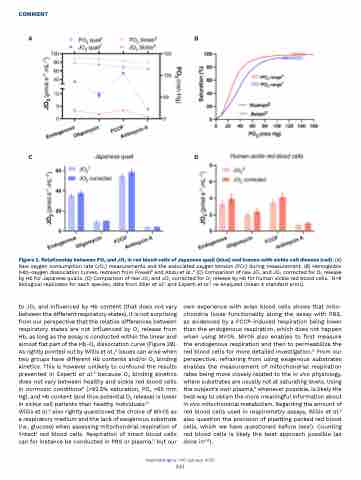
Figure 2. Relationship between PO2 and JO2 in red blood cells of Japanese quail (blue) and human with sickle cell disease (red). (A) Raw oxygen consumption rate (JO2) measurements and the associated oxygen tension (PO2) during measurement. (B) Hemoglobin (Hb)-oxygen dissociation curves, redrawn from Powell9 and Abdu et al..8 (C) Comparison of raw JO2 and JO2 corrected for O2 release by Hb for Japanese quails. (D) Comparison of raw JO2 and JO2 corrected for O2 release by Hb for human sickle red blood cells. N=8 biological replicates for each species, data from Stier et al.7 and Esperti et al.5 re-analyzed (mean ± standard error).
 to JO2 and influenced by Hb content (that does not vary between the different respiratory states), it is not surprising from our perspective that the relative differences between respiratory states are not influenced by O2 release from Hb, as long as the assay is conducted within the linear and almost flat part of the Hb-O2 dissociation curve (Figure 2B). As rightly pointed out by Willis et al.,6 issues can arise when two groups have different Hb contents and/or O2 binding kinetics. This is however unlikely to confound the results presented in Esperti et al.5 because O2 binding kinetics does not vary between healthy and sickle red blood cells in normoxic conditions8 (>92.5% saturation, PO2 >65 mm Hg), and Hb content (and thus potential O2 release) is lower in sickle cell patients than healthy individuals.10
Willis et al.6 also rightly questioned the choice of Mir05 as a respiratory medium and the lack of exogenous substrate (i.e., glucose) when assessing mitochondrial respiration of ‘intact’ red blood cells. Respiration of intact blood cells can for instance be conducted in PBS or plasma,11 but our
own experience with avian blood cells shows that mito- chondria loose functionality along the assay with PBS, as evidenced by a FCCP-induced respiration being lower than the endogenous respiration, which does not happen when using Mir05. Mir05 also enables to first measure the endogenous respiration and then to permeabilize the red blood cells for more detailed investigation.12 From our perspective, refraining from using exogenous substrates enables the measurement of mitochondrial respiration rates being more closely related to the in vivo physiology, where substrates are usually not at saturating levels. Using the subject’s own plasma,11 whenever possible, is likely the best way to obtain the more meaningful information about in vivo mitochondrial metabolism. Regarding the amount of red blood cells used in respirometry assays, Willis et al.6 also question the precision of pipetting packed red blood cells, which we have questioned before (see1). Counting red blood cells is likely the best approach possible (as done in4,12).
Haematologica | 110 January 2025
261


