


Page 268 - Haematologica Vol. 110 - January 2025
P. 268
COMMENT
Oxygen release from hemoglobin has limited effects on mitochondrial respiration measured from red blood cells. Reply to the Comment on “Increased retention of functional mitochondria in mature sickle red blood cells is associated with increased sickling tendency, hemolysis and oxidative stress”
The measurement of mitochondrial aerobic metabolism from blood cells has gained in popularity over the past decade due to its low invasiveness.1,2 In non-mammalian vertebrates, red blood cells are nucleated and possess functional mitochondria,3 which enables the assessment of mitochondrial respiration from small blood samples (as low as 20 μL of whole blood4). Recently, we have shown that human mature sickle red blood cells retain some functional mitochondria, which was associated with increased sick- ling tendency, hemolysis and oxidative stress.5 Willis et al.6 recently questioned the methodology used to demonstrate the functionality of the mitochondria retained in sickle red blood cells, since hemoglobin (Hb)-O2 dissociation could influence the oxygen consumption rate (JO2) measured with high-resolution respirometry.
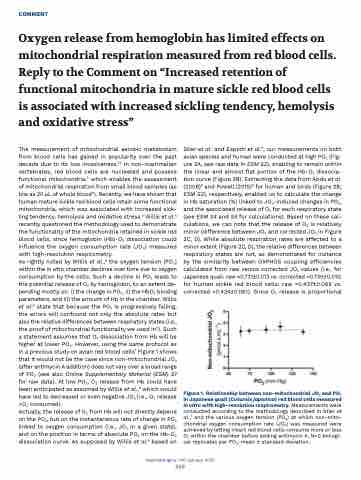
As rightly noted by Willis et al.,6 the oxygen tension (PO2) within the in vitro chamber declines over time due to oxygen consumption by the cells. Such a decline in PO2 leads to the potential release of O2 by hemoglobin, to an extent de- pending mostly on: i) the change in PO2, ii) the HbO2 binding parameters, and iii) the amount of Hb in the chamber. Willis et al.6 state that because the PO2 is progressively falling, the errors will confound not only the absolute rates but also the relative differences between respiratory states (i.e., the proof of mitochondrial functionality we used in5). Such a statement assumes that O2 dissociation from Hb will be higher at lower PO2. However, using the same protocol as in a previous study on avian red blood cells7 Figure 1 shows that it would not be the case since non-mitochondrial JO2 (after antimycin A addition) does not vary over a broad range of PO2 (see also Online Supplementary Material (ESM) S1 for raw data). At low PO2, O2 release from Hb could have been anticipated as assumed by Willis et al.,6 which would have led to decreased or even negative JO (i.e., O release >O consumed). 2 2
Stier et al.1 and Esperti et al.5, our measurements on both avian species and human were conducted at high PO2 (Fig- ure 2A, see raw data in ESM S2), enabling to remain within the linear and almost flat portion of the Hb-O2 dissocia- tion curve (Figure 2B). Extracting the data from Abdu et al. (2008)8 and Powell (2015)9 for human and birds (Figure 2B; ESM S3), respectively, enabled us to calculate the change in Hb saturation (%) linked to JO2-induced changes in PO2, and the associated release of O2 for each respiratory state (see ESM S4 and S5 for calculations). Based on these cal- culations, we can note that the release of O2 is relatively minor (difference between JO2 and corrected JO2 in Figure 2C, D). While absolute respiration rates are affected to a minor extent (Figure 2C, D), the relative differences between respiratory states are not, as demonstrated for instance by the similarity between OXPHOS coupling efficiencies calculated from raw versus corrected JO2 values (i.e., for Japanese quail: raw =0.731±0.013 vs. corrected =0.730±0.013; for human sickle red blood cells: raw =0.437±0.065 vs. corrected =0.424±0.061). Since O2 release is proportional
Figure 1. Relationship between non-mitochondrial JO2 and PO2 in Japanese quail (Coturnix japonica) red blood cells measured in vitro with high-resolution respirometry. Measurements were conducted according to the methodology described in Stier et al.,7 and the various oxygen tension (PO2) at which non-mito- chondrial oxygen consumption rate (JO2) was measured were achieved by letting intact red blood cells consume more or less O2 within the chamber before adding antimycin A. N=2 biologi- cal replicates per PO2; mean ± standard deviation.
 2
Actually, the release of O2 from Hb will not directly depend on the PO2, but on the instantaneous rate of change in PO2 linked to oxygen consumption (i.e., JO in a given state),
2
and on the position in terms of absolute PO2 on the Hb-O2
dissociation curve. As supposed by Willis et al.6 based on
Haematologica | 110 January 2025
260


