


Page 245 - Haematologica Vol. 110 - January 2025
P. 245
LETTER TO THE EDITOR
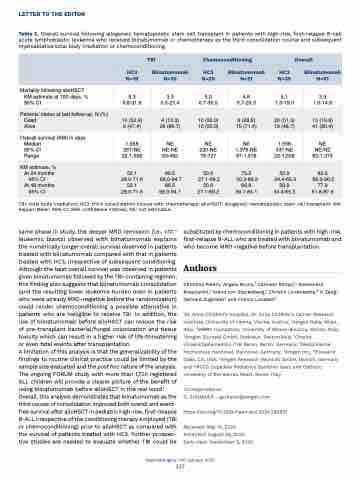
Table 2. Overall survival following allogeneic hematopoietic stem cell transplant in patients with high-risk, first-relapse B-cell acute lymphoblastic leukemia who received blinatumomab or chemotherapy as the third consolidation course and subsequent myeloablative total body irradiation or chemoconditioning.
  TBI
 Chemoconditioning
 Overall
 HC3 N=19
  Blinatumomab N=30
  HC3 N=20
  Blinatumomab N=21
  HC3 N=39
  Blinatumomab N=51
  Mortality following alloHSCT KM estimate at 100 days, % 95% CI
 5.3 0.8-31.9
 3.3 0.5-21.4
 5.0 0.7-30.5
 4.8 0.7-29.3
 5.1 1.3-19.0
 3.9 1.0-14.8
 Patients’ status at last follow-up, N (%) Dead
Alive
 10 (52.6) 9 (47.4)
 4 (13.3) 26 (86.7)
 10 (50.0) 10 (50.0)
 6 (28.6) 15 (71.4)
 20 (51.3) 19 (48.7)
 10 (19.6) 41 (80.4)
  Overall survival (KM) in days Median
95% CI
Range
   1,558 267-NE 22-1,558
 NE NE-NE 63-492
   NE 220-NE 78-727
 NE 1,379-NE 67-1,379
   1,558 431-NE 22-1,558
  NE NE-NE 63-1,379
  KM estimate, % At 24 months
95% CI
At 48 months
95% CI
   52.1 28.0-71.6 52.1 28.0-71.6
 86.5 68.0-94.7 86.5
68.0-94.7
   50.0 27.1-69.2 50.0
27.1-69.2
 75.2 50.3-88.9 66.8
39.1-84.1
   50.9 34.4-65.3 50.9
34.4-65.3
  82.0 68.3-90.2 77.9
61.8-87.9
    TBI: total body irradiation; HC3: third consolidation course with chemotherapy; alloHSCT: allogeneic hematopoietic stem cell transplant; KM: Kaplan-Meier; 95% CI: 95% confidence interval; NE: not estimable.
same phase III study, the deeper MRD remission (i.e., <10-4 leukemic blasts) observed with blinatumomab explains the numerically longer overall survival observed in patients treated with blinatumomab compared with that in patients treated with HC3, irrespective of subsequent conditioning. Although the best overall survival was observed in patients given blinatumomab followed by the TBI-containing regimen, this finding also suggests that blinatumomab consolidation (and the resulting lower leukemia burden even in patients who were already MRD-negative before the randomization) could render chemoconditioning a possible alternative in patients who are ineligible to receive TBI. In addition, the use of blinatumomab before alloHSCT can reduce the risk of pre-transplant bacterial/fungal colonization and tissue toxicity which can result in a higher risk of life-threatening or even fatal events after transplantation.
A limitation of this analysis is that the generalizability of the findings to routine clinical practice could be limited by the sample size evaluated and the post hoc nature of the analysis. The ongoing FORUM study with more than 1,700 registered ALL children will provide a clearer picture of the benefit of using blinatumomab before alloHSCT in the real word.1 Overall, this analysis demonstrates that blinatumomab as the third course of consolidation improved both overall and event- free survival after alloHSCT in pediatric high-risk, first-relapse B-ALL irrespective of the conditioning therapy employed (TBI or chemoconditioning) prior to alloHSCT as compared with the survival of patients treated with HC3. Further prospec- tive studies are needed to evaluate whether TBI could be
substituted by chemoconditioning in patients with high-risk, first-relapse B-ALL who are treated with blinatumomab and who become MRD-negative before transplantation.
Authors
Christina Peters,1 Angela Bruno,2 Carmelo Rizzari,3 Alessandra Brescianini,4 Arend von Stackelberg,5 Christin Linderkamp,6 Yi Zeng,7 Gerhard Zugmaier8 and Franco Locatelli9
1St. Anna Children’s Hospital, St. Anna Children’s Cancer Research Institute, University of Vienna, Vienna, Austria; 2Amgen Italia, Milan, Italy; 3MBBM Foundation, University of Milano-Bicocca, Monza, Italy; 4Amgen (Europe) GmbH, Rotkreuz, Switzerland; 5Charité Universitaetsmedizin CVK Berlin, Berlin, Germany; 6Medizinische Hochschule Hannover, Hannover, Germany; 7Amgen Inc., Thousand Oaks, CA, USA; 8Amgen Research (Munich) GmbH, Munich, Germany and 9IRCCS Ospedale Pediatrico Bambino Gesù and Catholic University of the Sacred Heart, Rome, Italy
Correspondence:
G. ZUGMAIER - gerhardz@amgen.com
https://doi.org/10.3324/haematol.2024.285837
Received: May 14, 2024. Accepted: August 26, 2024. Early view: September 5, 2024.
 Haematologica | 110 January 2025
237


