


Page 243 - Haematologica Vol. 110 - January 2025
P. 243
LETTER TO THE EDITOR
otrexate were commonly administered for graft-versus-host disease prophylaxis at the investigators’ discretion. The in- cidence of transplant-emergent adverse events in patients treated with blinatumomab was comparable with that of patients treated with HC3.5 One patient each in the HC3 and blinatumomab groups experienced graft failure.
The Kaplan-Meier analysis of both overall and event-free survival showed that survival in patients treated with blina- tumomab, regardless of subsequent treatment with TBI or chemoconditioning, was better than the survival of patients treated with HC3 followed by TBI or chemoconditioning (Fig- ure 1A, B). Twenty-four of 39 (62%) patients given HC3 and 15 of 51 (29%) blinatumomab-treated patients relapsed after transplantation. Treatment after relapse was heterogenous and included chemotherapy, inotuzumab and chimeric an- tigen receptor-modified T cells and allowed the rescue of a proportion of patients. In detail, eight of the 24 HC3-treated patients (33%) who relapsed are alive, as are ten of the 15 (66%) allocated to the blinatumomab arm. The Kaplan-Meier estimates for event-free survival at 36 and 48 months after transplantation (35.5%, 95% CI: 20.9-50.4% in both cases) indicated a higher probability of an event with HC3 than with blinatumomab (63.8%, 95% CI: 48.8-75.4% at 36 months and 60.2%, 95% CI: 44.4-72.8% at 48 months) irrespective of subsequent conditioning. Among patients treated with blina-
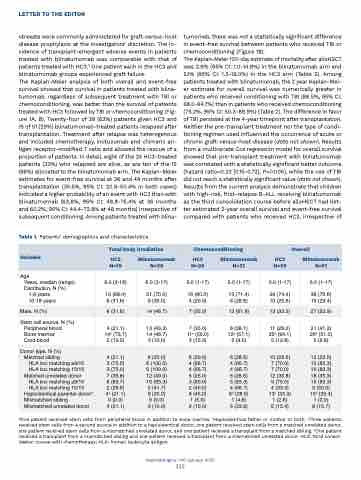
Table 1. Patients’ demographics and characteristics.
tumomab, there was not a statistically significant difference in event-free survival between patients who received TBI or chemoconditioning (Figure 1B).
The Kaplan-Meier 100-day estimate of mortality after alloHSCT was 3.9% (95% CI: 1.0-14.8%) in the blinatumomab arm and 5.1% (95% CI: 1.3-19.0%) in the HC3 arm (Table 2). Among patients treated with blinatumomab, the 2 year Kaplan-Mei- er estimate for overall survival was numerically greater in patients who received conditioning with TBI (86.5%, 95% CI: 68.0-94.7%) than in patients who received chemoconditioning (75.2%, 95% CI: 50.3-88.9%) (Table 2). The difference in favor of TBI persisted at the 4-year timepoint after transplantation. Neither the pre-transplant treatment nor the type of condi- tioning regimen used influenced the occurrence of acute or chronic graft-versus-host disease (data not shown). Results from a multivariate Cox regression model for overall survival showed that pre-transplant treatment with blinatumomab was correlated with a statistically significant better outcome (hazard ratio=0.33 [0.15-0.72]; P=0.005), while the use of TBI did not reach a statistically significant value (data not shown). Results from the current analysis demonstrate that children with high-risk, first-relapse B-ALL receiving blinatumomab as the third consolidation course before alloHSCT had bet- ter estimated 2-year overall survival and event-free survival compared with patients who received HC3, irrespective of
 Variable
  Total body irradiation
 Chemoconditioning
 Overall
 HC3 N=19
  Blinatumomab N=30
  HC3 N=20
  Blinatumomab N=21
  HC3 N=39
  Blinatumomab N=51
  Age
Years, median (range) Distribution, N (%)
1-9 years 10-18 years
  6.0 (3-16)
13 (68.4) 6 (31.6)
6.0 (3-17)
21 (70.0) 9 (30.0)
  5.0 (1-17)
16 (80.0) 4 (20.0)
 5.0 (1-17)
15 (71.4) 6 (28.6)
5.0 (1-17)
29 (74.4) 10 (25.6)
  6.0 (1-17)
36 (70.6) 15 (29.4)
 Male, N (%)
  6 (31.6)
  14 (46.7)
  7 (35.0)
  13 (61.9)
  13 (33.3)
  27 (52.9)
  Stem cell source, N (%) Peripheral blood Bone marrow
Cord blood
   4 (21.1) 14a (73.7) 2 (10.5)
 13 (43.3) 14 (46.7) 3 (10.0)
   7 (35.0) 11a (55.0) 3 (15.0)
  8 (38.1) 12a (57.1) 2 (9.5)
 11 (28.2) 25a (64.1) 5 (12.8)
   21 (41.2) 26a (51.0) 5 (9.8)
  Donor type, N (%) Matched sibling
HLA loci matching ≥9/10
HLA loci matching 10/10 Matched unrelated donor
HLA loci matching ≥9/10
HLA loci matching 10/10 Haploidentical parental donorb Mismatched sibling Mismatched unrelated donor
   4 (21.1) 3 (75.0) 3 (75.0) 7 (36.8) 6 (85.7) 2 (28.6) 4c (21.1) 0 (0.0)
4 (21.1)
 6 (20.0) 6 (100.0) 6 (100.0) 12 (40.0) 10 (83.3) 5 (41.7) 9 (30.0) 0 (0.0) 3 (10.0)
   6 (30.0) 4 (66.7) 4 (66.7) 5 (25.0) 3 (60.0) 2 (40.0) 9 (45.0) 1 (5.0) 2 (10.0)
  6 (28.6) 4 (66.7) 4 (66.7) 6 (28.6) 5 (83.3) 4 (66.7) 6d (28.6) 1 (4.8)
5 (23.8)
 10 (25.6) 7 (70.0) 7 (70.0) 12 (30.8) 9 (75.0) 4 (33.3) 13c (33.3) 1 (2.6)
6 (15.4)
   12 (23.5) 10 (83.3) 10 (83.3) 18 (35.3) 15 (83.3) 9 (50.0) 15d (29.4) 1 (2.0)
8 (15.7)
    aOne patient received stem cells from peripheral blood in addition to bone marrow. bHaploidentical father or mother or both. cThree patients received stem cells from a second source in addition to a haploidentical donor, one patient received stem cells from a matched unrelated donor, one patient received stem cells from a mismatched unrelated donor, and one patient received a transplant from a matched sibling. dOne patient received a transplant from a mismatched sibling and one patient received a transplant from a mismatched unrelated donor. HC3: third consol- idation course with chemotherapy; HLA: human leukocyte antigen.
Haematologica | 110 January 2025
235


