


Page 227 - Haematologica Vol. 110 - January 2025
P. 227
LETTER TO THE EDITOR
CD19 CAR T (axi-cel: N=2; tisa-cel: N=7). One patient expe- rienced grade 3 CRS and 2 patients had ≥ grade 3 ICANS. Recently, Choquet et al.12 reported retrospective findings on a French cohort of 25 patients with R/R PCNSL who were infused with CD19 CAR T (axi-cel: N=9; tisa-cel: N=16). With a median follow-up of 20.8 months after CAR T infusion, 14 patients (56%) achieved CR at three months, while 16 pa- tients (64%) obtained CR as best response. One-year PFS and OS from CAR T infusion was 46% (95% CI: 29-72%) and 55% (95% CI: 37-82%), respectively. Higher CR rates after CAR T were observed in patients in CR or PR versus stable or progressive disease at the time of cell infusion, and in patients receiving axi-cel.
Our analysis represents one of the largest cohorts with the longest follow-up of patients with R/R PCNSL following receipt of commercial CAR T-cell therapy. We show that CAR T cell has activity in PCNSL, as demonstrated by an ORR of 61% and 48% CR rate by day 100 in a heavily treated patient cohort. Despite the responses observed, a minority
of patients experienced a durable remission (2-year PFS: 28%). Several factors may influence this modest PFS, in- cluding having active disease at the time of cell infusion, immune evasion by the tumor through expression of PD-L1,14 or the intrinsic aggressive biology of the disease.1,2 Another explanation for poor PFS may be short persistence of CAR T cells in the CNS. These findings suggest that developing maintenance / consolidation treatment strategies (e.g., use of Bruton tyrosine kinase inhibitors, checkpoint inhibitors) in patients receiving a response after CAR T should be ex- plored in well-designed clinical trials.
While our results appear better than those published in sec- ondary CNS lymphoma following CAR T-cell therapy where the 1-year PFS and OS were 16% (95% CI: 8-30%) and 41% (95% CI: 30-57%), respectively,15 the efficacy of CAR T in our series seems to be lower compared to the pivotal CAR T trials in systemic lymphoma.5
Although the number of patients was small, we did not ob- serve an increase in CAR T-related toxicity in our patients
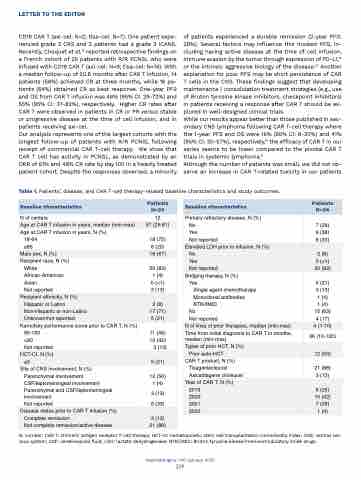
Table 1. Patients’, disease, and CAR T-cell therapy-related baseline characteristics and study outcomes.
  Baseline characteristics
Patients N=24
N of centers 12
 Age at CAR T infusion in years, median (min-max) 57 (25-81)
 Age at CAR T infusion in years, N (%)
 18-64 18 (75)
≥65 6 (25)
 Male sex, N (%) 16 (67)
Recipient race, N (%)
 White 20 (83)
African-American 1 (4)
Asian 0 (<1)
Not reported 3 (13)
 Recipient ethnicity, N (%)
Hispanic or Latino 2 (8)
Non-Hispanic or non-Latino 17 (71)
Unknown/not reported 5 (21)
 Karnofsky performance score prior to CAR T, N (%)
90-100 11 (46)
<90 10 (42)
Not reported 3 (13)
 HCT-CI, N (%)
≥3 5 (21)
 Site of CNS involvement, N (%)
Parenchymal involvement 12 (50)
CSF/leptomeningeal involvement 1 (4)
Parenchymal and CSF/leptomeningeal involvement
3 (13)
Not reported 8 (33)
 Disease status prior to CAR T infusion (%)
Complete remission 3 (13)
Not complete remission/active disease 21 (88)
   Baseline characteristics
Patients N=24
Primary refractory disease, N (%)
  No 7 (29)
Yes 9 (38)
Not reported 8 (33)
 Elevated LDH prior to infusion, N (%)
No 2 (8)
Yes 0 (<1)
Not reported 22 (92)
 Bridging therapy, N (%)
Yes 5 (21)
Single agent chemotherapy 3 (13)
Monoclonal antibodies 1 (4)
BTKi/IMID 1 (4)
No 15 (63)
Not reported 4 (17)
 N of lines of prior therapies, median (min-max) 4 (1-10)
 Time from initial diagnosis to CAR T in months, median (min-max)
36 (10-120)
Types of prior HCT, N (%)
 Prior auto-HCT 12 (50)
 CAR T product, N (%)
Tisagenlecleucel 21 (88)
Axicabtagene ciloleucel 3 (13)
 Year of CAR T, N (%)
2019 6 (25)
2020 10 (42)
2021 7 (29)
2022 1 (4)
     N: number; CAR T: chimeric antigen receptor T-cell therapy; HCT-CI: hematopoietic stem cell transplantation-comorbidity index; CNS: central ner- vous system; CSF: cerebrospinal fluid; LDH: lactate dehydrogenase; BTKi/IMID: Bruton tyrosine kinase/immunomodulatory imide drugs.
Haematologica | 110 January 2025
219


