


Page 217 - Haematologica Vol. 110 - January 2025
P. 217
LETTER TO THE EDITOR BC
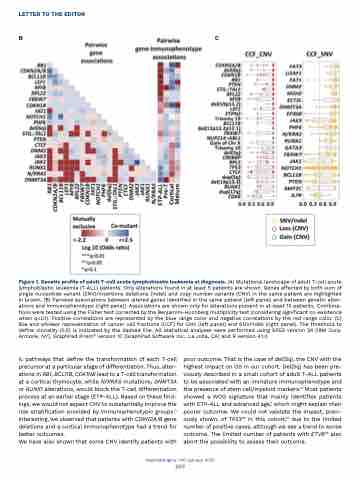
 Figure 1. Genetic profile of adult T-cell acute lymphoblastic leukemia at diagnosis. (A) Mutational landscape of adult T-cell acute lymphoblastic leukemia (T-ALL) patients. Only alterations found in at least 5 patients are shown. Genes affected by both sum of single nucleotide variant (SNV)/insertions deletions (indel) and copy number variants (CNV) in the same patient are highlighted in brown. (B) Pairwise associations between altered genes identified in the same patient (left panel) and between genetic alter- ations and immunophenotype (right panel). Associations are shown only for alterations present in at least 10 patients. Combina- tions were tested using the Fisher test corrected by the Benjamini-Hochberg multiplicity test (considering significant co-existence when q<0.1). Positive correlations are represented by the blue range color and negative correlations by the red range color. (C) Box and whisker representation of cancer cell fractions (CCF) for CNV (left panel) and SNV/indel (right panel). The threshold to define clonality (0.5) is indicated by the dashed line. All statistical analyses were performed using SPSS version 24 (IBM Corp. Armonk, NY), GraphPad Prism® version 10 (GraphPad Software Inc., La Jolla, CA) and R version 4.1.0.
ic pathways that define the transformation of each T-cell precursor at a particular stage of differentiation. Thus, alter- ations in RB1, BCL11B, CDK1NB lead to a T-cell transformation at a cortical thymocyte, while N/KRAS mutations, DNMT3A or RUNX1 alterations, would block the T-cell differentiation process at an earlier stage (ETP-ALL). Based on these find- ings, we would not expect CNV to substantially improve the risk stratification provided by immunophenotypic groups.11 Interesting, we observed that patients with CDKN2A/B gene deletions and a cortical immunophenotype had a trend for better outcomes.
We have also shown that some CNV identify patients with
poor outcome. That is the case of del(5q), the CNV with the highest impact on OS in our cohort. Del(5q) has been pre- viously described in a small cohort of adult T-ALL patients to be associated with an immature immunophenotype and the presence of stem cell/myeloid markers.12 Most patients showed a WOG signature that mainly identifies patients with ETP-ALL and advanced age,1 which might explain their poorer outcome. We could not validate the impact, previ- ously shown, of TP53alt in this cohort,13 due to the limited number of positive cases, although we see a trend to worse outcome. The limited number of patients with ETV6alt also abort the possibility to assess their outcome.
Haematologica | 110 January 2025
209


