


Page 173 - Haematologica Vol. 110 - January 2025
P. 173
ARTICLE - Multiple myeloma and the risk of infections
C.H. Blimark et al.
total number (N) and proportion (%). Patients were strati- fied into three calendar periods: 2008-2012, 2013-2017 and 2018- 2021, reflecting time periods with different treatment strategies, and both patients and controls were stratified by age. The absolute risk of infections was calculated and a multi-state Cox proportional hazard model with infec- tion as a time-dependent co-variate was used to estimate the overall, 1-and 5-year risk of infections, and the risk of infection before the MM diagnosis compared to controls. In addition, the effect of sex, age and calendar period of diagnosis, autologous stem cell transplantation (ASCT) and comorbidity, represented by the Charlson Comorbidity Score, were evaluated. All models were adjusted for sex, age and year of diagnosis. Hazard ratios (HR) with 95% confidence intervals (CI) were calculated. Cumulative incidence was estimated with the Kaplan Meier method. Using the Cause of Death Register, we estimated the proportion of patients and controls that died from infection. Furthermore, the proportion of individuals in the study that died within 90 days of a confirmed infection was calculated and defined as all-cause mortality. In order to evaluate the risk of infec- tion-related death, competing risk was calculated. In these analyses the censoring events were emigration or the end of follow-up. The competing events were defined as death from infection and death from other causes. In a sensitivity analysis, the accuracy of the Patient Register was evaluated using the Prescription Drug Register, and every antibiotic/ antiviral/antifungal prescription before the diagnosis of MM was counted as a separate infection. The same method was applied for infections after MM diagnosis, but excluding anti- biotics/antivirals/antifungals commonly used as prophylaxis.
Results
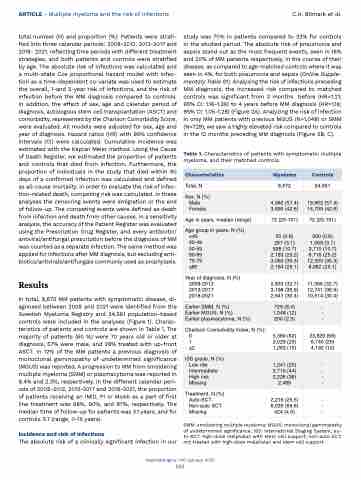
In total, 8,672 MM patients with symptomatic disease, di- agnosed between 2008 and 2021 were identified from the Swedish Myeloma Registry and 34,561 population-based controls were included in the analyses (Figure 1). Charac- teristics of patients and controls are shown in Table 1. The majority of patients (60 %) were 70 years old or older at diagnosis, 57% were male, and 26% treated with up-front ASCT. In 12% of the MM patients a previous diagnosis of monoclonal gammopathy of undetermined significance (MGUS) was reported. A progression to MM from smoldering multiple myeloma (SMM) or plasmacytoma was reported in 8.4% and 2.3%, respectively. In the different calendar peri- ods of 2008-2012, 2013-2017 and 2018-2021, the proportion of patients receiving an IMiD, PI or MoAb as a part of first line treatment was 68%, 90%, and 97%, respectively. The median time of follow-up for patients was 3.1 years, and for controls 5.7 (range, 0-15 years).
Incidence and risk of infections
The absolute risk of a clinically significant infection in our
study was 70% in patients compared to 32% for controls in the studied period. The absolute risk of pneumonia and sepsis stand out as the most frequent events, seen in 18% and 20% of MM patients respectively, in the course of their disease, as compared to age-matched controls where it was seen in 4%, for both pneumonia and sepsis (Online Supple- mentary Table S1). Analyzing the risk of infections preceding MM diagnosis, the increased risk compared to matched controls was significant from 3 months before (HR=1.21; 95% CI: 1.16-1.26) to 4 years before MM diagnosis (HR=1.16; 95% CI: 1.05-1.28) (Figure 2A). Analyzing the risk of infection in only MM patients with previous MGUS (N=1,048) or SMM (N=729), we saw a highly elevated risk compared to controls in the 12 months preceding MM diagnosis (Figure 2B, C).
Table 1. Characteristics of patients with symptomatic multiple myeloma, and their matched controls.
 Characteristics
 Myeloma
 Controls
 Total, N
  8,672
  34,561
 Sex, N (%) Male
Female
4,982 (57.4) 3,690 (42.6)
19,852 (57.4) 14,709 (42.6)
 Age in years, median (range)
  72 (20-101)
  72 (20-101)
  Age group in years, N (%) <40
40-49 50-59 60-69 70-79 ≥80
  50 (0.6) 267 (3.1) 928 (10.7) 2,183 (25.2) 3,060 (35.3) 2,184 (25.1)
 200 (0.6) 1,068 (3.1) 3,710 (10.7) 8,716 (25.2) 12,205 (35.3) 8,662 (25.1)
 Year of diagnosis, N (%) 2008-2012
2013-2017
2018-2021
 2,833 (32.7) 3,198 (36.9) 2,641 (30.4)
  11,306 (32.7) 12,741 (36.9) 10,514 (30.4)
 Earlier SMM, N (%)
Earlier MGUS, N (%)
Earlier plasmacytoma, N (%)
  729 (8.4) 1,048 (12) 200 (2.3)
  -
  Charlson Comorbidity Index, N (%) 01≥2
   5,380 (62) 2,029 (23) 1,263 (15)
  23,629 (68) 6,740 (20) 4,192 (12)
  ISS grade, N (%) Low risk Intermediate High risk Missing
  1,241 (20) 2,716 (44) 2,226 (36) 2,489
 -
 Treatment, N (%) Auto-SCT Non-auto SCT Missing
  2,216 (25.5) 6,035 (69.6) 424 (4.9)
   -
   Haematologica | 110 January 2025
165
SMM: smoldering multiple myeloma; MGUS: monoclonal gammopathy of undetermined significance; ISS: International Staging System; au- to-SCT: high-dose melphalan with stem cell support; non-auto SCT: not treated with high-dose melphalan and stem cell support.


