


Page 16 - Haematologica Vol. 110 - January 2025
P. 16
PROS AND CONS EDITORIAL
Y. Ofran and J.M. Rowe
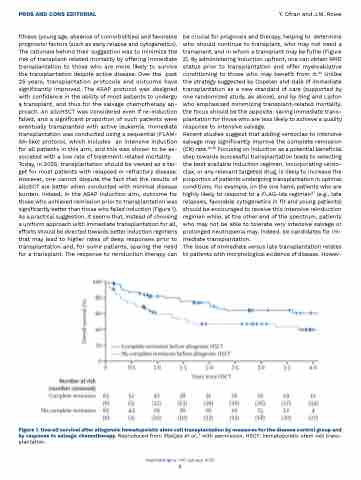
fitness (young age, absence of comorbidities) and favorable prognostic factors (such as early relapse and cytogenetics). The rationale behind their suggestion was to minimize the risk of transplant-related mortality by offering immediate transplantation to those who are more likely to survive the transplantation despite active disease. Over the past 25 years, transplantation protocols and outcome have significantly improved. The ASAP protocol was designed with confidence in the ability of most patients to undergo a transplant, and thus for the salvage chemotherapy ap- proach. An alloHSCT was considered even if re-induction failed, and a significant proportion of such patients were eventually transplanted with active leukemia. Immediate transplantation was conducted using a sequential (FLAM- SA-like) protocol, which includes an intensive induction for all patients in this arm, and this was shown to be as- sociated with a low rate of treatment-related mortality. Today, in 2025, transplantation should be viewed as a tar- get for most patients with relapsed or refractory disease. However, one cannot dispute the fact that the results of alloSCT are better when conducted with minimal disease burden. Indeed, in the ASAP induction arm, outcome for those who achieved remission prior to transplantation was significantly better than those who failed induction (Figure 1). As a practical suggestion, it seems that, instead of choosing a uniform approach with immediate transplantation for all, efforts should be directed towards better induction regimens that may lead to higher rates of deep responses prior to transplantation and, for some patients, sparing the need for a transplant. The response to reinduction therapy can
be crucial for prognosis and therapy, helping to determine who should continue to transplant, who may not need a transplant, and in whom a transplant may be futile (Figure 2). By administering induction upfront, one can obtain MRD status prior to transplantation and offer myeloablative conditioning to those who may benefit from it.24 Unlike the strategy suggested by Copelan and Gale of immediate transplantation as a new standard of care (supported by one randomized study, as above), and by Sing and Lipton who emphasized minimizing transplant-related mortality, the focus should be the opposite: saving immediate trans- plantation for those who are less likely to achieve a quality response to intensive salvage.
Recent studies suggest that adding ventoclax to intensive salvage may significantly improve the complete remission (CR) rate.25,26 Focusing on induction as a potential beneficial step towards successful transplantation leads to selecting the best available induction regimen. Incorporating vento- clax, or any relevant targeted drug, is likely to increase the proportion of patients undergoing transplantation in optimal conditions. For example, on the one hand, patients who are highly likely to respond to a FLAG-Ida regimen27 (e.g., late relapses, favorable cytogenetics in fit and young patients) should be encouraged to receive this intensive reinduction regimen while, at the other end of the spectrum, patients who may not be able to tolerate very intensive salvage or prolonged neutropenia may, indeed, be candidates for im- mediate transplantation.
The issue of immediate versus late transplantation relates to patients with morphological evidence of disease. Howev-
 Figure 1. Overall survival after allogeneic hematopoietic stem cell transplantation by measures for the disease control group and by response to salvage chemotherapy. Reproduced from Stelljes et al.,3 with permission. HSCT: hematopoietic stem cell trans- plantation.
Haematologica | 110 January 2025
8


