


Page 115 - Haematologica Vol. 110 - January 2025
P. 115
ARTICLE - LIPA modulates venetoclax/TKI response in bpCML M. Minhajuddin et al. A
BCD
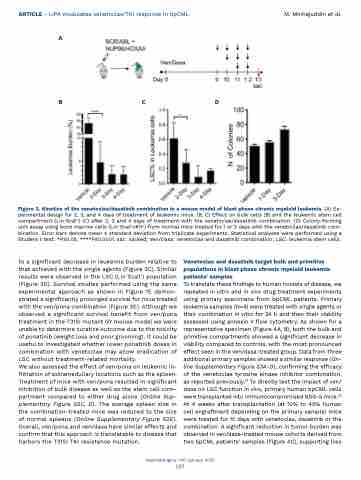
Figure 2. Kinetics of the venetoclax/dasatinib combination in a mouse model of blast phase chronic myeloid leukemia. (A) Ex- perimental design for 2, 3, and 4 days of treatment of leukemic mice. (B, C) Effect on bulk cells (B) and the leukemic stem cell compartment (Lin–Sca1+) (C) after 2, 3 and 4 days of treatment with the venetoclax/dasatinib combination. (D) Colony-forming unit assay using bone marrow cells (Lin–Sca1+cKit+) from normal mice treated for 1 or 3 days with the venetoclax/dasatinib com- bination. Error bars denote mean ± standard deviation from triplicate experiments. Statistical analyses were performed using a Student t test. *P≤0.05, ****P≤0.0001. sac: sacked; Ven/Dasa: venetoclax and dasatinib combination; LSC: leukemia stem cells.
 to a significant decrease in leukemia burden relative to that achieved with the single agents (Figure 3C). Similar results were observed in the LSC (Lin–Sca1+) population (Figure 3D). Survival studies performed using the same experimental approach as shown in Figure 1E demon- strated a significantly prolonged survival for mice treated with the ven/pona combination (Figure 3E). Although we observed a significant survival benefit from ven/pona treatment in the T315I mutant GY mouse model we were unable to determine curative outcome due to the toxicity of ponatinib (weight loss and poor grooming). It could be useful to investigated whether lower ponatinib doses in combination with venetoclax may allow eradication of LSC without treatment-related mortality.
We also assessed the effect of ven/pona on leukemic in- filtration of extramedullary locations such as the spleen. Treatment of mice with ven/pona resulted in significant inhibition of bulk disease as well as the stem cell com- partment compared to either drug alone (Online Sup- plementary Figure S2C, D). The average spleen size in the combination-treated mice was reduced to the size of normal spleens (Online Supplementary Figure S2E). Overall, ven/pona and ven/dasa have similar effects and confirm that this approach is translatable to disease that harbors the T315I TKI resistance mutation.
Venetoclax and dasatinib target bulk and primitive populations in blast phase chronic myeloid leukemia patients’ samples
To translate these findings to human models of disease, we repeated in vitro and in vivo drug treatment experiments using primary specimens from bpCML patients. Primary leukemia samples (N=4) were treated with single agents or their combination in vitro for 24 h and then their viability assessed using annexin V flow cytometry. As shown for a representative specimen (Figure 4A, B), both the bulk and primitive compartments showed a significant decrease in viability compared to controls, with the most pronounced effect seen in the ven/dasa-treated group. Data from three additional primary samples showed a similar response (On- line Supplementary Figure S3A-D), confirming the efficacy of the venetoclax tyrosine kinase inhibitor combination, as reported previously.21 To directly test the impact of ven/ dasa on LSC function in vivo, primary human bpCML cells were transplanted into immunocompromised NSG-S mice.35 At 4 weeks after transplantation (at 10% to 45% human cell engraftment depending on the primary sample) mice were treated for 10 days with venetoclax, dasatinib or the combination. A significant reduction in tumor burden was observed in ven/dasa-treated mouse cohorts derived from two bpCML patients’ samples (Figure 4C), supporting loss
Haematologica | 110 January 2025
107


