


Page 310 - Haematologica Vol. 109 - July 2024
P. 310
LETTER TO THE EDITOR
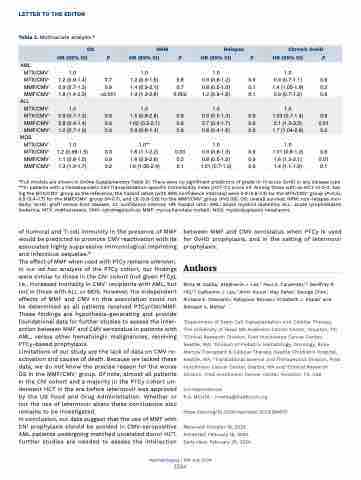
Table 2. Multivariate analysis.*
  OS
 NRM
 Relapse
 Chronic GvHD
 HR (95% CI)
P
  HR (95% CI)
P
  HR (95% CI)
P
  HR (95% CI)
P
 AML
         MTX/CMV–
1.0
1.0
1.0
1.0
MTX/CMV+
1.2 (0.9-1.4)
0.7
1.2 (0.9-1.6)
0.8
0.9 (0.8-1.2)
0.9
0.9 (0.7-1.1)
0.9
MMF/CMV–
0.9 (0.7-1.3)
0.9
1.4 (0.9-2.1)
0.7
0.8 (0.5-1.0)
0.1
1.4 (1.05-1.8)
0.2
MMF/CMV+
 1.8 (1.4-2.3)
 <0.001
 1.9 (1.3-2.6)
 0.002
 1.2 (0.9-1.6)
 0.1
 0.9 (0.7-1.2)
 0.9
 ALL
MTX/CMV–
1.0
1.0
1.0
1.0
MTX/CMV+
0.9 (0.7-1.3)
0.9
1.5 (0.8-2.8)
0.9
0.9 (0.5-1.3)
0.9
1.03 (0.7-1.4)
0.9
MMF/CMV–
0.8 (0.4-1.4)
0.9
1.02 (0.5-2.1)
0.9
0.7 (0.3-1.7)
0.9
2.1 (1.3-3.3)
0.01
MMF/CMV+
 1.2 (0.7-1.9)
 0.9
 0.9 (0.6-1.4)
 0.9
 0.8 (0.4-1.6)
 0.9
 1.7 (1.04-2.8)
 0.2
 MDS
MTX/CMV–
1.0
1.0**
1.0
1.0
MTX/CMV+
1.2 (0.99-1.5)
0.3
1.6 (1.1-2.2)
0.03
0.9 (0.8-1.3)
0.9
1.01 (0.8-1.2)
0.9
MMF/CMV–
1.1 (0.8-1.5)
0.9
1.6 (0.9-2.6)
0.2
0.8 (0.5-1.2)
0.9
1.6 (1.2-2.1)
0.01
MMF/CMV+
 1.3 (1.0-1.7)
 0.2
 1.6 (1.05-2.4)
 0.1
 1.01 (0.7-1.5)
 0.9
 1.4 (1.1-1.9)
 0.1
     *Full models are shown in Online Supplementary Table S1. There were no significant predictors of grade III-IV acute GvHD in any disease type. **In patients with a Hematopoietic Cell Transplantation-specific Comorbidity Index (HCT-CI) score ≥3. Among those with an HCT-CI 0-2, tak- ing the MTX/CMV– group as the reference, the hazard ratios (with 95% confidence intervals) were 0.9 (0.6-1.3) for the MTX/CMV+ group (P=0.5), 0.9 (0.4-1.7) for the MMF/CMV– group (P=0.7), and 1.6 (0.9-2.6) for the MMF/CMV+ group (P=0.09). OS: overall survival; NRM: non-relapse mor- tality; GvHD: graft-versus-host disease; CI: confidence interval; HR: hazard ratio; AML: acute myeloid leukemia; ALL: acute lymphoblastic leukemia; MTX: methotrexate; CMV: cytomegalovirus; MMF: mycophenolate mofetil; MDS: myelodysplastic neoplasms.
of humoral and T-cell immunity in the presence of MMF would be predicted to promote CMV reactivation with its associated highly suppressive immunological imprinting and infectious sequelae.15
The effect of MMF when used with PTCy remains unknown. In our ad hoc analysis of the PTCy cohort, our findings were similar to those in the CNI cohort (not given PTCy), i.e., increased mortality in CMV+ recipients with AML, but not in those with ALL or MDS. However, the independent effects of MMF and CMV on this association could not be determined as all patients received PTCy/CNI/MMF. These findings are hypothesis-generating and provide foundational data for further studies to assess the inter- action between MMF and CMV serostatus in patients with AML, versus other hematologic malignancies, receiving PTCy-based prophylaxis.
Limitations of our study are the lack of data on CMV re- activation and causes of death. Because we lacked these data, we do not know the precise reason for the worse OS in the MMF/CMV+ group. Of note, almost all patients in the CNI cohort and a majority in the PTCy cohort un- derwent HCT in the era before letermovir was approved by the US Food and Drug Administration. Whether or not the use of letermovir alters these conclusions also remains to be investigated.
In conclusion, our data suggest that the use of MMF with CNI prophylaxis should be avoided in CMV-seropositive AML patients undergoing matched unrelated donor HCT. Further studies are needed to assess the interaction
between MMF and CMV serostatus when PTCy is used for GvHD prophylaxis, and in the setting of letermovir prophylaxis.
Authors
Rima M. Saliba,1 Stephanie J. Lee,2 Paul A. Carpenter,2,3 Geoffrey R. Hill,4,5 Catherine J. Lee,2 Amin Alousi,1 May Daher,1 George Chen,1 Richard E. Champlin,1 Katayoun Rezvani,1 Elizabeth J. Shpall1 and Rohtesh S. Mehta2
1Department of Stem Cell Transplantation and Cellular Therapy, The University of Texas MD Anderson Cancer Center, Houston, TX; 2Clinical Research Division, Fred Hutchinson Cancer Center, Seattle, WA; 3Division of Pediatric Hematology, Oncology, Bone Marrow Transplant & Cellular Therapy, Seattle Children’s Hospital, Seattle, WA; 4Translational Science and Therapeutics Division, Fred Hutchinson Cancer Center, Seattle, WA and 5Clinical Research Division, Fred Hutchinson Cancer Center, Houston, TX, USA
Correspondence:
R.S. MEHTA - rmehta@fredhutch.org
https://doi.org/10.3324/haematol.2023.284501
Received: October 19, 2023. Accepted: February 16, 2024. Early view: February 29, 2024.
 Haematologica | 109 July 2024
2324


