


Page 31 - Haematologica Vol. 109 - July 2024
P. 31
SPOTLIGHT REVIEW ARTICLE - Coagulation factors and endothelial functionality C. Olgasi et al. Table 2. Summary of endothelial cell functions regulated by selected anti-coagulation factors.
 Anti-CF
  Study
In vitro or in vivo models
  Regulated function
 Identified receptor
Antithrombin
 Panicker et al.40
 EA.hy926 and HDMEC
 Apoptosis
 HSPG
 Zhang et al.41
 HUVEC
 Angiogenesis
 -
 O’Reilly et al.42
  EC (unspecified)
  Angiogenesis
  -
  Thrombomodulin
Hsu et al.43
HUVEC
EC adhesion, migration and angiogenesis
-
Shi et al.44
  HUVEC
  Angiogenesis
  -
  Kuo et al.45
 HUVEC
 Angiogenesis
 Lewis Y Ag
 Giri et al.46
TM-deficient EA.hy926
Quiescence
-
 Activated protein C
 Minhas et al.47
 HUVEC and mice
 Permeability
 Tie2
 Soh et al.48
 EA.hy926
 Permeability
 PAR1
 Molinar-Inglis et al.49
  EA.hy926
  Apoptosis
  PAR1
  Lin et al.6
 EA.hy926
 Permeability
 PAR1
     Anti-CF: anti-coagulation factor; EA.hy926: human umbilical vein cell line; EC: endothelial cells; HDMEC: human dermal microvascular EC; HU- VEC: human umbilical vein EC; HSPG: heparan sulfate proteoglycans; Lewis Y Ag: Lewis-Y carbohydrate antigen; TM: thrombomodulin; Tie2: angiopoietin 1 receptor; PAR: protease-activated receptor.
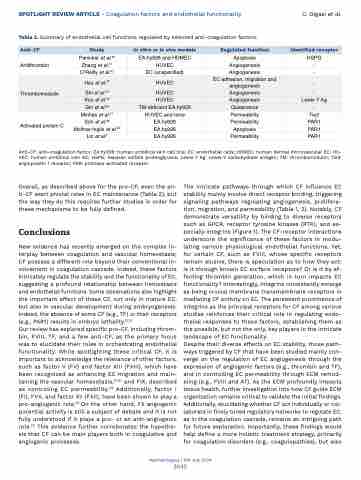
Overall, as described above for the pro-CF, even the an- ti-CF exert pivotal roles in EC maintenance (Table 2), but the way they do this requires further studies in order for these mechanisms to be fully defined.
Conclusions
New evidence has recently emerged on the complex in- terplay between coagulation and vascular homeostasis; CF possess a different role beyond their conventional in- volvement in coagulation cascade. Indeed, these factors intricately regulate the stability and the functionality of EC, suggesting a profound relationship between hemostasis and endothelial functions. Some observations also highlight the important effect of these CF, not only in mature EC, but also in vascular development during embryogenesis. Indeed, the absence of some CF (e.g., TF) or their receptors (e.g., PAR1) results in embryo lethality.12,37
Our review has explored specific pro-CF, including throm- bin, FVIII, TF, and a few anti-CF, as the primary focus was to elucidate their roles in orchestrating endothelial functionality. While spotlighting these critical CF, it is important to acknowledge the relevance of other factors, such as factor V (FV) and factor XIII (FXIII), which have been recognized as enhancing EC migration and main- taining the vascular homeostasis,50,51 and FIX, described as controling EC permeability.52 Additionally, factor I (FI), FVII, and factor XII (FXII), have been shown to play a pro-angiogenic role.53 On the other hand, FX angiogenic potential activity is still a subject of debate and it is not fully understood if it plays a pro- or an anti-angiogenic role.53 This evidence further corroborates the hypothe- sis that CF can be main players both in coagulative and angiogenic processes.
The intricate pathways through which CF influence EC stability mainly involve direct receptor binding, triggering signaling pathways regulating angiogenesis, prolifera- tion, migration, and permeability (Table 1, 2). Notably, CF demonstrate versatility by binding to diverse receptors such as GPCR, receptor tyrosine kinases (RTK), and es- pecially integrins (Figure 1). The CF-receptor interactions underscore the significance of these factors in modu- lating various physiological endothelial functions. Yet, for certain CF, such as FVIII, whose specific receptors remain elusive, there is speculation as to how they act: is it through known EC surface receptors? Or is it by af- fecting thrombin generation, which in turn impacts EC functionality? Interestingly, integrins consistently emerge as being crucial membrane transmembrane receptors in mediating CF activity on EC. The persistent prominence of integrins as the principal receptors for CF among various studies reinforces their critical role in regulating endo- thelial responses to these factors, establishing them as the possible, but not the only, key players in the intricate landscape of EC functionality.
Despite their diverse effects on EC stability, those path- ways triggered by CF that have been studied mainly con- verge on the regulation of EC angiogenesis through the expression of angiogenic factors (e.g., thrombin and TF), and in controlling EC permeability through ECM remod- eling (e.g., FVIII and AT). As the ECM profoundly impacts tissue health, further investigation into how CF guide ECM organization remains critical to validate the initial findings. Additionally, elucidating whether CF act individually or col- laborate in finely tuned regulatory networks to regulate EC, as in the coagulation cascade, remains an intriguing path for future exploration. Importantly, these findings would help define a more holistic treatment strategy, primarily for coagulation disorders (e.g., coagulopathies), but also
Haematologica | 109 July 2024
2045


