


Page 29 - Haematologica Vol. 109 - July 2024
P. 29
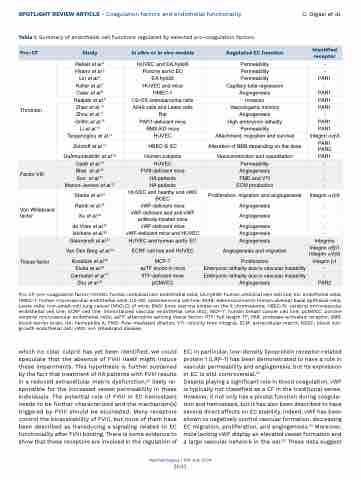
SPOTLIGHT REVIEW ARTICLE - Coagulation factors and endothelial functionality C. Olgasi et al. Table 1. Summary of endothelial cell functions regulated by selected pro-coagulation factors.
 Pro-CF
   Study In vitro or in vivo models Regulated EC function
Identified receptor
Thrombin
Rabiet et al.4 HUVEC and EA.hy926 Permeability -
  Hirano et al.5 Porcine aortic EC Permeability -
  Lin et al.6 EA.hy926 Permeability PAR1
  Koller et al.7 HUVEC and mice Capillary tube regression -
  Catar et al.8 HMEC-1 Angiogenesis PAR1
Radjabi et al.9 U2-OS osteosarcoma cells Invasion PAR1
  Zhao et al.10 A549 cells and Lewis cells Vasculogenic mimicry PAR1
  Zhou et al.11 Rat Angiogenesis -
  Griffin et al.12 PAR1-deficient mice High embryonic lethality PAR1
Li et al.13 BMX-KO mice Permeability PAR1
  Tsopanoglou et al.14 HUVEC Attachment, migration and survival Integrin αvb3
  Zolotoff et al.15 HBEC-5i EC Alteration of BBB depending on the dose
PAR1 PAR3
Guðmundsdóttir et al.16 Human subjects Vasoconstriction and vasodilation PAR1
   Factor VIII
 Cadé et al.19 HUVEC Permeability -
Bhat et al.20 FVIII-deficient mice Angiogenesis -
  Sun et al.21 HA patients FMD and VTI -
Manon-Jensen et al.22 HA patients ECM production -
  Von Willebrand factor
 Starke et al.24 HUVEC and healthy and vWD Proliferation, migration and angiogenesis Integrin αvb3 BOEC
Randi et al.25 vWF-deficient mice Angiogenesis -
  Xu et al.26 vWF-deficient and anti-vWF Angiogenesis - antibody-treated mice
de Vries et al.27 vWF-deficient mice Angiogenesis -
  Ishihara et al.28 vWF-deficient mice and HUVEC Angiogenesis -
  Tissue factor
 Giannarelli et al.33 HUVEC and human aortic EC Angiogenesis Integrins
  Van Den Berg et al.34 ECRF cell line and HUVEC Angiogenesis and migration
Integrin α6b1 Integrin αVb3
Kocatürk et al.35 MCF-7 Proliferation Integrin b1
  Sluka et al.36 asTF knock-in mice Embryonic lethality due to vascular instability -
Carmeliet et al.37 flTF-deficient mice Embryonic lethality due to vascular instability -
  Zhu et al.38 pCMVEC Angiogenesis PAR2
        Pro-CF: pro-coagulation factor; HUVEC: human umbilical vein endothelial cells; EA.hy926: human umbilical vein cell line; EC: endothelial cells; HMEC-1: human microvascular endothelial cells; U2-OS: osteosarcoma cell line; A549: adenocarcinomic human alveolar basal epithelial cells; Lewis cells: non-small-cell lung cancer (NSCLC) of mice; BMX: bone marrow kinase on the X chromosome; HBEC-5i: cerebral microvascular endothelial cell line; ECRF cell line: immortalized vascular endothelial cells (EC); MCF-7: human breast cancer cell line; pCMVEC: porcine cerebral microvascular endothelial cells; asTF: alternative splicing tissue factor; flTF: full length TF; PAR: protease-activated receptor; BBB: blood barrier brain; HA: hemophilia A; FMD: flow-mediated dilation; VTI: velocity time integral; ECM: extracellular matrix; BOEC: blood out- growth endothelial cell; vWD: von Willebrand disease.
which no clear culprit has yet been identified; we could speculate that the absence of FVIII itself might induce these impairments. This hypothesis is further sustained by the fact that treatment of HA patients with FVIII results in a reduced extracellular matrix dysfunction,22 likely re- sponsible for the increased vessel permeability in these individuals. The potential role of FVIII in EC hemostasis needs to be further characterized and the mechanism(s) triggered by FVIII should be elucidated. Many receptors control the bioavailability of FVIII, but none of them have been described as transducing a signaling related to EC functionality after FVIII binding. There is some evidence to show that these receptors are involved in the regulation of
EC; in particular, low-density lipoprotein receptor-related protein 1 (LRP-1) has been demonstrated to have a role in vascular permeability and angiogenesis, but its expression in EC is still controversial.23
Despite playing a significant role in blood coagulation, vWF is typically not classified as a CF in the traditional sense. However, it not only has a pivotal function during coagula- tion and hemostasis, but it has also been described to have several direct effects on EC stability. Indeed, vWF has been shown to negatively control vascular formation, decreasing EC migration, proliferation, and angiogenesis.24 Moreover, mice lacking vWF display an elevated vessel formation and a large vascular network in the ear.25 These data suggest
Haematologica | 109 July 2024
2043


