


Page 259 - Haematologica Vol. 109 - July 2024
P. 259
LETTER TO THE EDITOR
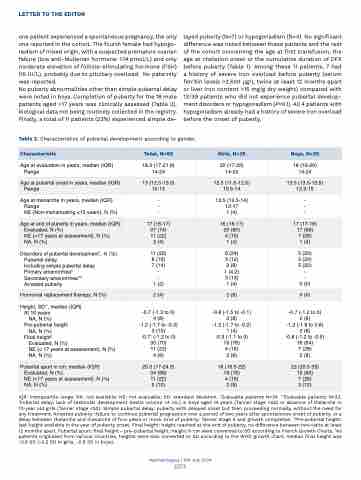
one patient experienced a spontaneous pregnancy, the only one reported in the cohort. The fourth female had hypogo- nadism of mixed origin, with a suspected premature ovarian failure (low anti-Mullerian hormone: 1.14 pmol/L) and only moderate elevation of follicle-stimulating hormone (FSH) (15 UI/L), probably due to pituitary overload. No paternity was reported.
No puberty abnormalities other than simple pubertal delay were noted in boys. Completion of puberty for the 18 male patients aged >17 years was clinically assessed (Table 2), biological data not being routinely collected in the registry. Finally, a total of 11 patients (22%) experienced simple de-
layed puberty (N=7) or hypogonadism (N=4). No significant difference was noted between these patients and the rest of the cohort concerning the age at first transfusion, the age at chelation onset or the cumulative duration of DFX before puberty (Table 1). Among these 11 patients, 7 had a history of severe iron overload before puberty (serum ferritin levels >2,500 μg/L twice at least 12 months apart or liver iron content >15 mg/g dry weight) compared with 13/39 patients who did not experience pubertal develop- ment disorders or hypogonadism (P=0.1). All 4 patients with hypogonadism already had a history of severe iron overload before the onset of puberty.
Table 2. Characteristics of pubertal development according to gender.
 Characteristic
  Total, N=50
  Girls, N=25
  Boys, N=25
 Age at evaluation in years, median (IQR) Range
 18.5 (17-21.8) 14-24
 20 (17-22) 14-24
 18 (16-20) 14-24
 Age at pubertal onset in years, median (IQR) Range
 13 (12.5-13.5) 10-15
 12.5 (11.5-12.5) 10.5-14
 13.5 (13.5-13.5) 12.5-15
 Age at menarche in years, median (IQR) Range
NE (Non-menstruating <15 years), N (%)
 -
 13.5 (12.5-14) 12-17
1 (4)
 -
  Age at end of puberty in years, median (IQR) Evaluated, N (%)
NE (<17 years at assessment), N (%)
NA, N (%)
   17 (16-17) 37 (74) 11 (22) 2 (4)
  16 (16-17) 20 (80) 4 (16)
1 (4)
  17 (17-18) 17 (68) 7 (28)
1 (4)
  Disorders of pubertal development°, N (%) Pubertal delay
Including simple pubertal delay
Primary amenorrhea*
Secondary amenorrhea** Arrested puberty
  11 (22) 8 (16) 7 (14)
-
1 (2)
 6 (24) 3 (12) 2 (8) 1 (4.2) 3 (13) 1 (4)
 5 (20) 5 (20) 5 (20)
-
0 (0)
 Hormonal replacement therapy, N (%)
  2 (4)
  2 (8)
  0 (0)
  Height, SD°°, median (IQR) At 10 years
NA, N (%) Pre-pubertal height
NA, N (%) Final height†
Evaluated, N (%)
NE (< 17 years at assessment), N (%) NA, N (%)
  -0.7 (-1.3 to 0) 4 (8)
-1.2 (-1.7 to -0.3) 3 (10)
-0.7† (-1.2 to 0) 35 (70)
11 (22)
4 (8)
 -0.8 (-1.5 to -0.1) 2 (8)
-1.2 (-1.7 to -0.2) 1 (4)
-0.3 (-1.1 to 0) 19 (76)
4 (16)
2 (8)
 -0.7 (-1.2 to 0) 2 (8)
-1.2 (-1.8 to 0.8) 2 (8)
-0.8 (-1.2 to -0.5) 16 (64)
7 (28)
2 (8)
 Pubertal spurt in cm, median (IQR) Evaluated, N (%)
NE (<17 years at assessment), N (%) NA, N (%)
  20.5 (17-24.5) 34 (68)
11 (22)
5 (10)
   18 (16.5-22) 19 (76)
4 (16)
2 (8)
   22 (20.5-26) 15 (60)
7 (28)
3 (12)
   IQR: interquartile range; NA: not available; NE: not evaluable; SD: standard deviation. *Evaluable patients N=24. **Evaluable patients N=23. °Pubertal delay: lack of testicular development (testis volume <4 mL) in boys aged 14 years (Tanner stage <G2) or absence of thelarche in 13-year old girls (Tanner stage <S2). Simple pubertal delay: puberty with delayed onset but then proceeding normally, without the need for any treatment. Arrested puberty: failure to continue pubertal progression over a period of two years after spontaneous onset of puberty, or a delay between thelarche and menarche of four years or more. End of puberty: Tanner stage 5 and growth completed. °°Pre-pubertal height: last height available in the year of puberty onset. Final height: height reached at the end of puberty, no difference between two visits at least 12 months apart. Pubertal spurt: final height - pre-pubertal height. Height in cm were converted to SD according to French Growth Charts. †As patients originated from various countries, heights were also converted to SD according to the WHO growth chart; median final height was -0.6 SD (-0.2 SD in girls, -0.9 SD in boys).
Haematologica | 109 July 2024
2273


