


Page 239 - Haematologica Vol. 109 - July 2024
P. 239
ARTICLE - Prior cancers and risk of MGUS
S. Rögnvaldsson et al.
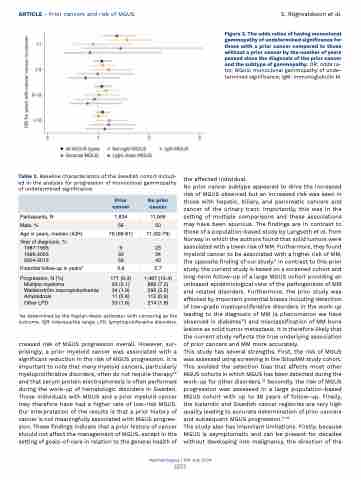
 Table 2. Baseline characteristics of the Swedish cohort includ- ed in the analysis for progression of monoclonal gammopathy of undetermined significance.
the affected individual.
No prior cancer subtype appeared to drive the increased risk of MGUS observed but an increased risk was seen in those with hepatic, biliary, and pancreatic cancers and cancer of the urinary tract. Importantly, this was in the setting of multiple comparisons and these associations may have been spurious. The findings are in contrast to those of a population-based study by Langseth et al. from Norway in which the authors found that solid tumors were associated with a lower risk of MM. Furthermore, they found myeloid cancer to be associated with a higher risk of MM, the opposite finding of our study.11 In contrast to this prior study, the current study is based on a screened cohort and long-term follow-up of a large MGUS cohort providing an unbiased epidemiological view of the pathogenesis of MM and related disorders. Furthermore, the prior study was affected by important potential biases including detection of low-grade myeloproliferative disorders in the work-up leading to the diagnosis of MM (a phenomenon we have observed in diabetes21) and misclassification of MM bone lesions as solid tumor metastasis. It is therefore likely that the current study reflects the true underlying association of prior cancers and MM more accurately.
This study has several strengths. First, the risk of MGUS was assessed using screening in the iStopMM study cohort. This avoided the selection bias that affects most other MGUS cohorts in which MGUS has been detected during the work-up for other disorders.22 Secondly, the risk of MGUS progression was assessed in a large population-based MGUS cohort with up to 36 years of follow-up. Finally, the Icelandic and Swedish cancer registries are very high quality leading to accurate determination of prior cancers and subsequent MGUS progression.17-19
The study also has important limitations. Firstly, because MGUS is asymptomatic and can be present for decades without developing into malignancy, the direction of the
Figure 2. The odds ratios of having monoclonal gammopathy of undetermined significance for those with a prior cancer compared to those without a prior cancer by the number of years passed since the diagnosis of the prior cancer and the subtype of gammopathy. OR: odds ra- tio; MGUS: monoclonal gammopathy of unde- termined significance; IgM: immunoglobulin M.
  Prior cancer
 No prior cancer
 Participants, N
  1,834
  11,956
 Male, %
56
50
 Age in years, median (IQR)
  76 (68-81)
  71 (62-79)
 Year of diagnosis, % 1987-1995 1996-2003 2004-2013
   9 33 59
 23 34 43
 Potential follow-up in years*
  3.6
  5.7
  Progression, N (%)
Multiple myeloma
Waldenström macroglobulinemia Amyloidosis
Other LPD
   171 (9.3) 93 (5.1) 34 (1.9) 11 (0.6) 33 (1.8)
  1,487 (12.4) 866 (7.2) 295 (2.5) 112 (0.9) 214 (1.8)
   *As determined by the Kaplan-Meier estimator with censoring as the outcome. IQR: interquartile range; LPD: lymphoproliferative disorders.
creased risk of MGUS progression overall. However, sur- prisingly, a prior myeloid cancer was associated with a significant reduction in the risk of MGUS progression. It is important to note that many myeloid cancers, particularly myeloproliferative disorders, often do not require therapy20 and that serum protein electrophoresis is often performed during the work-up of hematologic disorders in Sweden. Those individuals with MGUS and a prior myeloid cancer may therefore have had a higher rate of low-risk MGUS. Our interpretation of the results is that a prior history of cancer is not meaningfully associated with MGUS progres- sion. These findings indicate that a prior history of cancer should not affect the management of MGUS, except in the setting of goals-of-care in relation to the general health of
Haematologica | 109 July 2024
2253


