


Page 238 - Haematologica Vol. 109 - July 2024
P. 238
ARTICLE - Prior cancers and risk of MGUS S. Rögnvaldsson et al. Table 1. Baseline characteristics of the iStopMM cohort.
  Without MGUS
 With MGUS
 Subtype of MGUS
 Non-IgM
 IgM
 Biclonal
 Light chain
 Participants, N
 71,075
 3,579
 2,257
 704
 304
 314
 Male, %
 45
 54
 52
 55
 59
 60
 Age in years, median (IQR)
  61 (52-69)
  69 (62-77)
  69 (60-76)
  71 (64-79)
  73 (65-80)
  68 (59-76)
  Prior cancer,* N (%)
Solid cancer# Non-melanoma skin cancer# Myeloid cancer#
   9,176 (12.9) 6,837 (9.4) 2,854 (3.9) 119 (0.2)
  715 (20.0) 527 (13.9) 249 (6.5) 12 (0.3)
  437 (19.4) 324 (13.5) 152 (6.3) 7 (0.3)
 157 (22.3) 116 (15.2) 58 (7.6) 3 (0.4)
   69 (22.7) 49 (15.2) 24 (7.4) 2 (0.6)
  52 (16.6) 38 (11.7) 15 (4.6) 0 (0.0)
  Time from prior cancer, N (%) <1 year
1-5 years
5-10 years
>10 years
   919 (1.3) 2,266 (3.2) 2,287 (3.2) 3,704 (5.2)
  74 (2.1) 163 (4.6) 171 (4.8) 307 (8.6)
  53 (2.3) 101 (4.5) 112 (5.0) 171 (7.6)
 10 (1.4) 38 (5.4) 34 (4.8) 75 (10.7)
   7 (2.3) 14 (4.6) 14 (4.6) 34 (11.2)
  4 (1.3) 10 (3.2) 11 (3.5) 27 (8.6)
   Note that some participants had more than one prior cancer of different subtype. *Number of individuals with at least one prior cancer and as a ratio of all individuals in that group. #Number of prior cancer diagnoses of that subtype and as a ratio of all cancers. iStopMM: Iceland Screens, Treats, or Prevents Multiple Myeloma; MGUS: monoclonal gammopathy of undetermined significance; IQR: interquartile range.
 tically significant difference in progression risk overall for those with any subtype of solid or myeloid cancer, except in the case of myeloproliferative neoplasms for which those with a prior history had a lower risk of MGUS progression (Online Supplementary Table S3).
Discussion
In this study based on two high-quality large popula- tion-based cohorts including close to 100,000 individuals, we found that a prior cancer is associated with a 10% in- crease in the risk of having MGUS later in life. Prior cancer is therefore not a clinically significant risk factor for MGUS.
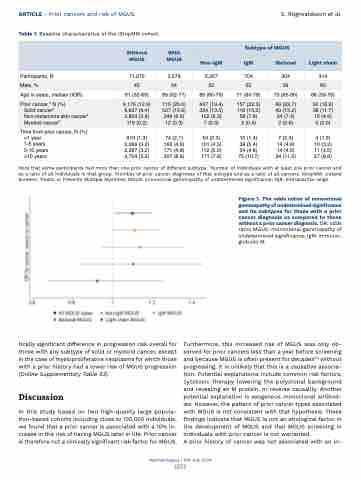
Furthermore, this increased risk of MGUS was only ob- served for prior cancers less than a year before screening and because MGUS is often present for decades2,3 without progressing, it is unlikely that this is a causative associa- tion. Potential explanations include common risk factors, cytotoxic therapy lowering the polyclonal background and revealing an M protein, or reverse causality. Another potential explanation is exogenous monoclonal antibod- ies. However, the pattern of prior cancer types associated with MGUS is not consistent with that hypothesis. These findings indicate that MGUS is not an etiological factor in the development of MGUS and that MGUS screening in individuals with prior cancer is not warranted.
A prior history of cancer was not associated with an in-
Haematologica | 109 July 2024
2252
Figure 1. The odds ratios of monoclonal gammopathy of undetermined significance and its subtypes for those with a prior cancer diagnosis as compared to those without a prior cancer diagnosis. OR: odds ratio; MGUS: monoclonal gammopathy of undetermined significance; IgM: immuno- globulin M.


