


Page 232 - Haematologica Vol. 109 - July 2024
P. 232
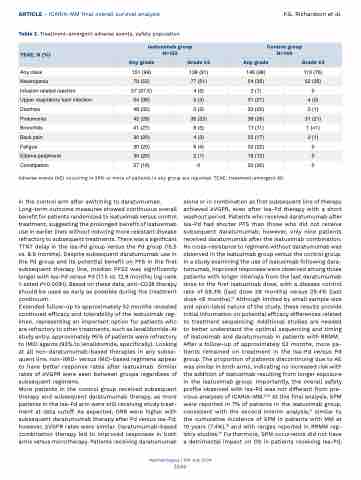
ARTICLE - ICARIA-MM final overall survival analysis P.G. Richardson et al. Table 2. Treatment-emergent adverse events, safety population.
 TEAE, N (%)
 Isatuximab group N=152
 Control group N=149
 Any grade
 Grade ≥3
 Any grade
 Grade ≥3
 Any class
  151 (99)
  138 (91)
  146 (98)
  113 (76)
 Neutropenia
79 (52)
77 (51)
54 (36)
52 (35)
 Infusion-related reaction
  57 (37.5)
  4 (3)
  2 (1)
  0
 Upper respiratory tract infection
54 (36)
5 (3)
31 (21)
4 (3)
 Diarrhea
  48 (32)
  3 (2)
  33 (22)
  2 (1)
 Pneumonia
42 (28)
35 (23)
38 (26)
31 (21)
 Bronchitis
  41 (27)
  8 (5)
  17 (11)
  1 (<1)
 Back pain
 30 (20)
 4 (3)
 25 (17)
 2 (1)
 Fatigue
30 (20)
6 (4)
32 (22)
0
 Edema peripheral
  30 (20)
  2 (1)
  18 (12)
  0
 Constipation
 27 (18)
 0
 30 (20)
 0
   Adverse events (AE) occurring in 20% or more of patients in any group are reported. TEAE: treatment-emergent AE.
in the control arm after switching to daratumumab. Long-term outcome measures showed continuous overall benefit for patients randomized to isatuximab versus control treatment, suggesting the prolonged benefit of isatuximab use in earlier lines without inducing more resistant disease refractory to subsequent treatments. There was a significant TTNT delay in the Isa-Pd group versus the Pd group (15.5 vs. 8.9 months). Despite subsequent daratumumab use in the Pd group and its potential benefit on PFS in the first subsequent therapy line, median PFS2 was significantly longer with Isa-Pd versus Pd (17.5 vs. 12.9 months; log-rank 1-sided P=0.0091). Based on these data, anti-CD38 therapy should be used as early as possible during the treatment continuum.
Extended follow-up to approximately 52 months revealed continued efficacy and tolerability of the isatuximab reg- imen, representing an important option for patients who are refractory to other treatments, such as lenalidomide. At study entry, approximately 95% of patients were refractory to IMiD agents (93% to lenalidomide, specifically). Looking at all non-daratumumab-based therapies in any subse- quent line, non-IMiD- versus IMiD-based regimens appear to have better response rates after isatuximab. Similar rates of ≥VGPR were seen between groups regardless of subsequent regimens.
More patients in the control group received subsequent therapy and subsequent daratumumab therapy, as more patients in the Isa-Pd arm were still receiving study treat- ment at data cutoff. As expected, ORR were higher with subsequent daratumumab therapy after Pd versus Isa-Pd; however, ≥VGPR rates were similar. Daratumumab-based combination therapy led to improved responses in both arms versus monotherapy. Patients receiving daratumumab
alone or in combination as first subsequent line of therapy achieved ≥VGPR, even after Isa-Pd therapy with a short washout period. Patients who received daratumumab after Isa-Pd had shorter PFS than those who did not receive subsequent daratumumab; however, only nine patients received daratumumab after the isatuximab combination. No cross-resistance to regimens without daratumumab was observed in the isatuximab group versus the control group. In a study examining the use of isatuximab following dara- tumumab, improved responses were observed among those patients with longer intervals from the last daratumumab dose to the first isatuximab dose, with a disease control rate of 58.3% (last dose ≥6 months) versus 26.4% (last dose <6 months).17 Although limited by small sample size and open-label nature of the study, these results provide initial information on potential efficacy differences related to treatment sequencing. Additional studies are needed to better understand the optimal sequencing and timing of isatuximab and daratumumab in patients with RRMM. After a follow-up of approximately 52 months, more pa- tients remained on treatment in the Isa-Pd versus Pd group. The proportion of patients discontinuing due to AE was similar in both arms, indicating no increased risk with the addition of isatuximab resulting from longer exposure in the isatuximab group. Importantly, the overall safety profile observed with Isa-Pd was not different from pre- vious analyses of ICARIA-MM.13,14 At this final analysis, SPM were reported in 7% of patients in the isatuximab group, consistent with the second interim analysis,14 similar to the cumulative incidence of SPM in patients with MM at 10 years (7.4%),18 and with ranges reported in RRMM reg- istry studies.19 Furthermore, SPM occurrence did not have a detrimental impact on OS in patients receiving Isa-Pd,
Haematologica | 109 July 2024
2246


