


Page 207 - Haematologica Vol. 109 - July 2024
P. 207
ARTICLE - S-DVd in RRMM patients
V. González-Calle et al.
Statistical analysis
The sample size was estimated based on the primary endpoint of the study. For part 1, the hypothesis was that we would be able to increase the ORR from 30% with da- ratumumab monotherapy14 and 45% with SVd in patients refractory to bortezomib15 to 70% with the quadruplet combination of SDVd. With 57 patients we would obtain statistical power of approximately 90% with a one-sided α error of 0.05. For part 2, the primary endpoint was CR rate. The CR rate reported with the SVd in patients with RRMM after one to three PL was 13%. Our hypothesis was that by adding daratumumab the CR rate could increase up to 35%. With 52 patients we would obtain a statistical power of approximately 90% to reject the null hypothesis, with a predefined α error of 0.05 (one-sided). Considering
a percentage of withdrawals of 10%, the final sample size would be 57 patients. The response rate was determined using an intent-to-treat (ITT) analysis. The statistical anal- ysis done is detailed in the Online Supplementary Appendix.
Results
Efficacy in part 1
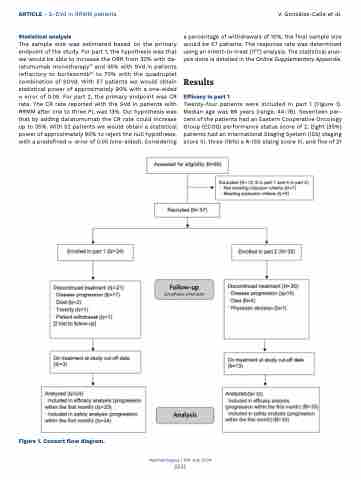
Twenty-four patients were included in part 1 (Figure 1). Median age was 66 years (range, 44-76). Seventeen per- cent of the patients had an Eastern Cooperative Oncology Group (ECOG) performance status score of 2. Eight (35%) patients had an International Staging System (ISS) staging score III, three (16%) a R-ISS staing score III, and five of 21
 Figure 1. Consort flow diagram.
Haematologica | 109 July 2024
2221


