


Page 95 - Haematologica Vol. 110 - January 2025
P. 95
ARTICLE - LP-118: a promising treatment for CLL J. Ravikrishnan et al.
***P≤0.001, ****P≤0.0001, mixed effect model. Comparisons between the 2 treatment groups with WT BCL2 are in blue and be- tween the 2 treatment groups with BCL2 G101V mutation are in gray. (Middle) RS4;11 cells were collected at 15 hr and stained with cytochrome C (Cyt C) and analyzed on a flow cytometer. Plots display mean ± SD, N=3 independent experiments. *P≤0.05, **P≤0.01, ***P≤0.001, ****P≤0.0001, mixed effect model. Comparisons between the 2 treatment groups with WT BCL2 are in blue and be- tween the two treatment groups with BCL2 G101V mutation are in gray. (Right) Cells were collected at 72 hr and stained with Annexin V-FITC/TMRM for flow cytometry. Plots display mean ± SD, N=3 independent experiments. **P≤0.01, ****P≤0.0001, mixed effect model. Overall trend analysis is indicated by black stars and individual comparisons are indicated for comparisons between the 2 treatment groups with WT BCL2 in blue, and between the two treatment groups with BCL2 G101V mutation in gray. (B) OSU- CLL WT and BCL2 knockout (KO) cell lines were treated with venetoclax, A-1331852, navitoclax, or LP-118 for 72 hr, followed by CellTiter-Glo viability assay. Plots display mean ± SD, N=3 independent experiments in triplicate. *P≤0.05, **P≤0.01, mixed effect model. (C) RS4;11 (N=2), LOUCY (N=3), CCRF-CEM (N=3), PF-382 (N=3), and MOLT4 (N=3) cell lines were treated with venetoclax, A-1331852, navitoclax, or LP-118 for 24 hr, followed by CellTiter-Glo viability assay. Plots display mean ± SD from the indicated numbers of independent experiments, in triplicate. ****P≤0.0001, mixed effect model.
survival of mice versus venetoclax (50 mg/kg P=0.0104, 100 mg/kg P= 0.0012, 150 mg/kg P=0.0005) (Figure 6D). Taken together, both studies show that, at the same doses, LP-118 is more potent than venetoclax in reducing tumor burden and prolonging survival of mouse models of leukemia harboring either WT or G101V BCL2.
Next, we evaluated whether LP-118 is potent in a CLL cell line xenograft. Immunodeficient NOG mice were engrafted with OSU-CLL cells via tail vein injection. Four days post engraftment, we initiated daily treatment with vehicle (N=8), LP-118 (50 mg/kg, N=12), or venetoclax (50 mg/kg, N=8). Splenic involvement with leukemia was confirmed by flow
 ABC
DE
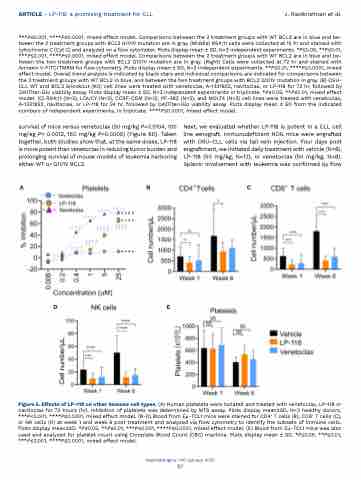
Figure 5. Effects of LP-118 on other immune cell types. (A) Human platelets were isolated and treated with venetoclax, LP-118 or navitoclax for 72 hours (hr). Inhibition of platelets was determined by MTS assay. Plots display mean±SD, N=3 healthy donors. ***P<0.001, ****P≤0.0001, mixed effect model. (B-D) Blood from Eμ-TCL1 mice were stained for CD4+ T cells (B), CD8+ T cells (C), or NK cells (D) at week 1 and week 6 post treatment and analyzed via flow cytometry to identify the subsets of immune cells. Plots display mean±SD. *P≤0.05, **P≤0.01, ***P≤0.001, ****P≤0.0001, mixed effect model. (E) Blood from Eμ-TCL1 mice was also used and analyzed for platelet count using Complete Blood Count (CBC) machine. Plots display mean ± SD. *P≤0.05, **P≤0.01, ***P≤0.001, ****P≤0.0001, mixed effect model.
Haematologica | 110 January 2025
87


