


Page 34 - Haematologica Vol. 110 - January 2025
P. 34
REVIEW ARTICLE - Molecular pathogenesis and novel treatments for CMML L. Marando et al.
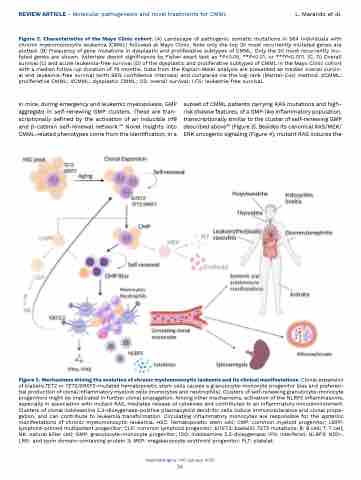
Figure 2. Characteristics of the Mayo Clinic cohort. (A) Landscape of pathogenic somatic mutations in 564 individuals with chronic myelomonocytic leukemia (CMML) followed at Mayo Clinic. Note only the top 20 most recurrently mutated genes are plotted. (B) Frequency of gene mutations in dysplastic and proliferative subtypes of CMML. Only the 20 most recurrently mu- tated genes are shown. Asterisks depict significance by Fisher exact test as *P<0.05, **P<0.01, or ***P<0.001. (C, D) Overall survival (C) and acute leukemia-free survival (D) of the dysplastic and proliferative subtypes of CMML in the Mayo Clinic cohort with a median follow-up duration of 79 months. Data from the Kaplan-Meier analysis are presented as median overall surviv- al and leukemia-free survival (with 95% confidence intervals) and compared via the log-rank (Mantel-Cox) method. pCMML: proliferative CMML; dCMML: dysplastic CMML; OS: overall survival; LFS: leukemia-free survival.
In mice, during emergency and leukemic myelopoiesis, GMP aggregate in self-renewing GMP clusters. These are tran- scriptionally defined by the activation of an inducible Irf8 and β-catenin self-renewal network.44 Novel insights into CMML-related phenotypes come from the identification, in a
subset of CMML patients carrying RAS mutations and high- risk disease features, of a GMP-like inflammatory population, transcriptionally similar to the cluster of self-renewing GMP described above45 (Figure 3). Besides its canonical RAS/MEK/ ERK oncogenic signaling (Figure 4), mutant RAS induces the
 Figure 3. Mechanisms driving the evolution of chronic myelomonocytic leukemia and its clinical manifestations. Clonal expansion of biallelicTET2 or TET2/SRSF2-mutated hematopoietic stem cells causes a granulocyte-monocyte progenitor bias and preferen- tial production of clonal inflammatory myeloid cells (monocytes and neutrophils). Clusters of self-renewing granulocyte-monocyte progenitors might be implicated in further clonal propagation. Among other mechanisms, activation of the NLRP3 inflammasome, especially in association with mutant RAS, mediates release of cytokines and contributes to an inflammatory microenvironment. Clusters of clonal indoleamine 2,3-dioxygenase-positive plasmacytoid dendritic cells induce immunotolerance and clonal propa- gation, and can contribute to leukemia transformation. Circulating inflammatory monocytes are responsible for the systemic manifestations of chronic myelomonocytic leukemia. HSC: hematopoietic stem cell; CMP: common myeloid progenitor; LMPP: lymphoid-primed multipotent progenitor; CLP: common lymphoid progenitor; biTET2: biallellic TET2 mutations; B: B cell; T: T cell; NK: natural killer cell; GMP: granulocyte-monocyte progenitor; IDO: indoleamine 2,3-dioxygenase; IFN: interferon; NLRP3: NOD-, LRR- and pyrin domain-containing protein 3; MEP: megakaryocyte-erythroid progenitor; PLT: platelet.
Haematologica | 110 January 2025
26


