


Page 260 - Haematologica Vol. 110 - January 2025
P. 260
LETTER TO THE EDITOR
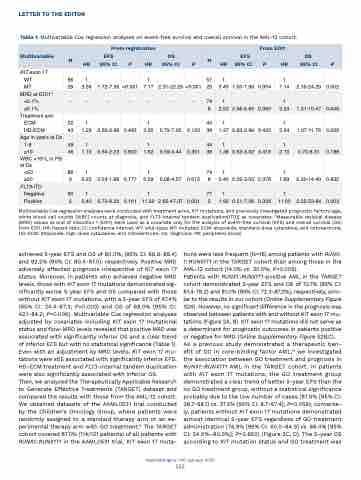
Table 1. Multivariable Cox regression analyses on event-free survival and overall survival in the AML-12 cohort.
 Multivariable
  From registration
 From EOI1
N
 EFS
 OS
N
 EFS
 OS
 HR
 95% CI
P
 HR
 95% CI
P
 HR
 95% CI
P
  HR
 95% CI
P
 KIT exon 17
           WT
66
1
1
57
1
1
MT
 29
3.56
 1.72-7.36
 <0.001
 7.17
2.31-22.29
 <0.001
 25
3.45
1.50-7.96
 0.004
 7.14
 2.10-24.29
 0.002
 MRD at EOI1a
<0.1%
-
-
-
-
-
-
-
74
1
1
≥0.1%
      8
2.53
0.96-6.65
 0.060
 3.24
 1.01-10.47
 0.049
 Treatment arm
ECM
52
1
1
44
1
1
HD-ECM
43
1.29
0.62-2.66
0.493
2.35
0.79-7.00
0.123
38
1.37
0.63-2.99
0.432
3.54
1.07-11.76
0.039
Age in years at Dx
           1-9
49
1
1
44
1
1
≥10
 46
1.10
 0.54-2.23
 0.800
 1.62
0.59-4.44
 0.351
 38
1.38
0.63-3.02
 0.416
 2.10
 0.70-6.31
 0.188
 WBC ×109/L in PB at Dx
<50
86
1
1
74
1
1
≥50
 9
0.25
 0.03-1.86
 0.177
 0.59
0.08-4.57
 0.613
 8
0.40
0.05-3.03
 0.376
 1.69
 0.20-14.40
 0.632
 FLT3-ITD
Negative
90
1
1
77
1
1
Positive
 5
2.40
 0.70-8.20
 0.161
 11.20
2.65-47.37
 0.001
 5
1.93
0.51-7.36
 0.336
 11.00
 2.25-53.64
 0.003
   Multivariable Cox regression analyses were conducted with treatment arms, KIT mutations, and previously investigated prognostic factors (age, white blood cell counts [WBC] counts at diagnosis, and FLT3-internal tandem duplication[ITD]) as covariates. aMeasurable residual disease (MRD) values at end of induction 1 (EOI1) were used as a covariate only for the analysis of event-free survival (EFS) and overall survival (OS) from EOI1. HR: hazard ratio; CI: confidence interval; WT: wild-type; MT: mutated; ECM: etoposide, standard-dose cytarabine, and mitoxantrone; HD-ECM: etoposide, high-dose cytarabine, and mitoxantrone; Dx: diagnosis; PB: peripheral blood.
achieved 5-year EFS and OS of 80.0%, (95% CI: 66.8-88.4) and 92.2% (95% CI: 80.4-97.0), respectively. Positive MRD adversely affected prognosis irrespective of KIT exon 17 status. Moreover, in patients who achieved negative MRD levels, those with KIT exon 17 mutations demonstrated sig- nificantly worse 5-year EFS and OS compared with those without KIT exon 17 mutations, with a 5-year EFS of 47.4% (95% CI: 24.4-67.3; P=0.003) and OS of 68.0% (95% CI: 42.1-84.2; P=0.006). Multivariable Cox regression analyses adjusted by covariates including KIT exon 17 mutational status and flow-MRD levels revealed that positive MRD was associated with significantly inferior OS and a clear trend of inferior EFS but with no statistical significance (Table 1). Even with an adjustment by MRD levels, KIT exon 17 mu- tations were still associated with significantly inferior EFS. HD-ECM treatment and FLT3-internal tandem duplication were also significantly associated with inferior OS.
Then, we analyzed the Therapeutically Applicable Research to Generate Effective Treatments (TARGET) dataset and compared the results with those from the AML-12 cohort. We obtained datasets of the AAML0531 trial conducted by the Children’s Oncology Group, where patients were randomly assigned to a standard therapy arm or an ex- perimental therapy arm with GO treatment.14 The TARGET cohort covered 87.0% (114/131 patients) of all patients with RUNX1::RUNX1T1 in the AAML0531 trial. KIT exon 17 muta-
tions were less frequent (N=16) among patients with RUNX- 1::RUNX1T1 in the TARGET cohort than among those in the AML-12 cohort (14.0% vs. 30.5%; P=0.006).
Patients with RUNX1::RUNX1T1-positive AML in the TARGET cohort demonstrated 5-year EFS and OS of 70.7% (95% CI: 61.4-78.2) and 81.0% (95% CI: 72.3-87.2%), respectively, simi- lar to the results in our cohort (Online Supplementary Figure S2A). However, no significant difference in the prognosis was observed between patients with and without KIT exon 17 mu- tations (Figure 2A, B). KIT exon 17 mutations did not serve as a determinant for prognostic outcomes in patients positive or negative for MRD (Online Supplementary Figure S2B,C). As a previous study demonstrated a therapeutic ben- efit of GO in core-binding factor AML,15 we investigated the association between GO treatment and prognosis in RUNX1::RUNX1T1 AML in the TARGET cohort. In patients with KIT exon 17 mutations, the GO treatment group demonstrated a clear trend of better 5-year EFS than the no GO treatment group, without a statistical significance probably due to the low number of cases (87.5% [95% CI: 38.7-98.1] vs. 37.5% [95% CI: 8.7-67.4]; P=0.059); converse- ly, patients without KIT exon 17 mutations demonstrated almost identical 5-year EFS regardless of GO treatment administration (74.9% [95% CI: 60.0-84.9] vs. 69.4% [95% CI: 54.5%–80.3%]; P=0.650) (Figure 2C, D). The 5-year OS according to KIT mutation status and GO treatment was
Haematologica | 110 January 2025
252


