


Page 224 - Haematologica Vol. 110 - January 2025
P. 224
LETTER TO THE EDITOR
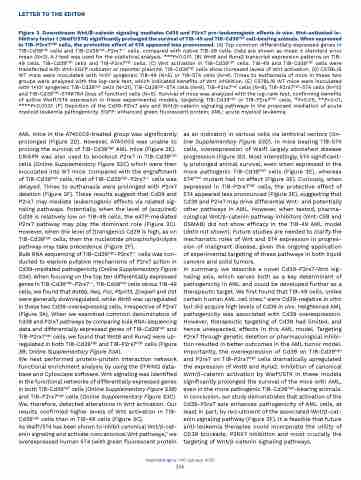
Figure 3. Downstream Wnt/β-catenin signaling mediates Cd39 and P2rx7 pro-leukemogenic effects in vivo. Wnt-activated in- hibitory factor 1 (Waif1/5T4) significantly prolonged the survival of TIB-49 and TIB-Cd39high cell-bearing animals. When expressed in TIB-P2rx7high cells, the protective effect of 5T4 appeared less pronounced. (A) Top common differentially expressed genes in TIB-Cd39high cells and TIB-Cd39high-P2rx7-/- cells, compared with native TIB-49 cells. Data are shown as mean ± standard error mean (N=3). A t test was used for the statistical analysis. ***P<0.001. (B) Wnt6 and Runx2 transcript expression patterns on TIB- 49 cells, TIB-Cd39high cells and TIB-P2rx7high cells. (C) Wnt activation in TIB-Cd39high cells. TIB-49 and TIB-Cd39high cells were transfected with Wnt-EGFP indicator or reporter plasmid. TIB-Cd39high cells show increased levels of Wnt activation. (D) C57BL/6 WT mice were inoculated with 1×10⁶ syngeneic TIB-49 (N=5) or TIB-5T4 cells (N=4). Times to euthanasia of mice in these two groups were analyzed with the log-rank test, which indicated benefits of Wnt inhibition. (E) C57BL/6 WT mice were inoculated with 1×10⁶ syngeneic TIB-Cd39high cells (N=21), TIB-Cd39high-5T4 cells (N=9), TIB-P2rx7high cells (N=8), TIB-P2rx7high-5T4 cells (N=10) and TIB-Cd39high-5T4K76A (loss of function) cells (N=5). Survival of mice was analyzed with the log-rank test, confirming benefits of active Waif1/5T4 expression in these experimental models, targeting TIB-Cd39high or TIB-P2rx7high cells. *P<0.05, **P<0.01, ****P<0.0001. (F) Depiction of the Cd39-P2rx7 axis and Wnt/β-catenin signaling pathways in the proposed mediation of acute myeloid leukemia pathogenicity. EGFP: enhanced green fluorescent protein; AML: acute myeloid leukemia.
AML mice in the A740003-treated group was significantly prolonged (Figure 2D). However, A740003 was unable to prolong the survival of TIB-Cd39high AML mice (Figure 2E). CRISPR was also used to knockout P2rx7 in TIB-Cd39high cells (Online Supplementary Figure S2C) which were then inoculated into WT mice. Compared with the engraftment of TIB-Cd39high cells, that of TIB-Cd39high-P2rx7-/- cells was delayed. Times to euthanasia were prolonged with P2rx7 deletion (Figure 2F). These results suggest that Cd39 and P2rx7 may mediate leukemogenic effects via related sig- naling pathways. Potentially, when the level of (acquired) Cd39 is relatively low on TIB-49 cells, the eATP-mediated P2rx7 pathway may play the dominant role (Figure 2C). However, when the level of (transgenic) Cd39 is high, as on TIB-Cd39high cells, then the nucleotide phosphohydrolysis pathway may take precedence (Figure 2F).
Bulk RNA sequencing of TIB-Cd39high-P2rx7-/- cells was con- ducted to explore putative mechanisms of P2rx7 action in Cd39-mediated pathogenicity (Online Supplementary Figure S3A). When focusing on the top ten differentially expressed genes in TIB-Cd39high-P2rx7-/-, TIB-Cd39high cells versus TIB-49 cells, we found that Kat6b, Nes, Fos, Ptpn13, Zcwpw1 and Dst were generally downregulated, while Wnt6 was upregulated in these two Cd39-overexpressing cells, irrespective of P2rx7 (Figure 3A). When we examined common denominators of Cd39 and P2rx7 pathways by comparing bulk RNA-sequencing data and differentially expressed genes of TIB-Cd39high and TIB-P2rx7high cells, we found that Wnt6 and Runx2 were up- regulated in both TIB-Cd39high and TIB-P2rx7high cells (Figure 3B; Online Supplementary Figure S3A).
We next performed protein-protein interaction network functional enrichment analysis by using the STRING data- base and Cytoscape software. Wnt signaling was identified in the functional networks of differentially expressed genes in both TIB-Cd39high cells (Online Supplementary Figure S3B) and TIB-P2rx7high cells (Online Supplementary Figure S3C). We, therefore, detected alterations in Wnt activation. Our results confirmed higher levels of Wnt activation in TIB- Cd39high cells than in TIB-49 cells (Figure 3C).
As Waif1/5T4 has been shown to inhibit canonical Wnt/β-cat- enin signaling and activate noncanonical Wnt pathways,11 we overexpressed human 5T4 (with green fluorescent protein
as an indicator) in various cells via lentiviral vectors (On- line Supplementary Figure S3D). In mice bearing TIB-5T4 cells, overexpression of Waif1 largely abolished disease progression (Figure 3D). Most interestingly, 5T4 significant- ly prolonged animal survival, even when expressed in the more pathogenic TIB-Cd39high cells (Figure 3E), whereas 5T4K76A mutant had no effect (Figure 3E). Curiously, when expressed in TIB-P2rx7high cells, the protective effect of 5T4 appeared less pronounced (Figure 3E), suggesting that Cd39 and P2rx7 may drive differential Wnt- and potentially other pathways in AML. However, when tested, pharma- cological Wnt/β-catenin pathway inhibitors (Wnt-C59 and DSMAB) did not show efficacy in the TIB-49 AML model (data not shown). Future studies are needed to clarify the mechanistic roles of Wnt and 5T4 expression in progres- sion of malignant disease, given the ongoing application of experimental targeting of these pathways in both liquid cancers and solid tumors.
In summary, we describe a novel Cd39-P2rx7-Wnt sig- naling axis, which serves both as a key determinant of pathogenicity in AML and could be developed further as a therapeutic target. We first found that TIB-49 cells, unlike certain human AML cell lines,2 were Cd39-negative in vitro but did acquire high levels of Cd39 in vivo. Heightened AML pathogenicity was associated with Cd39 overexpression. However, therapeutic targeting of Cd39 had limited, and hence unexpected, effects in this AML model. Targeting P2rx7 through genetic deletion or pharmacological inhibi- tion resulted in better outcomes in the AML tumor model. Importantly, the overexpression of Cd39 on TIB-Cd39high and P2rx7 on TIB-P2rx7high cells dramatically upregulated the expression of Wnt6 and Runx2. Inhibition of canonical Wnt/β-catenin activation by Waif1/5T4 in these models significantly prolonged the survival of the mice with AML, even in the more pathogenic TIB-Cd39high-bearing animals. In conclusion, our study demonstrates that activation of the Cd39-P2rx7 axis enhances pathogenicity of AML cells, at least in part, by recruitment of the associated Wnt/β-cat- enin signaling pathway (Figure 3F). It is feasible that future anti-leukemia therapies could incorporate the utility of CD39 blockade, P2RX7 inhibition and most crucially the targeting of Wnt/β-catenin signaling pathways.
Haematologica | 110 January 2025
216


