


Page 188 - Haematologica Vol. 110 - January 2025
P. 188
LETTER TO THE EDITOR
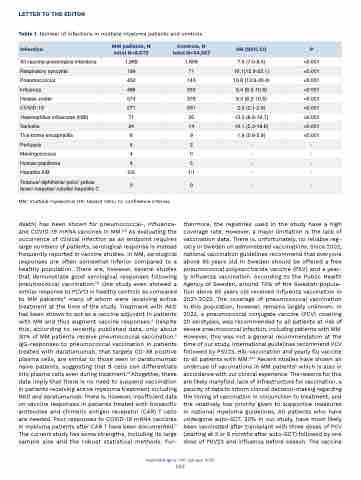
Table 1. Number of infections in multiple myeloma patients and controls.
 Infection
 MM patients, N total N=8,672
 Controls, N total N=34,567
 HR (95% CI)
 P
 All vaccine-preventable infections
  1,969
  1,608
  7.5 (7.0-8.0)
  <0.001
 Respiratory syncytial
199
71
16.1(12.9-22.1)
<0.001
 Pneumococcus
 452
 143
 16.8 (13.9-20.4)
 <0.001
 Influenza
 486
 333
 9.4 (8.2-10.8)
 <0.001
 Herpes zoster
  574
  376
  9.3 (8.2-10.6)
  <0.001
 COVID-19
 271
 651
 2.5 (2.1-2.9)
 <0.001
 Haemophilus influenzae (HiB)
71
30
13.0 (8.6-19.7)
<0.001
 Varicella
 24
 14
 10.1 (5.3-19.6)
 <0.001
 Tick-borne encephalitis
  6
  9
  1.9 (0.6-5.9)
  <0.001
 Pertussis
4
2
-
-
 Meningococcus
  4
  0
  -
  -
 Human papilloma
4
5
-
-
 Hepatitis A/B
  0/5
  1/1
  -
  -
 Tetanus/ diphtheria/ polio/ yellow fever/ measles/ rubella/ hepatitis C
 0
 0
 -
 -
   MM: multiple myelpoma; HR: Hazard ratio; CI: confidence interval.
death) has been shown for pneumococcal-, influenza- and COVID-19 mRNA vaccines in MM.5,6 As evaluating the occurrence of clinical infection as an endpoint requires large numbers of patients, serological response is instead frequently reported in vaccine studies. In MM, serological responses are often somewhat inferior compared to a healthy population. There are, however, several studies that demonstrate good serological responses following pneumococcal vaccination.7,8 One study even showed a similar response to PCV13 in healthy controls as compared to MM patients8 many of whom were receiving active treatment at the time of the study. Treatment with IMiD has been shown to act as a vaccine adjuvant in patients with MM and thus augment vaccine responses.9 Despite this, according to recently published data, only about 30% of MM patients receive pneumococcal vaccination.5 IgG-responses to pneumococcal vaccination in patients treated with daratumumab, that targets CD-38 positive plasma cells, are similar to those seen in daratumumab naïve patients, suggesting that B cells can differentiate into plasma cells even during treatment.10 Altogether, these data imply that there is no need to suspend vaccination in patients receiving active myeloma treatment including IMID and daratumumab. There is, however, insufficient data on vaccine responses in patients treated with bispecific antibodies and chimeric antigen recepetor (CAR) T cells are needed. Poor responses to COVID-19 mRNA vaccines in myeloma patients after CAR T have been documented.11 The current study has some strengths, including its large sample size and the robust statistical methods. Fur-
thermore, the registries used in the study have a high coverage rate. However, a major limitation is the lack of vaccination data. There is, unfortunately, no reliable reg- istry in Sweden on administered vaccinations. Since 2002, national vaccination guidelines recommend that everyone above 65 years old in Sweden should be offered a free pneumococcal polysaccharide vaccine (PSV) and a year- ly influenza vaccination. According to the Public Health Agency of Sweden, around 70% of the Swedish popula- tion above 65 years old received influenza vaccination in 2021-2022. The coverage of pneumococcal vaccination in this population, however, remains largely unknown. In 2022, a pneumococcal conjugate vaccine (PCV) covering 20 serotypes, was recommended to all patients at risk of severe pneumococcal infection, including patients with MM. However, this was not a general recommendation at the time of our study. International guidelines recommend PCV followed by PSV23, Hib-vaccination and yearly flu vaccine to all patients with MM.12,13 Recent studies have shown an underuse of vaccinations in MM patients5 which is also in accordance with our clinical experience. The reasons for this are likely manyfold, lack of infrastructure for vaccination, a paucity of data to inform clinical decision-making regarding the timing of vaccination in conjunction to treatment, and the relatively low priority given to supportive measures in national myeloma guidelines. All patients who have undergone auto-SCT, 30% in our study, have most likely been vaccinated after transplant with three doses of PCV (starting at 3 or 6 months after auto-SCT) followed by one dose of PSV23 and influenza before season. The vaccine
Haematologica | 110 January 2025
180


