


Page 168 - Haematologica Vol. 110 - January 2025
P. 168
ARTICLE - Targeted CDK7 and BRD4 inhibition in myeloma Y. Yao et al. DE
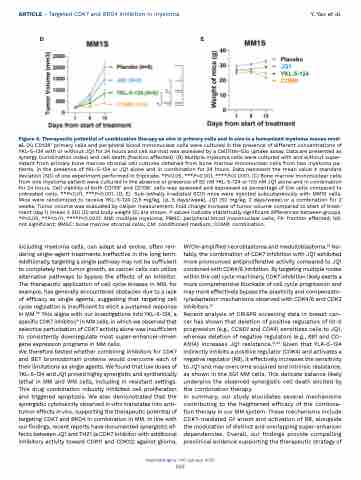
Figure 4. Therapeutic potential of combination therapy ex vivo in primary cells and in vivo in a humanized myeloma mouse mod- el. (A) CD138+ primary cells and peripheral blood mononuclear cells were cultured in the presence of different concentrations of YKL-5-124 with or without JQ1 for 24 hours and cell survival was assessed by a CellTiter-Glo uptake assay. Data are presented as synergy (combination index) and cell death (fraction affected). (B) Multiple myeloma cells were cultured with and without super- natant from primary bone marrow stromal cell cultures obtained from bone marrow mononuclear cells from two myeloma pa- tients, in the presence of YKL-5-124 or JQ1 alone and in combination for 24 hours. Data represent the mean value ± standard deviation (SD) of one experiment performed in triplicate. *P<0.05, ***P<0.001, ****P<0.0001. (C) Bone marrow mononuclear cells from one myeloma patient were cultured in the absence or presence of 50 nM YKL-5-124 or 100 nM JQ1 alone and in combination for 24 hours. Cell viability of both CD138+ and CD138– cells was assessed and expressed as percentage of live cells compared to untreated cells. **P<0.01, ***P<0.001. (D, E). Sub-lethally irradiated SCID mice were injected subcutaneously with MM1S cells. Mice were randomized to receive YKL-5-124 (2.5 mg/kg, i.p, 5 days/week), JQ1 (50 mg/kg, 2 days/week) or a combination for 2 weeks. Tumor volume was evaluated by caliper measurement. Fold change increase of tumor volume compared to start of treat- ment (day 1) (mean ± SD) (D) and body weight (E) are shown. P values indicate statistically significant differences between groups. *P<0.05, **P<0.01, ****P<0.0001. MM: multiple myeloma; PBMC: peripheral blood mononuclear cells; FA: fraction affected; NS: not significant; BMSC: bone marrow stromal cells; CM: conditioned medium; COMB: combination.
 including myeloma cells, can adapt and evolve, often ren- dering single-agent treatments ineffective in the long term. Additionally, targeting a single pathway may not be sufficient to completely halt tumor growth, as cancer cells can utilize alternative pathways to bypass the effects of an inhibitor. The therapeutic application of cell cycle kinases in MM, for example, has generally encountered obstacles due to a lack of efficacy as single agents, suggesting that targeting cell cycle regulation is insufficient to elicit a sustained response in MM.28 This aligns with our investigations into YKL-5-124, a specific CDK7 inhibitor,19 in MM cells, in which we observed that selective perturbation of CDK7 activity alone was insufficient to consistently downregulate most super-enhancer-driven gene expression programs in MM cells.
We therefore tested whether combining inhibitors for CDK7 and BET bromodomain proteins would overcome each of their limitations as single agents. We found that low doses of YKL-5-124 and JQ1 proved highly synergistic and synthetically lethal in MM and WM cells, including in resistant settings. This drug combination robustly inhibited cell proliferation and triggered apoptosis. We also demonstrated that the synergistic cytotoxicity observed in vitro translates into anti- tumor effects in vivo, supporting the therapeutic potential of targeting CDK7 and BRD4 in combination in MM. In line with our findings, recent reports have documented synergistic ef- fects between JQ1 and THZ1 (a CDK7 inhibitor with additional inhibitory activity toward CDK11 and CDK12) against glioma,
MYCN-amplified neuroblastoma and medulloblastoma.23 No- tably, the combination of CDK7 inhibition with JQ1 exhibited more pronounced antiproliferative activity compared to JQ1 combined with CDK4/6 inhibition. By targeting multiple nodes within the cell cycle machinery, CDK7 inhibition likely exerts a more comprehensive blockade of cell cycle progression and may more effectively bypass the plasticity and compensato- ry/adaptation mechanisms observed with CDK4/6 and CDK2 inhibitors.30
Recent analysis of CRISPR screening data in breast can- cer has shown that deletion of positive regulators of G1-S progression (e.g., CCND1 and CDK4) sensitizes cells to JQ1, whereas deletion of negative regulators (e.g., RB1 and CD- KN1A) increases JQ1 resistance.31,32 Given that YLK-5-124 indirectly inhibits a positive regulator (CDK4) and activates a negative regulator (RB), it effectively increases the sensitivity to JQ1 and may overcome acquired and intrinsic resistance, as shown in the XG1 MM cells. This delicate balance likely underpins the observed synergistic cell death elicited by the combination therapy.
In summary, our study elucidates several mechanisms contributing to the heightened efficacy of the combina- tion therapy in our MM system. These mechanisms include CDK7-mediated G1 arrest and activation of RB, alongside the modulation of distinct and overlapping super-enhancer dependencies. Overall, our findings provide compelling preclinical evidence supporting the therapeutic strategy of
Haematologica | 110 January 2025
160


