


Page 165 - Haematologica Vol. 110 - January 2025
P. 165
ARTICLE - Targeted CDK7 and BRD4 inhibition in myeloma
noted in vivo when JQ1 was combined with palbociclib, although the difference did not achieve statistical sig- nificance, likely due to the limited sample size (Online Supplementary Figure S4D).
Discussion
Alterations (loss- or gain-of-function) in factors and en-
Y. Yao et al. zymes that control transcription and genome stability are
frequently associated with transformation, contributing to the “transcriptional addiction” observed in cancer. Myeloma cells are characterized by enhancer alterations, such as Ig enhancer translocations to key drivers including CCND2, MAF, MYC, and MMSET; and chromatin modifiers have been successfully exploited as novel targets against myeloma cells.1,25-29 Indeed, both genetic and pharmacological in- terventions aimed at BRD4 yield anti-myeloma effects in
 A
B
CD
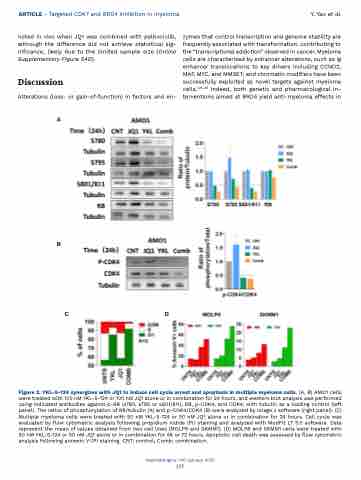
Figure 2. YKL-5-124 synergizes with JQ1 to induce cell cycle arrest and apoptosis in multiple myeloma cells. (A, B) AMO1 cells were treated with 100 nM YKL-5-124 or 100 nM JQ1 alone or in combination for 24 hours, and western blot analysis was performed using indicated antibodies against p-RB (s780, s795 or s801/811), RB, p-CDK4, and CDK4, with tubulin as a loading control (left panel). The ratios of phosphorylation of RB/tubulin (A) and p-CDK4/CDK4 (B) were analyzed by Image J software (right panel). (C) Multiple myeloma cells were treated with 50 nM YKL-5-124 or 50 nM JQ1 alone or in combination for 24 hours. Cell cycle was evaluated by flow cytometric analysis following propidium iodide (PI) staining and analyzed with ModFit LT 5.0 software. Data represent the mean of values obtained from two cell lines (MOLP8 and SKMM1). (D) MOLP8 and SKMM1 cells were treated with 50 nM YKL-5-124 or 50 nM JQ1 alone or in combination for 48 or 72 hours. Apoptotic cell death was assessed by flow cytometric analysis following annexin V+/PI staining. CNT: control; Comb: combination.
Haematologica | 110 January 2025
157


