


Page 156 - Haematologica Vol. 110 - January 2025
P. 156
ARTICLE - R-GemOx+Atezo in R/R transformed DLBCL T. Othman et al. C
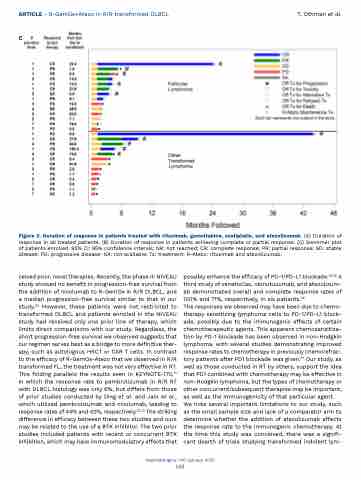
Figure 2. Duration of response in patients treated with rituximab, gemcitabine, oxaliplatin, and atezolizumab. (A) Duration of response in all treated patients. (B) Duration of response in patients achieving complete or partial response. (C) Swimmer plot of patients enrolled. 95% CI: 95% confidence interval; NR: not reached; CR: complete response; PR: partial response; SD: stable disease; PD: progressive disease; NA: not available; Tx: treatment; R-Atezo: rituximab and atezolizumab.
 ceived prior, novel therapies. Recently, the phase III NIVEAU study showed no benefit in progression-free survival from the addition of nivolumab to R-GemOx in R/R DLBCL, and a median progression-free survival similar to that in our study.30 However, these patients were not restricted to transformed DLBCL and patients enrolled in the NIVEAU study had received only one prior line of therapy, which limits direct comparisons with our study. Regardless, the short progression-free survival we observed suggests that our regimen serves best as a bridge to more definitive ther- apy, such as autologous HSCT or CAR T cells. In contrast to the efficacy of R-GemOx-Atezo that we observed in R/R transformed FL, the treatment was not very effective in RT. This finding parallels the results seen in KEYNOTE-170,31 in which the response rate to pembrolizumab in R/R RT with DLBCL histology was only 6%, but differs from those of prior studies conducted by Ding et al. and Jain et al., which utilized pembrolizumab and nivolumab, leading to response rates of 44% and 42%, respectively.32,33 The striking difference in efficacy between these two studies and ours may be related to the use of a BTK inhibitor. The two prior studies included patients with recent or concurrent BTK inhibition, which may have immunomodulatory effects that
possibly enhance the efficacy of PD-1/PD-L1 blockade.34,35 A third study of venetoclax, obinutuzumab, and atezolizum- ab demonstrated overall and complete response rates of 100% and 71%, respectively, in six patients.36
The responses we observed may have been due to chemo- therapy sensitizing lymphoma cells to PD-1/PD-L1 block- ade, possibly due to the immunogenic effects of certain chemotherapeutic agents. This apparent chemosensitiza- tion by PD-1 blockade has been observed in non-Hodgkin lymphoma, with several studies demonstrating improved response rates to chemotherapy in previously chemorefrac- tory patients after PD1 blockade was given.37 Our study, as well as those conducted in RT by others, support the idea that PD1 combined with chemotherapy may be effective in non-Hodgkin lymphoma, but the types of chemotherapy or other concurrent/subsequent therapies may be important, as well as the immunogenicity of that particular agent. We note several important limitations to our study, such as the small sample size and lack of a comparator arm to determine whether the addition of atezolizumab affects the response rate to the immunogenic chemotherapy. At the time this study was conceived, there was a signifi- cant dearth of trials studying transformed indolent lym-
Haematologica | 110 January 2025
148


