


Page 122 - Haematologica Vol. 110 - January 2025
P. 122
ARTICLE - LIPA modulates venetoclax/TKI response in bpCML M. Minhajuddin et al. ABC
DE
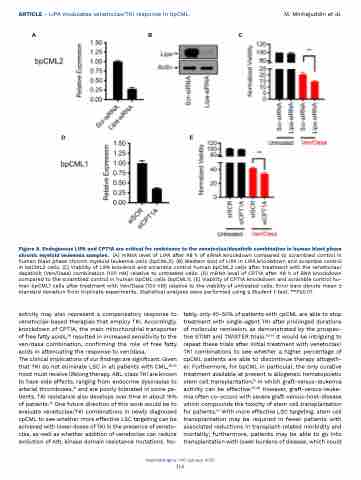
Figure 8. Endogenous LIPA and CPT1A are critical for resistance to the venetoclax/dasatinib combination in human blast phase chronic myeloid leukemia samples. (A) mRNA level of LIPA after 48 h of siRNA knockdown compared to scrambled control in human blast phase chronic myeloid leukemia cells (bpCML2). (B) Western blot of LIPA in LIPA knockdown and scramble control in bpCML2 cells. (C) Viability of LIPA knockout and scramble control human bpCML2 cells after treatment with the venetoclax/ dasatinib (Ven/Dasa) combination (100 nM) relative to untreated cells. (D) mRNA level of CPT1A after 48 h of RNA knockdown compared to the scrambled control in human bpCML cells (bpCML1). (E) Viability of CPT1A knockdown and scramble control hu- man bpCML1 cells after treatment with Ven/Dasa (100 nM) relative to the viability of untreated cells. Error bars denote mean ± standard deviation from triplicate experiments. Statistical analyses were performed using a Student t test. **P≤0.01.
 activity may also represent a compensatory response to venetoclax-based therapies that employ TKI. Accordingly, knockdown of CPT1A, the main mitochondrial transporter of free fatty acids,38 resulted in increased sensitivity to the ven/dasa combination, confirming the role of free fatty acids in attenuating the response to ven/dasa.
The clinical implications of our findings are significant. Given that TKI do not eliminate LSC in all patients with CML,39,40 most must receive lifelong therapy. ABL-class TKI are known to have side effects, ranging from endocrine dyscrasias to arterial thromboses,41 and are poorly tolerated in some pa- tients. TKI resistance also develops over time in about 15% of patients.42 One future direction of this work would be to evaluate venetoclax/TKI combinations in newly diagnosed cpCML to see whether more effective LSC targeting can be achieved with lower doses of TKI in the presence of veneto- clax, as well as whether addition of venetoclax can reduce evolution of ABL kinase domain resistance mutations. No-
tably, only 40-50% of patients with cpCML are able to stop treatment with single-agent TKI after prolonged durations of molecular remission, as demonstrated by the prospec- tive STIM1 and TWISTER trials.43,44 It would be intriguing to repeat these trials after initial treatment with venetoclax/ TKI combinations to see whether a higher percentage of cpCML patients are able to discontinue therapy altogeth- er. Furthermore, for bpCML in particular, the only curative treatment available at present is allogeneic hematopoietic stem cell transplantation,13 in which graft-versus-leukemia activity can be effective.45,46 However, graft-versus-leuke- mia often co-occurs with severe graft-versus-host-disease which compounds the toxicity of stem cell transplantation for patients.47 With more effective LSC targeting, stem cell transplantation may be required in fewer patients with associated reductions in transplant-related morbidity and mortality; furthermore, patients may be able to go into transplantation with lower burdens of disease, which could
Haematologica | 110 January 2025
114


