


Page 12 - Haematologica Vol. 110 - January 2025
P. 12
PROS AND CONS EDITORIAL
Hematopoietic cell transplantation soon after first relapse in acute myeloid leukemia – the PROS
Edward Copelan1 and Robert P. Gale2
1Department of Hematologic Oncology and Blood Disorders, Atrium Health Levine Cancer Institute, Wake Forest School of Medicine, Charlotte, NC, USA and 2Centre for Haematology, Department of Immunology and Inflammation, Imperial College London, London, UK
“When the facts change, I change my mind. What do you do, sir?” - John Maynard Keynes
 More than 40 years ago, Appelbaum and colleagues sug- gested the best time to do an allogenic hematopoietic cell transplant in people with acute myeloid leukemia (AML) not transplanted in first histological complete remission is as soon as possible after they relapse.1 Their suggestion was based on several considerations, including the loss of transplant candidates from adverse events caused by trying to achieve a second histological complete remission pretransplant.2 Since then, there have been important advances in the range of acceptable donors, pretransplant conditioning regimens, prevention of graft-versus-host disease (GvHD), and sup- portive care which have improved safety and efficacy of allotransplants in people with AML in remission or not.3-5 Large retrospective analyses and recent observational data from the Center for International Blood and Marrow Trans- plant Research (CIBMTR) report better outcomes in people receiving transplants in second histological complete remis- sion compared to those transplanted not in remission.5-10 However, these data do not address whether pretransplant intensive re-induction chemotherapy improves survival of people who relapse, and do not account for people receiving re-induction therapy but not proceeding to transplant for diverse reasons, such as toxicities precluding a transplant, withdrawal of consent, and death. Additionally, these data do not distinguish people transplanted in untreated first relapse from those receiving a transplant after failed at- tempted reinduction or from those never achieving a first histological complete remission. Also, many studies focus on point-estimates of outcomes without reporting confi- dence intervals, which are often huge.11
Despite these considerations, most transplant centers request achieving a second complete histological or mea- surable residual disease (MRD)-negative status before advancing to a transplant.12-16 Transplants in untreated first relapse are rarely considered or mentioned. Consequently, most people transplanted in relapse failed re-induction
and increasing numbers are transplanted in second com- plete remission.6-10 Comparing outcomes of these cohorts obviously ignores strong selection biases.
Several factors likely account for this practice and influ- ence current expert recommendations and clinical practice guidelines. We previously reported our view of consensus guidelines.17,18 Physicians and/or patients may choose to not
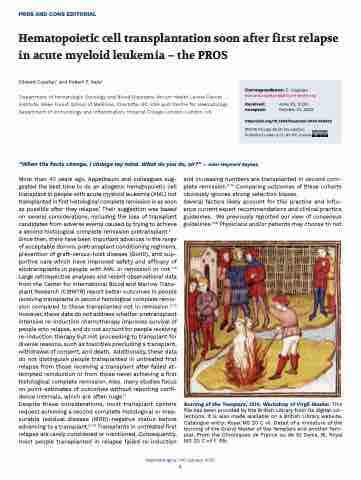
Burning of the Templars, 1314. Workshop of Virgil Master. This file has been provided by the British Library from its digital col- lections. It is also made available on a British Library website. Catalogue entry: Royal MS 20 C vii. Detail of a miniature of the burning of the Grand Master of the Templars and another Tem- plar. From the Chroniques de France ou de St Denis, BL Royal MS 20 C vii f. 48r.
 Haematologica | 110 January 2025
4
Correspondence: E. Copelan edward.copelan@atriumhealth.org
Received: June 25, 2024. Accepted: October 10, 2024.
https://doi.org/10.3324/haematol.2024.286063
©2025 Ferrata Storti Foundation Published under a CC BY-NC license


